THE OUTSIDER WITHIN RUSSIA AND EUROPE’S LONG COLD PEACE By Zach Battat *** The Montréal Review, October 2026 |
|||
In the spring of 1814, Russian soldiers entered Paris as victors. They had pursued Napoleon’s retreating armies across Europe after surviving the invasion and devastation of their own country, and their arrival in the French capital marked the collapse of the empire that had dominated the continent for more than a decade. The following year, Tsar Alexander I stood among the principal architects of the post-Napoleonic settlement. Russia emerged from the Congress of Vienna as one of the guarantors of the European order, its influence now too extensive to be considered peripheral to the affairs of the continent. It would be difficult to imagine a moment when Russia appeared more fully European, more indispensable to the continental balance, or more firmly situated near the centre of European diplomacy.[i] Yet within forty years, Britain and France were at war with Russia in Crimea, determined to restrain the power that had once helped liberate them. The transformation from European saviour to European threat was neither final nor unique. Over the next two centuries, Russia would repeatedly move between the centre and the margins of Europe: ally and adversary, liberator and occupier, cultural insider and political outsider, indispensable partner and civilizational enemy. European powers would repeatedly discover that Russia was too important to exclude permanently, while Russian rulers would find that formal inclusion did not necessarily bring the recognition, equality, or strategic freedom they believed their country deserved. The conflict between Russia and Europe is therefore not best understood as one uninterrupted cold war. There were periods of genuine alliance, diplomatic cooperation, economic interdependence, cultural intimacy, and institutional partnership. Russia fought alongside European powers as often as it fought against them. Its elites adopted European languages, philosophies, art forms, military practices, and administrative models. Russian writers, composers, painters, dancers, and religious thinkers became inseparable from European culture. At several moments, European and Russian leaders sincerely imagined that the persistent conflict between them had finally been overcome. It is more accurate to describe the relationship as a long cold peace: a recurring condition of incomplete inclusion, strategic suspicion, frustrated reconciliation, and periodic confrontation, interrupted at times by devastating hot wars. Its political form has changed repeatedly, but central questions have remained unresolved. Can Russia be incorporated into a European order without either subordinating Russia or granting it dominance over its neighbours? Can European states recognize Russian power and acknowledge legitimate Russian security concerns without accepting a Russian sphere of influence? Can Russia regard the independence of nearby states as something more than a strategic vulnerability or an instrument of hostile encirclement? Across different political systems and historical periods, these tensions have produced a remarkably persistent cycle. Periods of Russian inclusion in the European order have given way to disputes over equality, hierarchy, and the sovereignty of Russia’s neighbours, followed by confrontation and, eventually, another attempt at reintegration. The American–Russian conflict developed largely across oceans and continents.[ii] The European–Russian conflict is different, however, because Russia is not geographically or historically external to Europe. Russian Christianity, dynastic politics, literature, intellectual history, diplomacy, warfare, and state formation are inseparable from the broader European experience. Moscow and St. Petersburg are no more foreign to European history than Vienna, Berlin, or Paris. Russia has participated in nearly every major European transformation since the eighteenth century, from Enlightenment absolutism and revolutionary war to nationalism, industrialization, socialism, fascism, decolonization, European integration, and the creation of the contemporary international order. Yet Russia has also remained Europe’s great insider-outsider. Most of its territory lies east of the conventional geographical boundary of Europe. Its political institutions developed differently from those of Britain, France, and the Low Countries. Its imperial expansion moved simultaneously westward into Poland and the Baltic lands, southward into the Caucasus and the Black Sea region, and eastward across Siberia and Central Asia. Its rulers frequently imported European institutions and techniques while modifying them in the service of a highly centralized imperial state. Russian intellectuals themselves have never reached a final agreement over whether their country is European, Eurasian, Orthodox, universal, imperial, or civilizationally unique. Moreover, “Europe” has never been a permanent or unified political actor. In the eighteenth and nineteenth centuries, it referred to a competitive state system dominated by dynastic empires. After 1917, it became an ideological battleground among liberalism, conservatism, communism, fascism, nationalism, and social democracy. After 1945, Europe was divided between an American-protected West and a Soviet-controlled East. Since the end of the Cold War, “Europe” has increasingly meant the European Union, Britain, and the European members of NATO, although even these governments have differed greatly in their attitudes toward Moscow. France has not experienced Russia in the same way as Poland; Germany’s history with Russia differs sharply from Estonia’s; and Italy, Hungary, Finland, Romania, Greece, Britain, and Ukraine each carry their own strategic interests and historical memories. Any history of Europe and Russia must therefore resist two temptations. The first is to treat Europe as a single coherent actor. The second is to treat the countries between Germany and Russia as passive territory over which larger powers may bargain. The states of East-Central Europe are not merely pieces on a geopolitical chessboard. Their fears of Russia are rooted in invasions, partitions, occupations, imposed political systems, deportations, border changes, and the repeated denial of independent statehood. Any attempt to create a European security structure by dismissing these memories will fail. But an order that assumes Russian insecurity can simply be ignored will fail as well. The problem is not that one side possesses legitimate security concerns and the other does not; it is rather that European powers, Russia, and the states between them have continually pursued their own security in ways that intensify the insecurity of everyone else.
Russia Enters Europe
The prehistory of the long cold peace begins with Russia’s transformation under Peter the Great (1682–1725). Russia had long participated in the political and religious affairs of Eastern Europe, but Peter sought to turn it into a great power within the European state system itself. His reforms reorganized the military, bureaucracy, educational institutions, court culture, and social habits of the elite with European models in mind. The construction of St. Petersburg on the Baltic—Russia’s okno v Evropu (окно в Европу) or “window onto Europe”—symbolized this ambition. It was more than a capital. It was a declaration that Russia would no longer remain at the edge of European affairs. Russia would face west, compete on European terms, and compel the other powers to recognize its new status.[iii] Peter’s westernization, however, was not equivalent to Western liberalization. European science, military organization, technology, administrative practice, architecture, and dress were imported primarily to strengthen the state. The result was a paradox that would recur throughout modern Russian history. Russia became more European in form while remaining politically distinct from the constitutional systems that gradually developed in parts of Western Europe. The state became stronger and more capable of competing with European rivals, but this very success intensified foreign concern about Russian power. Under Catherine II (1762–1796), Russia’s position within the European order became even more prominent. Catherine corresponded with leading Enlightenment thinkers, presented herself as an enlightened ruler, intervened decisively in European diplomacy, and expanded Russian influence around the Black Sea and into the Polish-Lithuanian Commonwealth. Russia was becoming culturally fashionable and strategically indispensable. At the same time, its territorial growth caused mounting apprehension. The partitions of Poland revealed the darker side of Russia’s admission into the European great power system. Russia alone did not destroy the Polish-Lithuanian Commonwealth; Prussia and Austria were active participants, and the partitions reflected a broader imperial order in which powerful states treated weaker ones as negotiable territory. Nevertheless, Russia acquired the largest share and became the principal ruler of lands and populations that would later stand at the heart of the European–Russian conflict.[iv] This helps explain why European memories of Russia have differed so sharply. To Parisian philosophers and aristocrats, Catherine could appear as a sophisticated patron of letters. To many Poles, Russian power meant partition, political repression, and the destruction of statehood. Russia’s Europeanization and its imperial expansion were not separate processes; they developed together. The stronger and more European Russia became, the more capable it was of intervening in the political life of Europe and the more threatening it appeared to those who lived under or near its authority. The main history of the long cold peace, however, begins in 1815. Russia emerged from the Napoleonic Wars not as an excluded enemy but as a victorious member of the coalition that had defeated French domination. Russian forces had endured Napoleon’s invasion, pursued the retreating armies across the continent, and entered Paris. Alexander I stood near the centre of the settlement constructed in Vienna, and Russia joined Britain, Austria, and Prussia as one of the principal guarantors of the new European order. The Congress of Vienna established a system intended to prevent another revolutionary empire from dominating Europe. It rested on consultation among the great powers, territorial compromise, dynastic legitimacy, and a shared interest in preserving stability. Russia’s role within this arrangement was ambiguous from the beginning. Alexander promoted the Holy Alliance and spoke in the language of Christian fraternity, but Russia also possessed the largest land army in Europe and enjoyed enormous influence over Poland and the German states. The first great paradox of modern European–Russian relations was therefore already visible. Russia was simultaneously a pillar of the European order and a source of European fear. The problem was not Russian exclusion but Russian centrality. Europe depended on Russian power to maintain the postwar settlement while worrying that the same power might eventually overwhelm it.[v] This anxiety grew as Alexander’s Russia became associated with the defence of monarchy against revolution. This role initially reflected the interests of other conservative European governments; indeed, Austria under Metternich was no less committed to suppressing revolutionary movements. Yet Russia’s size and military strength made it an especially powerful symbol of reaction. As revolutionary nationalism and constitutional liberalism spread, Russia increasingly appeared not merely as another conservative monarchy but as the principal armed opponent of European political change. Russian rule over much of Poland and the suppression of the Polish uprising of 1830–1831 reinforced this image. Polish émigrés carried accounts of Russian repression into France and Britain, helping transform the Polish cause into a wider European argument about liberty and despotism. The Russian intervention against the Hungarian Revolution in 1849 further entrenched this perception. Tsar Nicholas I sent a large Russian force to assist the Habsburg monarchy, whose own army had struggled to defeat the Hungarian revolutionaries. From the Russian government’s standpoint, the operation defended the European settlement and prevented revolutionary instability from spreading toward Russian-controlled Poland. To many European liberals, it confirmed that Russia had become the gendarme of Europe: an empire prepared to cross borders to preserve autocratic rule. [vi] But not every British liberal accepted this construction of Russia. In 1836, Richard Cobden, writing anonymously as “A Manchester Manufacturer,” published Russia, a pamphlet that presented itself as “A Cure for the Russo-Phobia.” He argued that British commentators exaggerated Russia’s danger, ignored Britain’s own imperial expansion, and invoked the balance of power to rationalize intervention, armaments, and taxation. His argument was at times too indulgent toward Russian rule, especially in Poland, but its central contention remains relevant: perceptions of Russian danger were shaped not only by Russian conduct but also by forces within European politics. Cobden’s dissent shows that the image of Russia as Europe’s inevitable enemy was contested even as it hardened.[vii] The change in Russia’s position was striking. In 1814, Russian soldiers had entered Paris as liberators from Napoleon. By the middle of the century, Russia was increasingly represented in Western European political culture as the principal enemy of liberty. The country that had helped save the continental balance was now accused of threatening it.
Crimea and the First Great Rupture
The Eastern Question—the nineteenth-century contest over the future of the weakening Ottoman Empire—brought Russia into direct conflict with the Ottoman Empire, Britain, and France. Russia sought greater influence in the Balkans and around the Black Sea for strategic reasons, invoking both treaty rights and its claimed role as protector of Orthodox Christians. Britain and France feared that Russian expansion toward the Mediterranean would upset the balance of power by threatening their commercial and imperial routes and placing Constantinople under excessive Russian influence. The resulting Crimean War marked the first rupture of the European–Russian cold peace. Russia occupied the Ottoman-ruled Danubian principalities in 1853. The Ottoman Empire subsequently declared war, and Britain and France entered the conflict the following year. Piedmont-Sardinia later joined the coalition. The war demonstrated that the Concert of Europe, the system of great power consultation established after 1815, could not survive indefinitely when its leading members disagreed over the limits of Russian power. Russia, which had entered the post-Napoleonic era as one of Europe’s guarantors, now faced a coalition determined to restrain it.[viii] The Crimean War was a hot war within the longer cold peace, but its political significance extended beyond the battlefield. Defeat exposed weaknesses in Russian transportation, military organization, administration, industrial capacity, and technology. It also convinced Russian leaders that the empire had fallen dangerously behind Western Europe. Alexander II’s subsequent reforms, including the emancipation of the serfs in 1861, were driven partly by the recognition that Russia could not retain its status as a great power without internal transformation. Once again, European pressure produced not a Russian abandonment of Europe but a renewed attempt at Europeanization. Yet the lesson many Russian officials drew from Crimea was not that Russia should withdraw from great power politics or accept a diminished role. It was that Russia required a stronger state and economy in order to compete successfully within the European system. The settlement imposed after Crimea did not permanently exclude Russia. Within a relatively short period, Russian diplomacy had recovered much of its position. This became another recurring pattern. European coalitions might restrain Russia temporarily, but geography, population, military capacity, resources, and strategic importance made permanent exclusion impossible. Between 1856 and 1914, Russia moved through overlapping systems of rivalry and cooperation. The Congress of Berlin in 1878 provided one example of how this older European order attempted to manage Russian power without excluding Russia from the continental system altogether. The settlement limited some of the gains Russia had secured in the Russo-Turkish War of 1877–1878, but it did so through great power bargaining that gave considerably less weight to the political agency of the smaller peoples whose futures were being negotiated. Russia competed with Austria-Hungary in the Balkans, maintained shifting arrangements with Germany, expanded into Central Asia, and eventually entered into alliance with republican France. Bismarck’s diplomacy attempted to prevent a permanent Franco-Russian alignment, but after Germany declined in 1890 to renew the Reinsurance Treaty, its secret neutrality agreement with Russia, St. Petersburg and Paris moved closer together. The Franco-Russian Military Convention was concluded in the early 1890s, and by 1894 the alliance had been formalized.[ix] This alliance demonstrated that ideology did not determine European diplomacy. French republicans who criticized Russian autocracy nevertheless welcomed Russian power as a counterweight to Germany. Russian rulers who feared revolution accepted financing and strategic cooperation from France. Europe did not treat Russia as a civilizational outsider when Russian armies and resources served the balance of power. Economic and cultural integration deepened Russia’s relationship with Europe. French capital helped finance Russian industrialization and railway construction. German and British firms traded extensively with the empire. Russian elites studied, travelled, and lived in European capitals, and Russian literature, music, ballet, painting, and philosophy became essential components of European culture. Admiration for Tolstoy, Dostoevsky, Tchaikovsky, Chekhov, and later the Ballets Russes existed alongside criticism of censorship, autocracy, pogroms, and the treatment of Poland and other subject peoples. Russia could be embraced as a civilization while condemned as a political system. Within Russia, the argument over Europe became more intense. The zapadniki (западники), or Westernizers, viewed European institutions, science, law, and political philosophy as essential to Russia’s development. The slavyanofily (славянофилы), or Slavophiles, insisted that Russia possessed distinctive Orthodox and communal traditions that should not be sacrificed to Western individualism or rationalism. Later thinkers transformed this debate into more elaborate theories of Russian civilizational difference. Even Russian anti-Westernism remained profoundly shaped by European thought. It drew upon Romanticism, nationalism, conservatism, socialism, theories of historical development, and critiques of modernity that circulated across the continent. Russia’s intellectual separation from Europe was itself a European argument. By the early twentieth century, Russia was both an integral participant in the European alliance system and a deeply unstable empire. The revolution of 1905 exposed pressures generated by industrialization, rural poverty, national movements, political exclusion, and social inequality. Limited constitutional reforms followed, but the struggle over the nature of the Russian state remained unresolved. At the outbreak of World War I, Russia fought alongside France and Britain against Germany, Austria-Hungary, and the Ottoman Empire. It entered the conflict as a European great power defending its alliances and influence in the Balkans. Nothing about the alliance system suggested a permanent separation between Russia and Europe; Russia belonged fully to one of the two coalitions that divided the continent. Yet the war destroyed Russia’s imperial structure, with military defeats, food shortages, political paralysis, and social exhaustion contributing to the fall of the monarchy in 1917. The Bolshevik seizure of power and the ensuing Russian Civil War transformed Russia’s conflict with Europe. The older struggle over balance, empire, and Russian political difference became an explicit confrontation over the future of society itself.
Revolution and Ideological Quarantine
The Bolsheviks did not present themselves as another national government pursuing conventional Russian interests. They claimed to represent a universal revolutionary movement destined to overthrow capitalism across Europe. They repudiated tsarist debts, published secret treaties, transferred property, withdrew from the war, and encouraged European workers to challenge their own governments. European elites now feared Russia not simply because it was powerful but because the new regime rejected the legitimacy of their political and social order. Britain, France, the United States, Japan, and other Allied powers intervened in the Russian Civil War by deploying forces to strategic areas of Russian territory and supporting various anti-Bolshevik forces. Their intervention arose from several motives: to reopen or preserve an eastern front against Germany, to protect Allied military supplies, to rescue the Czechoslovak Legion, to resist revolutionary socialism, and to influence the shape of postwar Russia. Whatever the Allies’ intentions, their intervention reinforced the Soviet conviction that the capitalist powers had attempted to destroy the revolution at its birth.[x] From the European perspective, Soviet Russia became a source of political subversion. Communist parties were organized across the continent, revolutionary uprisings occurred in Germany and Hungary, and the Communist International openly advocated the replacement of existing governments. From Moscow’s perspective, revolution abroad was both an ideological mission and a strategy for survival. A Soviet state surrounded by capitalist powers appeared vulnerable; a revolutionary Europe might provide security. Thus began a new phase of the long cold peace: ideological quarantine. European governments attempted to contain revolutionary Russia, while Moscow treated European political conflict as part of an international class struggle. Diplomatic relations existed, trade continued, and periods of cooperation emerged, revealing that the ideological divide was never absolute despite structural suspicion. The 1922 Treaty of Rapallo between Germany and Soviet Russia restored diplomatic relations and cancelled mutual financial claims between two powers dissatisfied with the post-World War I settlement. While both countries had been marginalized in different ways, their cooperation demonstrated that exclusion could push former enemies together and that geopolitical interests continued to operate beneath ideological hostility.[xi] The new Soviet order was not ideologically monolithic, however. Within Bolshevism, Nikolai Bukharin defended the New Economic Policy (NEP) as the foundation of a more gradual transition to socialism that preserved limited market exchange, encouraged peasant production, and rejected the convulsive transformation that Stalin would later impose. Bukharin’s defeat and eventual execution removed not only a political rival but also the memory of an alternative, more gradual path of socialist economic development within the revolution—one that Soviet reformers were to rediscover six decades later. Even as Stalin increasingly closed off these internal alternatives, the Soviet Union gradually re-entered European diplomacy. It established relations with additional governments, participated in international conferences, and joined the League of Nations in 1934. The Franco–Soviet Treaty of Mutual Assistance followed in 1935 just as concern about Nazi Germany was intensifying. Moscow’s campaign for collective security represented another attempt to join a European coalition against a common threat. The failure of this effort became one of the foundational grievances of Soviet and later Russian historical memory. Soviet leaders argued that Britain and France hesitated to construct a firm alliance against Hitler because they remained more suspicious of communism than of fascism, perhaps hoping that German expansion would turn eastward. There is evidence supporting parts of this interpretation. Western appeasement, the exclusion of the Soviet Union from the Munich settlement of 1938, and the slow and mistrustful negotiations of 1939 deepened Moscow’s suspicions. But the Soviet Union cannot be presented simply as an abandoned potential ally. Stalin’s government had conducted purges, supported revolutionary organizations, and generated legitimate fears among neighbouring states. Poland, in particular, had strong reasons to distrust both Nazi Germany and the Soviet Union. The Molotov–Ribbentrop Pact of August 23, 1939 revealed the destructive consequences of mutual distrust and great power bargaining. Nazi Germany and the Soviet Union publicly agreed to non-aggression while secretly dividing territories in Eastern Europe into spheres of influence: Germany invaded Poland from the west on September 1, and Soviet forces entered from the east on September 17. The agreement facilitated the destruction and partition of Poland and was followed by Soviet annexations, deportations, and coercive territorial changes elsewhere.[xii] This episode must remain central to any serious history of Europe and Russia. It demonstrates why invocations of Russian security cannot automatically justify spheres of influence. Stalin sought strategic depth and time, but he pursued them through an arrangement that denied smaller nations any meaningful political existence. The Pact also failed on its own terms. Hitler invaded the Soviet Union on June 22, 1941, beginning a war of extraordinary destruction. The state that had been treated as both an ideological enemy and a temporary partner now became indispensable to the defeat of Nazi Germany. Once again, Russia’s position in Europe changed with remarkable speed.
Liberation and Domination
The Soviet contribution to the defeat of Nazism was immense. The bulk of Germany’s armed forces was committed to the Eastern Front, where Soviet soldiers and civilians endured catastrophic losses. Without the Red Army’s campaigns, the liberation of Western Europe by Britain, the United States, Canada, and their allies would have been far more difficult and perhaps impossible in the form it ultimately took.[xiii] Yet the meaning of Soviet victory differed across Europe. For Russians and many other peoples of the Soviet Union, the conflict became the Velikaya Otechestvennaya voina (Великая Отечественная война), the “Great Patriotic War,” a struggle for national survival against a genocidal invader. For many Europeans, the Red Army was the force that destroyed Nazi rule and liberated extermination camps. For much of East-Central Europe, however, liberation from Nazism was followed by political subordination to Moscow. These truths are not mutually exclusive. The Soviet Union liberated Europe from Nazi rule while imposing its dominance over a large part of the continent. The inability to hold both realities together has distorted the debate between Europe and Russia over the war’s meaning ever since. Moscow’s determination to create a protective belt in Eastern Europe emerged from genuine historical trauma. Russia had been invaded repeatedly from the west. Napoleon’s invasion and the destruction of World War I had been followed by an even more devastating German assault. Soviet leaders concluded that friendly governments along the western frontier were essential to prevent another catastrophe. For the peoples of Eastern Europe, however, living within this Soviet security belt meant restricted sovereignty. Communist governments were consolidated across Eastern Europe under conditions shaped by Soviet military presence, local communist parties, coercion, manipulated political processes, and the elimination of political rivals. Moscow presented its control of the region as a defensive glacis, but many of the region’s inhabitants experienced this control as imperial domination.[xiv] This contradiction lay at the heart of the European Cold War. The Soviet Union sought security through control. The countries it controlled became insecure because of that control. Western governments responded by integrating their own military and political systems more closely, strengthening the Soviet conviction that hostile powers were organizing against it. The North Atlantic Treaty was signed on April 4, 1949. NATO’s establishment was shaped by fear of Soviet military power, political instability, and uncertainty about the future of Germany. Western European governments wanted an American security guarantee because they doubted their ability to deter the Soviet Union independently. NATO was therefore not simply imposed upon reluctant Europeans by Washington but also reflected European demands for protection.[xv] The division of Germany and recurring crises over the status of Berlin made the centre of Europe the most dangerous frontier in the world. Soviet and NATO forces confronted each other across a relatively narrow space. Nuclear weapons transformed the consequences of miscalculation. The European–Russian long cold peace now existed within the wider American–Soviet Cold War, but Europe was not merely its stage. European governments, political movements, and publics helped shape the rivalry. Western Europe also developed economic and political institutions that increasingly defined Europe in contrast to the Soviet system. The European communities presented integration, the social market economy, parliamentary government, and reconciliation between France and West Germany as an alternative to both the nationalist conflicts of the past and the Soviet-dominated order in the east. This development strengthened Western Europe but also narrowed the meaning of “Europe.” The Soviet Union and its allies were geographically European, yet they were increasingly described as belonging to an eastern bloc outside the authentic European project. In Western discourse, Europe gradually became synonymous with the institutions and political values of only one part of the continent. The Soviet Union responded with its own ideological and institutional claims, portraying communist Europe as the progressive Europe, liberated from fascism and capitalism. But the credibility of this claim was repeatedly damaged by the use of force. In 1956, a popular uprising in Hungary challenged communist rule and Soviet domination. Soviet forces intervened and suppressed it. In 1968, reformers in Czechoslovakia sought a less coercive form of socialism, only to be crushed by an invasion led by the Soviet Union and several of its Warsaw Pact allies. The Brezhnev Doctrine, articulated in 1968, formalized the principle that the sovereignty of socialist states was limited when political change threatened the interests of the Soviet bloc. It was the language of collective security used to defend hierarchy. From Moscow’s viewpoint, allowing one state to leave the system might unravel the entire defensive structure. From the viewpoint of Hungarians, Czechs, Slovaks, Poles, and others, the structure denied them the right to determine their own political future.[xvi] The division of Europe was reproduced within the political life of Western European states. In France, socialist polemicists declared that the French Communist Party (Parti communiste français; PCF) was “neither left nor right, but East,” reducing its political identity to its presumed allegiance to Moscow.[xvii] Yet the career of Georges Guingouin complicated that accusation. A genuine socialist, an important resistance leader, and mayor of Limoges from 1945 to 1947, Guingouin consistently resisted the authority of the party hierarchy and was eventually expelled from the PCF in 1952.[xviii] His fate revealed something more complicated than a continent neatly divided between a Soviet “East” and a European “West”: even within Western European communism, political identity could not be reduced simply to allegiance to Moscow. Local traditions, wartime experiences, national loyalties, and individual independence could conflict sharply with the discipline associated with the Soviet centre. However, confrontation was never the whole story. European governments also developed policies of engagement. Under Charles de Gaulle, France pursued a policy of indépendance nationale (national independence): it remained a member of NATO but withdrew from the alliance’s integrated military command in 1966, thus preserving national control over its armed forces and nuclear deterrent. De Gaulle also imagined a Europe stretching “from the Atlantic to the Urals,” a formulation that treated Russia as part of a wider European order rather than as a permanently external enemy. France gradually moved closer to NATO under François Mitterrand and Jacques Chirac, although it did not formally rejoin until 2009.[xix] West Germany’s Ostpolitik—its effort to improve relations with the Soviet Union and Eastern Europe—similarly rested on the belief that lasting stability required negotiation. The Moscow Treaty, signed by West Germany and the Soviet Union on August 12, 1970, was a cornerstone of Chancellor Willy Brandt’s approach. The agreement advanced détente, affirmed the inviolability of existing European frontiers, and helped reduce East–West tension. Engagement did not dissolve the NATO–Warsaw Pact divide, but it reflected the recognition that security could not rest exclusively upon military containment.[xx] The Helsinki Final Act of August 1, 1975 embodied this more complex approach. It recognized the territorial and political realities of postwar Europe while establishing principles concerning sovereign equality, non-intervention, territorial integrity, human rights, and cooperation. Soviet leaders valued the recognition of existing European frontiers. Western governments and dissidents later used the human rights provisions to challenge communist repression.[xxi] The agreement proved effective because it did not require either side to trust the other before cooperation could begin. It combined recognition with obligation: the West accepted that the Soviet Union possessed legitimate security interests and that European borders could not be revised casually; the Soviet Union accepted, at least formally, that the treatment of individuals and the autonomy of states were matters of international concern. This did not, however, end the Cold War. The Soviet invasion of Afghanistan, the deployment of intermediate-range missiles, the declaration of martial law in Poland, and renewed military competition produced another period of confrontation. But the diplomatic architecture of détente created channels through which the rivalry could later be managed.
Bukharin’s Afterlife and the Common European Home
The next attempt to overcome the long cold peace began not with a new diplomatic settlement but with a reconsideration of the Soviet system itself. Before Mikhail Gorbachev could imagine a common European home, he had to reopen the Soviet past. One of the most consequential figures recovered under glasnost was Nikolai Bukharin, once among the most prominent theorists and leaders of the Bolshevik Revolution. During the 1920s, Bukharin defended the NEP not simply as a temporary retreat from socialism but as the basis of a more gradual process of development. Limited market exchange, material incentives, cooperation with the peasantry, and the slow growth of a socialist economy could, in his understanding, accomplish what administrative coercion could not. His defeat by Stalin and execution following the 1938 show trial therefore eliminated both a political rival and the memory of an alternative route within Bolshevism.[xxii] Bukharin’s rehabilitation under Gorbachev carried significance beyond the correction of a historical injustice. It allowed Soviet reformers to argue that forced collectivization, extreme economic centralization, political terror, and administrative command had not been the inevitable consequences of the revolution. Stalinism could instead be presented as the victory of one possible Soviet future over others. Gorbachev’s perestroika drew legitimacy from this recovered possibility. Greater enterprise autonomy, cooperatives, restricted market mechanisms, public discussion, and gradual institutional change could be portrayed not as a surrender to capitalism but as the renewal of a neglected socialist tradition. In this qualified sense, Gorbachev may be regarded as Bukharin’s posthumous intellectual heir, though not as his literal pupil. He was not implementing a complete program that Bukharin had left behind, and Bukharin should not be transformed retrospectively into a liberal democrat. Bukharin remained an Old Bolshevik committed to the revolutionary state and understood his economic position largely as an extension of the possibilities opened by Lenin’s NEP. Gorbachev’s reforms eventually travelled considerably further: glasnost widened public debate, competitive elections weakened the political monopoly of the Communist Party, and “new thinking” challenged the assumption that Soviet security required ideological uniformity or the permanent subordination of Eastern Europe.[xxiii] The recovery of Bukharin therefore helps explain the relationship between Gorbachev’s domestic reforms and his European policy. If socialism no longer required rigid administrative command within the Soviet Union, it might no longer require coercive uniformity throughout the Soviet bloc. If political and economic difference could be tolerated at home—limited at first and then increasingly openly—political diversity in Eastern Europe might cease to be treated as an existential threat. Gorbachev’s European opening was not simply a diplomatic response to economic weakness or strategic competition; it formed part of a larger wager that the Soviet Union could remain socialist and secure while becoming less centralized, less coercive, and more closely connected to Europe. Bukharin’s afterlife therefore mattered to the long cold peace because it helped make a different relationship between security and control conceivable: first within the Soviet system and ultimately in Moscow’s relations with the rest of Europe. Gorbachev carried this reformist logic further than any Soviet leader before him. In his address to the Parliamentary Assembly of the Council of Europe on July 6, 1989, he presented the continent as an obshchii evropeiskii dom (общий европейский дом), a “common European home,” and rejected the assumption that political difference necessarily required permanent military confrontation. The social and political systems of individual countries, he argued, were matters for their own peoples to determine.[xxiv] Gorbachev’s decision not to use Soviet force to preserve communist governments transformed the continent. In 1989, regimes that had survived earlier challenges through coercion collapsed in rapid succession. The Berlin Wall fell, Germany moved toward unification, and the Soviet military did not repeat the interventions of 1956 or 1968. The end of the divided European order appeared to offer an answer to the Russian question. Russia might no longer require an empire in Eastern Europe because the continent would no longer be organized against it. Europe, in turn, might no longer need to define itself through opposition to Russia. The Charter of Paris for a New Europe, adopted on November 21, 1990, declared that “the era of confrontation and division of Europe has ended” and that relations would henceforth rest on respect and cooperation. It imagined a continent based on democracy, peace, human rights, sovereign equality, and common security. The language now sounds painfully distant, but it represented a genuine historical possibility.[xxv] When the Soviet Union dissolved in 1991, the ideological partition of Europe disappeared. Russian leaders initially spoke not of turning away from Europe but of joining it. Boris Yeltsin’s government sought integration with Western political and economic institutions. Russian reformers often imagined that their country would become a normal European state, although they disagreed sharply over what normality required. European governments also pursued integration. Russia joined the Council of Europe in February 1996. The decision was controversial because the Russian political system and human rights record remained deeply problematic, particularly during the war in Chechnya. Nevertheless, membership reflected the belief that Russia should be tied into European legal and political structures rather than left outside.[xxvi] Russia joined NATO’s Partnership for Peace in 1994 and later cooperated with NATO-led peacekeeping operations in the Balkans. NATO and Russia signed the Founding Act on Mutual Relations, Cooperation and Security on May 27, 1997. The agreement rejected the adversarial logic of the Cold War and created a framework for consultation and cooperation within a common European security order. The NATO–Russia Council, established in 2002, provided another forum in which Russia and NATO members could address common concerns.[xxvii] The European Union and Russia developed an even more extensive relationship. Trade expanded, energy connections deepened, visa and educational exchanges increased, and Russian elites developed financial and personal ties throughout Europe. European firms entered the Russian market, while Russian oil and natural gas became central to the economies of several European states. At the May 2003 St. Petersburg Summit, the European Union and Russia agreed to create four “common spaces”: economic relations; freedom, security, and justice; external security; and research, education, and culture. They called for cooperation in trade, investment, regulation, transport, energy, environmental protection, law enforcement, academic exchange, and international security.[xxviii] This was not a superficial peace. By the beginning of the twenty-first century, Russia had been woven into European institutions and economic life to an extent that would have seemed inconceivable during the Cold War. Russian leaders attended summits with NATO and the European Union. European leaders described Russia as a strategic partner. Millions of Russians travelled to Europe, purchased European goods, studied at European universities, and treated London, Paris, Berlin, Prague, Rome, and the Mediterranean as familiar destinations. Yet the European order into which Russia was supposedly being integrated was itself neither politically settled nor universally accepted within Western Europe. In response to the deadly French heatwave of 2003, Jean-Pierre Raffarin’s government established a “day of solidarity” in 2004, initially tied to work on Whit Monday, to finance assistance for older people and people with disabilities. Its first nationwide observance on May 16, 2005 provoked strikes and widespread resentment only thirteen days before France’s referendum on the proposed European Constitution. The measure did not by itself cause the 54.7 percent “no” vote, which also reflected unemployment, social anxiety, objections to the treaty, and hostility toward the government. The episode nevertheless showed how readily domestic grievances could be projected onto the question of European integration.[xxix] Russia was therefore not simply being asked to enter a finished European system; Western and Russian officials held sharply different assumptions about the post-Cold War settlement and Russia’s place within the emerging order. Many Western European governments believed that Russia was moving, however unevenly, toward a system based on liberal democracy, market economics, legal restraint, and cooperation with Western institutions. Many Russian officials, on the other hand, understood partnership differently and expected Russia to be recognized as a velikaya derzhava (великая держава)—a great power entitled to an equal and privileged voice in determining the European security order. They did not believe that the collapse of the Soviet system had erased Russia’s strategic interests or reduced it to the status of an ordinary regional state. The unsettled politics surrounding Crimea illustrated this ambiguity particularly clearly. The peninsula remained within independent Ukraine after 1991, but its status was politically contested within Russia. In May 1992, the Russian Supreme Soviet declared the 1954 transfer legally invalid and called for negotiations; in July 1993, it asserted Russian federal status for Sevastopol. Yeltsin did not adopt these claims as presidential policy. Instead, he sought accommodation with Kyiv, culminating in the 1997 Treaty on Friendship, Cooperation and Partnership, in which Russia formally committed itself to respect Ukraine’s territorial integrity and the inviolability of their common borders.[xxx] Yet formal recognition did not resolve the historical and strategic questions surrounding Crimea. For Ukraine, the post-Soviet borders constituted the territorial basis of an independent state; for many in Russia, Crimea—and especially Sevastopol—retained a significance shaped by imperial and Soviet history, the Black Sea Fleet, and the circumstances of the Soviet Union’s dissolution. The disagreement therefore persisted beneath the formal interstate settlement, not primarily as an unresolved legal boundary but as a conflict over the meaning of the post-Soviet order. The broader disagreement over Russia’s place in the post-Cold War European order concerned both power and language. Western leaders described the enlargement of NATO and the European Union as the voluntary expansion of peaceful institutions. Each applicant country possessed the sovereign right to select its alliances and political orientation. For Poland, the Baltic states, and other former members of the Soviet bloc, admission to NATO represented protection from a threat deeply rooted in historical experience. Russian leaders, however, saw NATO enlargement as the eastward movement of a military alliance created during the Cold War while Russia itself remained outside it. NATO insisted that enlargement was not directed against Russia, prompting Moscow to ask why a common security structure including Russia could not therefore replace the old alliance system. Both positions contained important truths. The states of East-Central Europe were not coerced into joining NATO. They actively sought membership because they feared renewed Russian domination. Their political agency cannot be dismissed as an extension of American or Western European strategy. At the same time, it was unrealistic to expect Moscow to view the movement of a powerful military organization toward Russia’s frontiers as strategically meaningless. Alliances may describe their intentions as defensive, but states usually judge one another by military capabilities, geographical position, and the possibility of future political change. The security of new NATO members therefore produced increasing insecurity in Russia. This was the central failure of the post-1990 settlement. Europe never developed an architecture capable of reconciling the sovereignty of Russia’s neighbours with Russia’s desire not to face a potentially hostile strategic system along its borders. Instead, enlargement and partnership proceeded simultaneously, supported by the hope that economic interdependence and diplomatic consultation would help manage the contradiction.[xxxi] Russian domestic developments aggravated the problem. The economic collapse, privatization, corruption, and concentration of wealth during the 1990s discredited the language of westernization for many Russians. Liberal democracy and market reform became associated not only with political freedom but also with unpaid salaries, lost savings, social insecurity, oligarchic power, and the weakening of the state. Vladimir Putin’s rise initially appeared compatible with continued European integration. He sought foreign investment, cultivated relationships with European leaders, spoke favourably of cooperation with NATO, supported the United States after the attacks of September 11, 2001, and presided over an economic recovery heavily dependent on trade with Europe. At the same time, Putin’s effort to rebuild centralized state authority unfolded amid growing tensions with Europe and the United States, whose policies were increasingly portrayed in Moscow as attempts to constrain Russia abroad and influence its politics at home. His government curtailed the independence of oligarchs, brought national media under tighter control, suppressed separatism, and restricted organizations regarded as channels of foreign influence. These were deliberate choices, but NATO enlargement, Western criticism, democracy-promotion initiatives, and support for post-Soviet civil society strengthened those within the Kremlin who argued that openness invited external interference. European and US governments increasingly viewed Moscow’s consolidation as authoritarian retrenchment; Russian officials, in turn, portrayed Western pressure as evidence that sovereignty required tighter internal control. Each interpretation reinforced the other. The revolutions in Georgia and Ukraine intensified these suspicions. To many Europeans, they represented popular movements against corrupt or authoritarian governments. To the Kremlin, they appeared as Western-supported transfers of power designed to pull strategically important countries away from Russia. The distinction between domestic revolution and foreign intervention became blurred. Western governments and foundations did indeed support civil society and democratic institutions, but local populations possessed political ambitions and grievances of their own. Moscow’s tendency to attribute these movements to external manipulation denied the agency of Georgians and Ukrainians; Western accounts that ignored the geopolitical consequences of expanding institutions eastward were equally incomplete.
The Return of the Frontier
The 2008 NATO summit in Bucharest brought the contradiction into the open. NATO did not grant Ukraine and Georgia immediate Membership Action Plans but stated that both countries “will become members of NATO.” The promise provided no timetable and no immediate protection but implied a future strategic transformation that Russia had repeatedly opposed.[xxxii] It was dangerous precisely because it combined provocation with ambiguity. It encouraged pro-Western political forces in Georgia and Ukraine while providing no alliance guarantee if conflict occurred: Moscow could interpret the promise as evidence that time was working against Russian influence; Georgia and Ukraine could interpret it as evidence that eventual Western protection was assured. The war between Russia and Georgia later that year marked a decisive break. Responsibility for the immediate military escalation was disputed, but the broader significance was clear. Russia was prepared to use force to prevent further erosion of its position in what Russian officials had come to call the blizhnee zarubezh’e (ближнее зарубежье) or “near abroad” and to demonstrate that Western institutional promises did not necessarily determine political realities on the ground. The following year, the European Union launched its Eastern Partnership in Prague, seeking closer political and economic relations with Armenia, Azerbaijan, Belarus, Georgia, Moldova, and Ukraine. Ukraine’s bilateral negotiations for a new association agreement with the European Union had already begun in 2007, but the Eastern Partnership placed that process within a broader regional framework, which offered association, regulatory alignment, trade agreements, reform assistance, and deeper integration without promising full EU membership. The proposed association with Ukraine was not just economic. It envisaged Ukraine’s gradual convergence with European foreign and security policy, including the European Union’s Common Security and Defence Policy, joint policy planning, participation in EU-led civilian and military crisis-management activities, and closer cooperation with the European Defence Agency. This did not amount to NATO membership or a collective-defence guarantee, but when combined with NATO’s still-standing commitment that Ukraine would eventually become a member, it pointed toward the country’s progressive incorporation into a Western security as well as economic space. From Brussels’ perspective, the Eastern Partnership was a voluntary civilian framework; for Moscow, it increasingly appeared as a competing geopolitical system extending into a region Russia regarded as vital to its security and influence. [xxxiii] Ukraine became the point at which these competing visions of regional order collided. After Viktor Yanukovych became president in 2010, his government maintained a formal policy of nonalignment while continuing negotiations over the European association agreement. The negotiations concluded in 2011, and the agreement was initialled in 2012, reflecting Ukraine’s ongoing attempt to preserve political and economic relationships with both Russia and the West. In a society comprising various regional histories, linguistic patterns, economic interests, and political orientations, many Ukrainians sought closer relations with Europe, regarding the European Union as a source of prosperity, legal reform, and protection from Russian influence; others maintained strong cultural, familial, economic, and linguistic connections with Russia. These orientations were neither fixed nor mutually exclusive, but the competing institutional projects surrounding Ukraine made it increasingly difficult to sustain a balance between them, and they came into direct conflict during the Maidan protests of 2013 and 2014. The protests began after Yanukovych suspended preparations for signing the association agreement with the European Union. By then, however, Ukraine was no longer being asked to choose merely between two commercial arrangements: the European agreement formed part of a wider movement toward Euro-Atlantic political, economic, and security structures, while Russia was seeking to draw Ukraine into its own integration project and applying economic and political pressure on Kyiv. Ukraine’s room to maintain close relations with both Russia and the European Union had narrowed considerably. The protests soon developed into a broader revolt against corruption, police violence, political repression, and the government’s direction. The uprising had deep domestic roots and drew its strength from Ukrainian political grievances, although it unfolded within an intensifying international contest over the country’s future. US and European involvement continued during the protests. Western officials publicly supported the demonstrators’ democratic and European aspirations, met Ukrainian opposition and civil society representatives, and pressured Yanukovych’s government to refrain from further violence. A leaked conversation between senior US diplomats revealed that Washington was also discussing its preferred roles for particular opposition leaders in a future Ukrainian government. This demonstrated active US political involvement in the unfolding crisis, although it did not establish that the United States had created or controlled the mass protest movement. Russia, likewise, supported Yanukovych and regarded the preservation of his government’s existing orientation as strategically important. On February 21, 2014, Yanukovych and the opposition leaders signed an agreement mediated by the foreign ministers of France, Germany, and Poland that stipulated constitutional reform, the formation of a national unity government, and an early presidential election. However, the agreement soon collapsed as the protesters rejected its timetable and Yanukovych’s remaining political authority disintegrated. Yanukovych left Kyiv, and on February 22 parliament declared that he had ceased performing his constitutional duties and scheduled a presidential election for May 25. Because parliament did not employ the Constitution’s formal impeachment procedure, the transfer of power was legally irregular and remains politically contested. Its supporters regarded it as a popular revolution following the collapse of Yanukovych’s legitimacy; Moscow and other critics described it as a Western-supported coup. The political upheaval is therefore best understood as a genuine domestic uprising shaped by foreign political involvement and culminating in a constitutionally disputed change of government. Its significance for the long cold peace lay precisely in this overlap: a struggle rooted in Ukrainian domestic politics had become inseparable from the unresolved question of how the sovereign choices of Russia’s neighbours could coexist with Moscow’s understanding of its own security. Within weeks, in March 2014, Russia annexed Crimea and supported armed separatists in Donbass. The Crimean crisis brought back into interstate politics questions that the agreements of the 1990s had formally contained but had not eliminated from Russian political and strategic thinking. The crisis unfolded amid the collapse of Yanukovych’s authority and uncertainty over Ukraine’s geopolitical direction. Against this backdrop of Russia’s longstanding attachment to Sevastopol and the Black Sea Fleet, Moscow saw the loss of influence in Kyiv as a threat to its position in Crimea and the Black Sea, and the wider regional balance. Ukraine, on the other hand, saw the Russian response to a domestic political transformation as violating Ukrainian sovereignty and seizing territory. The annexation revealed the most dangerous element of Russian security thinking: the belief that geopolitical vulnerability could justify revising borders and limiting the independence of neighbouring states. Russian officials invoked history, local preferences, strategic necessity, and Western precedents. But even legitimate concerns do not create an automatic right to territorial acquisition. European governments responded with sanctions, diplomatic pressure, and support for Ukraine. The Minsk agreements of 2014 and 2015 attempted to halt the fighting and establish a framework for reintegrating separatist-held territories into Ukraine. The agreements, however, left unresolved the order in which their provisions were to be implemented, especially whether elections and constitutional changes should precede or follow the withdrawal of foreign forces and the restoration of Ukrainian control over the international border. Ukraine feared that implementing the political provisions first would institutionalize Russian influence over its political system, while Russia insisted that Kyiv had accepted political obligations that it refused to fulfil. Ultimately, neither the military nor the political provisions were fully implemented.[xxxiv] The ensuing period therefore became another cold peace within the long cold peace. Europe and Russia remained economically connected: gas continued to flow, diplomats continued to meet, European leaders travelled to Moscow, and Russian wealth, businesses, and citizens remained connected to European economies and societies. But the political relationship had lost its organizing principle. The idea of gradual Russian integration into a common European system had been replaced by sanctions, deterrence, competing historical narratives, and the management of an unresolved war. Russia increasingly described itself not as an imperfect member of the European order but as a separate centre of power resisting Western universalism. European institutions increasingly treated Russia not as a partner moving toward common norms but as an authoritarian state attempting to revise the European system through coercion.
Rupture
The full-scale invasion of Ukraine on February 24, 2022 transformed estrangement into rupture. Russia’s leaders claimed that Ukraine’s growing military alignment with the West, NATO’s enlargement, the unresolved war in Donbass, and the possibility of further strategic encirclement had created an intolerable threat. They also invoked history, Russian–Ukrainian unity, the status of Russian speakers, and the argument that Ukraine was being transformed into an anti-Russian political and military platform. However, these arguments did not make the invasion necessary. Russia faced serious strategic disputes and a deteriorating regional position, but it was not under imminent attack. While diplomacy had failed to produce an agreement, it had not been exhausted to the point that war was unavoidable. The decision to invade was ultimately Russia’s, and it transformed a long-term security dilemma into a catastrophic war of choice. The invasion also demonstrated the failure of coercive security. By attacking Ukraine in an effort to prevent its integration into the Western military system, Russia strengthened Ukrainian national identity, intensified European fear, brought Finland and Sweden into NATO, and encouraged a major increase in European military spending. In seeking a weaker NATO presence near its borders, Russia helped produce a stronger one. Europe’s response marked the collapse of the post-Cold War integration project. The European Union imposed extensive sanctions, reduced energy dependence, restricted financial relations, and provided Ukraine with political, economic, humanitarian, and military support. On March 16, 2022, after twenty-six years of membership, the Russian Federation ceased to be a member of the Council of Europe.[xxxv] The rupture was institutional, economic, cultural, and psychological. European companies withdrew or reduced their activities. Air routes closed. Educational and scientific cooperation contracted. Russian media were restricted, and European organizations left Russia. Moscow responded with countersanctions, controls, expulsions, and a sharper ideological rejection of the West. The rupture also revived an older connection in Russian political thought between external confrontation and the danger of internal instability. On April 21, 2026, Gennady Zyuganov, leader of the Communist Party of the Russian Federation, warned the State Duma that unless the government immediately changed its financial and economic course, by autumn Russia might face “what happened in February 1917.”[xxxvi] The historically analogy was striking. Zyuganov simultaneously reaffirmed his support for Putin and invoked revolution not as the fulfillment of the Communist tradition but as a catastrophe to be prevented. His warning did not demonstrate that political upheaval was imminent. Its significance lay instead in the historical analogy he chose. February 1917 evokes not simply revolution, but the disintegration of political authority under the combined pressures of war, economic disruption, administrative failure, and declining confidence in the state. By invoking that memory, Zyuganov revealed the extent to which the contemporary Russian language of stability remains organized around the fear that external confrontation and internal weakness might once again reinforce one another. The Communist leader thus appropriated one of the central historical assumptions of the governing order: that revolution represents not political renewal but the collapse of sovereignty and the destruction of the state from within. In this sense, the memory of 1917 belongs to the long cold peace as well: within Russian political thought, security has concerned not only the balance of power beyond the country’s borders but also the possibility that external pressure and strategic weakness might contribute to the disintegration of the state itself. European defence planning again centred on the possibility of prolonged confrontation with Russia. NATO strengthened its eastern flank, expanded military investment, and described Russia as a long-term threat to Euro-Atlantic security. This characterization was reiterated at the Ankara Summit of July 8, 2026 and linked to the implementation of increased defence commitments; meanwhile, the European Union extended its principal economic sanctions against Russia until July 31, 2027.[xxxvii] Russia and Europe have therefore returned to a relationship resembling earlier periods: fortified frontiers, military mobilization, economic separation, hostile rhetoric, and competing claims about the nature of the European order. Yet the current confrontation cannot simply be described as a restoration of the twentieth-century Cold War. Russia is no longer the centre of a universal communist movement. It does not command a political bloc extending to central Germany. The European Union is not merely an extension of the old Western alliance, and the continent is no longer divided along the Iron Curtain. The ideological divide is less coherent than the conflict between capitalism and communism. The present struggle concerns sovereignty, hierarchy, alliances, borders, historical identity, political legitimacy, and the authority to define the rules of European security. Russia increasingly presents itself as a gosudarstvo-tsivilizatsiya (государство-цивилизация), a distinct “state-civilization” defending sovereignty, tradition, and international plurality against a universalizing West. European governments present their resistance to Russia as a defence of international law, democratic choice, national independence, and the principle that borders cannot be changed through force.[xxxviii] Russia’s claim to be a distinct civilization is expressed not only in official doctrine but in the reinterpretation of its European cultural inheritance. On Russia Day, June 12, 2026, the Mariinsky Theatre performed Glinka’s A Life for the Tsar, long regarded a foundational work of Russian national opera. The work embodies Russia’s insider-outsider position: it uses a European operatic form, indebted partly to Italian bel canto, to dramatize Russian sacrifice, dynastic loyalty, and resistance to foreign invasion. In the context of war and rupture with Europe, these themes acquired renewed political resonance. Russia’s cultural separation from Europe is thus often constructed not by rejecting European forms but by turning them into arguments for Russian distinctiveness.[xxxix] Each side identifies a genuine danger. Russian power has frequently been used to restrict the sovereignty of neighbouring peoples. Western governments have frequently treated their own institutions and political preferences as neutral expressions of a universal order, even when the expansion of those institutions altered strategic power in ways that others predictably resisted. But the two dangers are not morally or politically identical in every situation. Criticizing European triumphalism does not require denying Ukrainian sovereignty. Recognizing NATO’s role in the security dilemma does not erase Russia’s responsibility for choosing invasion. Understanding Russian fear does not require granting Moscow a veto over the political orientation of neighbouring states. Similarly, defending the sovereign choices of Russia’s neighbours does not require pretending that power, geography, military alliances, and historical memories have ceased to matter. A legal principle may be universal while producing strategically unequal consequences. Responsible diplomacy must address both the principle and the consequence.
The Unresolved Russian Question
The European–Russian long cold peace has collapsed time and again because leaders have treated the problem as a choice between two flawed approaches. One treats Russia as an inherently imperial and despotic power that can only be contained until it changes fundamentally; the other treats Russia as a natural great power whose security requires deference from the states around it. The former risks making Russia’s permanent exclusion the organizing principle of Europe, while the latter reduces smaller nations to buffers and bargaining pieces. Neither offers a durable peace. Since Peter the Great, history has demonstrated that Russia cannot be permanently separated from Europe. Attempts to isolate it have tended to give way to reintegration because Russia’s size, resources, culture, military power, and geography make it an unavoidable European presence. The same history shows that Russian inclusion cannot be built upon domination. Russia’s neighbours possess their own identities, memories, political communities, and security concerns. They are not empty territory separating Russia from “real” Europe. Whenever Moscow has attempted to obtain security by restricting their sovereignty, it has created the hostility and counter-alliances it claimed to fear. The Congress of Vienna offers one lesson, although this is not a model that can simply be restored. The settlement endured because it recognized the major powers as necessary participants in the order, including defeated France. Its architects understood that peace could not be sustained by permanently humiliating or excluding a major state. But Vienna belonged to an imperial age in which smaller peoples were frequently denied political agency. A modern settlement cannot reproduce that hierarchy; it must combine the inclusion of major powers with meaningful protections for weaker states. Bismarck’s management of the Congress of Berlin in 1878 offers a related, although similarly qualified, lesson. He presided over a negotiation in which the major European powers accepted that none could obtain everything it wanted without risking a wider conflict. The resulting settlement satisfied none of the principal powers completely, but it temporarily managed competing Russian, British, Austro-Hungarian, Ottoman, and German interests through compromise rather than an attempt by one power to dictate the entire European order. This form of diplomacy, in which compromises were reached by great powers bargaining over the territories and political futures of smaller peoples, has become increasingly unfamiliar in an age when negotiation is often understood as the acceptance of rules established by the stronger coalition. The lesson is therefore not that Europe requires another imperial congress but that durable security will demand a Bismarckian recognition of competing power realities joined to principles that nineteenth-century diplomacy did not adequately protect: sovereign equality, territorial integrity, and the political agency of the states most directly affected. The Helsinki process, culminating in the 1975 Final Act, offers another lesson. It did not require trust before negotiation. It combined recognition of borders and security realities with commitments concerning sovereignty, cooperation, human rights, and political restraint. Its achievements were limited and its principles frequently violated, but it created common obligations across the divide. The post-Cold War integration project failed partly because it assumed that economic integration would solve political conflict automatically. Trade, investment, personal connections, and institutional forums created powerful interests in cooperation, but they could not answer the fundamental questions of military alignment, regional hierarchy, and political order. It also failed because partnership meant different things to each participant. European leaders offered Russia consultation and integration into institutions whose fundamental rules had already been written, but Russian leaders wanted co-authorship of the order and special recognition of their country’s power. Neither side fully acknowledged the difference. The invasion of Ukraine has made any new settlement far more difficult. It has produced suffering, destruction, displacement, political radicalization, and memories that will shape politics for generations. Ukrainians will not easily trust assurances from Moscow. Europeans near Russia will regard rapid demilitarization or reconciliation as dangerous. Russians will interpret extensive Western rearmament and Ukrainian integration as evidence that the hostile encirclement they feared has become permanent. Yet when the fighting ends, geography will remain: Russia will still be Europe’s largest neighbour and partly a European country; Ukraine will still exist beside it; and the European Union and NATO will still face the problem of combining deterrence with coexistence. The alternative to coexistence is not the disappearance of Russia. It is an indefinite armed confrontation conducted across a militarized frontier, accompanied by sanctions, cyber conflict, political interference, proxy competition, and the permanent risk of escalation between nuclear powers. Europe cannot construct lasting security through Russian defeat alone, especially if defeat is understood to mean the fragmentation, permanent weakness, or externally imposed political transformation of Russia. Such ambitions would reinforce the siege mentality that has repeatedly shaped Russian politics. Russia cannot construct lasting security by forcing Ukraine or other neighbours into neutrality against their will, annexing territory, or demanding recognition of an exclusive sphere of influence. Coerced neutrality is not reconciliation. It is an arrangement maintained by fear and therefore vulnerable to renewed conflict. A sustainable order would have to begin from several uncomfortable propositions. Russia must be treated as a permanent participant in European security and not as a temporary problem that will disappear after a change of leadership. The states between Russia and Western Europe must possess real sovereignty and not independence conditional upon Moscow’s approval. Military arrangements must account for the proximity and vulnerability of all parties. Borders cannot become endlessly negotiable whenever a great power invokes historical entitlement. Such an order would not require Europeans to admire the Russian government or Russians to adopt the European Union’s political model. It would require a more modest conception of coexistence: adversarial where necessary, cooperative where possible, limited by rules, and sustained by institutions designed for states that do not trust one another. While less inspiring than the dream of a common European home, this model is perhaps more realistic. A home presumes a degree of shared identity and purpose that may no longer exist, while a neighbourhood requires only the recognition that no resident can achieve complete safety by setting fire to the house next door. The tragedy of European-Russian history is not that Russia has always been excluded or that Europe has always been threatened. It is that moments of inclusion have repeatedly failed to resolve the deeper conflict between equality and hierarchy. Russia has wanted to be accepted as an equal, but Russian leaders have often understood equality among great powers as carrying the right to limit the equality of smaller ones. European states have defended the sovereignty of smaller nations, but Western governments have sometimes assumed that an order built around their own institutions is politically neutral and universally applicable. Thus the old cycle continues. Russia enters the European order, grows dissatisfied with its position, becomes feared, is contained or defeated, undergoes internal reform, and seeks reintegration. Europe welcomes Russian cooperation, assumes convergence will follow, expands its own institutions, encounters resistance, and rediscovers Russia as a threat. Peter built St. Petersburg as Russia’s window onto Europe. Alexander I entered Paris and helped construct the European concert. Alexander II modernized Russia after defeat in Crimea. The tsarist empire joined France and Britain against Germany. The Bolsheviks rejected the European capitalist system and then sought alliances within it. Stalin divided Eastern Europe with Hitler and later became indispensable to Hitler’s defeat. Gorbachev recovered a suppressed reformist tradition and imagined a common European home. Yeltsin sought admission to Western institutions. Putin began as a proponent of cooperation and ended by framing Russia’s conflict with the West in civilizational terms. These reversals are not accidental. They reflect an unresolved historical identity and an unresolved strategic structure. Russia is too European to be treated as entirely external, too large to be absorbed easily, too powerful to be ignored, and too insecure in its historical self-conception to accept an order in which it believes itself to be merely one state among many. Europe, for its part, has never decided whether Russian inclusion means accepting Russia as it is, waiting for Russia to become more like Western Europe, or constructing institutions that permit profound political difference without abandoning common rules. What we are witnessing today is therefore not simply a new cold war between Russia and Europe. It is the latest and most violent breakdown of a long cold peace that has endured in different forms since Russia’s emergence as a central European power. The relationship has included congresses, alliances, revolutions, occupations, détente, trade, cultural admiration, institutional partnership, and war. Beneath these changes lies the same recurring failure: the inability to imagine a European order in which Russia is neither master nor outcast. For Europeans, the lesson should not be that Russian power must be appeased. Appeasement that sacrifices the sovereignty of others will only postpone conflict and reward coercion. The lesson is that deterrence must ultimately serve a political settlement rather than become a permanent substitute for one. For Russians, the lesson should not be that Europe will inevitably seek Russia’s destruction. European fear has usually intensified in response to the methods Russian rulers used to obtain security. A state that seeks security by invading, occupying, or controlling its neighbours cannot be surprised when those neighbours seek powerful allies. The smaller states of Europe face an equally difficult reality. Their sovereignty must be defended, but their geography cannot be repealed. They will continue to live beside Russia, and a policy based exclusively on punishment and exclusion cannot guarantee their safety forever. The task is not to dissolve every disagreement or create sentimental friendship. It is to construct restraints strong enough to prevent insecurity from producing another war. This would require arms control agreements, military transparency, channels for crisis communication, negotiated limits on certain deployments, and clear commitments to sovereignty and territorial integrity. Most importantly, it would require abandoning the belief that only one side’s fears are legitimate. Security cannot be monopolized; when one state defines its absolute freedom of action as sovereignty and another state’s reaction as aggression, diplomacy becomes impossible. The long cold peace will not end through the triumph of Europe over Russia or Russia over Europe. Reciprocal restraint is the sine qua non of any durable European settlement: Russia must accept that its neighbours are political communities rather than strategic property, while European governments must accept that a stable order cannot be built around the permanent exclusion of the continent’s largest state. Such a settlement may now appear impossibly distant. The institutions of partnership have collapsed, trust is nearly absent, and the war in Ukraine has revived memories that will influence politics for generations. But earlier moments of reconciliation also emerged from periods that appeared beyond repair. In 1815, countries devastated by the Napoleonic Wars constructed a diplomatic system that prevented a general European war for decades. After 1945, France and West Germany transformed a rivalry that had fuelled successive wars on the continent. During the Cold War, adversaries facing the possibility of nuclear catastrophe nevertheless negotiated arms controls and common European principles. None of these achievements was perfect, and none eliminated power politics. They mattered because they replaced fatalism with restraint. Europe and Russia do not need another declaration that history has ended. They need an order founded upon the recognition that history has not ended and that historical grievance, cultural difference, and strategic competition must therefore be managed rather than wished away. Russia has been Europe’s defender, conqueror, liberator, occupier, ally, pupil, critic, and enemy. Europe has been Russia’s model, marketplace, battlefield, judge, partner, and imagined antagonist. Neither can remove the other from its history. The question is whether they will continue staging new variations of the same drama, in which every reconciliation contains the seeds of exclusion and every attempt at security prepares the next confrontation. The same history carries an equally severe warning for Moscow: attempts to secure Russia through the subordination of its neighbours have often generated the hostility, counter-alliances, and military pressure that Russian leaders sought to escape. Europe faces the reciprocal warning. In 1814, Russian armies entered Paris after helping to defeat the power that had dominated Europe, and in 1815 Alexander I stood among the principal architects of the European order that followed. More than two centuries later, European leaders who imagine that lasting security can be achieved through Russia’s permanent exclusion are pursuing a course that is not merely self-defeating but potentially ruinous to Europe itself. This is not an
argument for appeasement, for sacrificing Ukraine, or for granting Moscow
authority over the sovereign choices of its neighbours. It is an argument for
recognizing the harder lesson of European history: Russia is too large, too
powerful, too geographically present, and too deeply entangled with Europe to
be treated as a temporary problem that isolation will eventually remove. Europe
need not stand behind Russia, but it must ultimately find a way to stand
alongside it within a common structure of restraint, coexistence, and
reciprocal security. Until Europe and Russia accept that neither can make
itself secure through the exclusion or subordination of the other, the outsider
will remain within, the frontier will remain unsettled, and Europe’s long cold
peace will continue.
WAR & МИР
ВОЙНА & PEACE 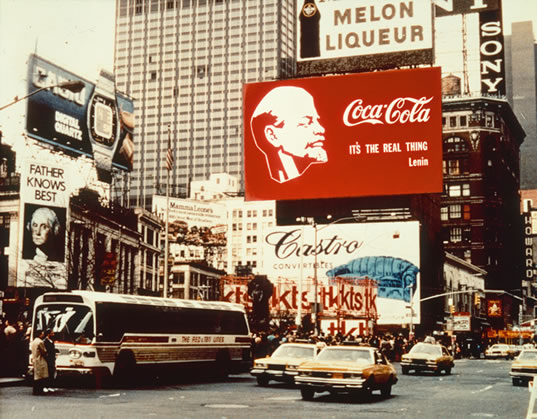
Alexander Kosolapov, Lenin and Coca-Cola, 1982. A classic work of Soviet "Sots Art" juxtaposing the profile of Vladimir Lenin with American consumer branding, reflecting the ideological crossover of East and West. (Courtesy of the artist / Sotsart.com)
THE LONG COLD WAR |

Art Note: Over Eternal Peace, Isaac Levitan, 1894. A tiny, weathered wooden church and cemetery perch on a high bluff, overlooking a vast, windswept lake under a heavy, bruised sky. Nature is vast and unchanging, sheltering human spiritual endurance on a lonely frontier that has repeatedly witnessed the rise and fall of empires. Oil on canvas, 150 × 203 cm. Collection: The State Tretyakov Gallery, Moscow. Public domain; image via Wikimedia Commons.


