MANIFESTING THE FLANEUR TEACHING HENRY JAMES AND HIS MOVEMENT INTO MODERNISM By Lisa Stein Haven *** The Montréal Review, August 2026 |
|||
I travel a lot, usually by myself. Walking the streets of big cities like New York, London and Paris is something I enjoy doing, largely because there is an unmatchable sense of freedom about it. Usually, there are no time constraints and no goals for the time spent, beyond seeing and then reading the images I take in, although I don’t consciously say to myself, “I am reading images now.” It wasn’t until grad school that I realized that someone had attached a name to this occupation and made a big deal out of it. I had been engaging in (and still do) this thing called flânerie without knowing anything about it. And it was one of my most rewarding pastimes. Once the term came into my consciousness, of course, I wanted to find out more about it and when I did, I realized flânerie would be a useful teaching tool. The flâneur as archetypal character doesn’t exist. The flâneur as a metaphor for perspective and taking in the outside world exists only as he is applied to texts in which he seems to appear. And, as such a moving lens, the flâneur provides the optimal vehicle through which the student can see and understand the evolution of an author over time. Recorded first in about 1850, the term simply refers to a person who lounges or strolls around aimlessly, an idler or loafer. Although the term flâneuse, a term that refers to the female version of the persona, does exist, it is largely a male characterization, at least in Henry James and especially in the novels of focus in this study. While Virginia Woolf and James Joyce are the masters of this device in literature, Henry James, their precursor, seems to readily adopt him, possibly through James’s own experience as an expat walking through the great cities of Europe. In any event, the flâneur, as he appears first in The American (1870), then Princess Casamassima (1886) and finally, in The Ambassadors (1903), clearly demonstrates James’s movement from literary realism to literary modernism in his fiction. It is perhaps the last of these, The Ambassadors, in its use of Lambert Strether as a somewhat clunky third-person limited narrator, that is the best example of this phenomenon and as such, can be employed in any American Literature II syllabus. The flâneur, then, is an historical figure that was adopted into literary criticism most notably by Walter Benjamin in the late 1920s as a sort of observer of the late 19th century architectural innovation of the arcade (passage in French). This observer became the lens through which both the interior and exterior world of the third-person limited narrator was revealed, allowing the high modernist characteristic of stream-of-consciousness narration to exist. Thus, the reader sees and understands the environment the flâneur is walking through, as well as every internal thought he has when walking through it. In this way, he becomes a sort of perambulatory philosopher. Benjamin referred to the persona in many of his critical writings, most notably “On Motifs in Baudelaire” and “The Return of the Flâneur,” a review of Franz Hessel’s Spazieren in Berlin. In the first essay, Benjamin notes that
Here, he is creating a direct opposition between the flâneur and Edgar Allan Poe’s “man of the crowd,” found in his story of the same name. Benjamin argues that such a manic individual as Poe’s protagonist cannot assume the cloak of a man of leisure—a lens through which the sights and sounds of the city can be best interpreted—because he must not be jostled about. There must be no unexpected intrusions or restrictions. Then, in his review of the Hessel book, Benjamin claims the flâneur is the creation of Paris, for the city had become his Promised Land: “Landscape—this is what the city becomes for the flâneur. Or, more precisely, the city splits into its dialectical poles. It becomes a landscape that opens up to him and a parlor that encloses him.”[ii] While true to the character of the critic, Benjamin’s teasing out the whys and wherefores of this character can be a little difficult for undergraduates, especially if the term “Marxist critic” is applied, but the basics can be easily transmitted to them, especially if they are able to practice it. Of course, Benjamin wants to place the flâneur in his Parisian habitat, although he does admit that he can exist in London and Berlin, among other big cities. It would be worthwhile, then, to transport students to such a place and have them practice the behavior, if that’s at all feasible. In my location, there is a refurbished arcade in Newark, Ohio, about 35 miles away and drivable for most students (some even live there) and one in a bigger city—Cleveland. Strolling through either one of these or a similar locale should be followed by a written reflection in which students recount this experience as an actual flâneur/flâneuse and how it amplified their understanding of the character and its use in literature. Sharing these reflections, either in group or as a class, proves even more useful in helping students to grasp the concept. Additionally, an example from one or both masters of this innovation, provided to students, helps to compound upon the experience and help them to better understand then the evolution in James’ adoption of him in The American, through Princess Casamassima to The Ambassadors, thereby allowing them to see and understand how James moved from a master of realism to one of modernism—outside of the demarcated period of literary modernism, which, according to Woolf, arose “on or about 1910.” A prime example and one with which students may already be familiar is provided by really any walking character in Virginia Woolf’s Mrs. Dalloway, such as this remarkable passage in which Clarissa Dalloway is à pied:
In the first paragraph of this passage, the reader gets an explicit description of the action the flâneur’s eye engages in—“slicing like a knife through everything.” This is specifically the moment in which the stroller becomes a philosopher. He or she must be at leisure, an idle stroller in essence, but even so, he or she is at work engaging with images. The stream-of-consciousness narration Woolf utilizes allows the reader to see the process of the flâneur/flâneuse—the work he/she accomplishes. After students have experienced these activities and are able to express their understanding, we can begin to read The American. As critic Edward Wagenknecht noted, The American was James’s first international novel. It was serialized first in The Atlantic Monthly in 1876-1877 and then published as a book in 1877.[iv] In it, Christopher Newman, a wealthy American, has left his business interests behind and traveled to Europe to seek a wife. As our Ur-text for this exercise, we expect that James’s omniscient narrator will overwhelm the text and we will end up knowing only superficialities about Newman’s perambulations. Newman, our flâneur of sorts, spends his first summer abroad walking the great cities in what is his only instance of flânerie in the novel. Still, even this account offers some hint at Newman’s ability to take in and engage with the images he encounters:
Newman’s “singular inward tremor” could well be evidence of the flâneur’s process of reading the landscape. James’s character of Hyacinth Robinson in the later Princess Casamassima, though, is easily the missing link between Christopher Newman and the clearly modern Lambert Strether in the final James novel of focus, The Ambassadors. *** James’s Princess Casamassima, whose title suggests the protagonist will be Christine Light, the only character he ever brought from one novel, Roderick Hudson, to another, began its serialization in The Atlantic in September 1885, continuing for 14 issues, until October 1886, when it was then published in book form.[vi] In fact, the protagonist is not Christine, the princess, but the illegitimate Hyacinth Robinson, born of a prostitute, Florentine Vivier, who dies in prison, and an aristocratic father, Lord Frederick Purvis. Having fallen into the bookbinding trade, Hyacinth meets many people above his station who are actively working against the status quo. He eventually finds himself in the City of Light—Paris. Students should now be able to identify these passages themselves, so it is useful to have them bring their chosen passages to class to present and share with others—either in full class discussion or in small groups. Here, Hyacinth, our only protagonist, not an American, seems the consummate flâneur:
Perhaps more importantly and more flâneur-like, as he sits there, Hyacinth begins to reflect on the grandfather he never knew, his namesake, Hyacinthe Vivier, a talented watchmaker who lost his life in the French Revolution, and starts to walk alongside him:
In essence, the grandson is sifting the Parisian landscape through his grandfather’s experience, which creates distance that a true flâneur would not have, but in some sense, it suggests a movement forward from Christopher Newman. Hyacinth is interpreting—he is reading the landscape—even if he must filter it through a loved one. James notes in his introduction to the novel that the origin of the novel could be ascribed “to his own peregrinations in the London streets, ‘the urgent appeal’ to ‘a mind curious, before the human scene, of meanings and revelations,’ that is, ‘of everything, to be interpreted and, so far as may be, reproduced.’”[ix] In this sense, Hyacinth Robinson is “like” his creator, James, who, in engaging in flânerie himself, sees its value when applied to certain characters. *** Finally, from Princess Casamassima we move to The Ambassadors, James’s final novel to be released initially as a serialization. His publisher sat on it, after James submitted it in 1901 and it didn’t then start its serialization until 1903 in 12 issues. Because this one landed in The North American Review, where it received almost no notice, James ended the practice. This is the novel that is touted by scholars as demonstrating James’s discovery of third person limited narration and his expert employment of it. John E. Tilford, in an essay entitled “James the Old Intruder,” published in 1958, made the initial observation that “both internal and external evidence shows that James intends us to read The Ambassadors in its entirety as Strether’s experience, registered by him and relayed by him.”[x] Wagenknecht adds,
The flâneur protagonist in this novel is Lambert Strether, who has been sent to Europe to retrieve the errant brother (Chad Newsome) of the woman to whom he is affianced, Mrs. Newsome. The problem is that Mrs. Newsome believes that Chad has become involved in a scandalous relationship with a French woman named Madame Marie de Vionnet. However, Strether finds Chad much improved rather than degraded, and Madame de Vionnet and her daughter enchanting. He loses all interest in returning to America. Meanwhile, Mrs. Newsome sends over her sister and brother-in-law, the Pococks, to take over for what she believes to be Strether’s ineptitude. Chad and Madame de Vionnet do not get together after all and Strether returns to Massachusetts, future plans unknown. With a large portion of the plot taking place in Paris, there is much opportunity for Strether to display his accomplished flânerie. However, this first occurs in Chester, England, where he strolls about with new acquaintance Maria Gostrey and an old conservative friend, Waymarsh. Again, it is useful to have students identify these passages. Strether offers that
Walking in Chester in these circumstances, however, is hardly comparable to the strolling Strether experiences in Paris proper. Here the reader can experience first-hand James’s third person limited narration (in Strether) in all of its innovative glory. Strether as flâneur provides our best example yet of this type of perspective in James—a point of view that is a clear precursor to what Woolf is doing in Mrs. Dalloway and James Joyce in Ulysses. In Book Second, Chapter II, Strether is experiencing his second day in Paris and finally has occasion to go onto the streets, having received his correspondence that morning, including a letter from a bank that is to set him up financially. This particular walk, as James describes it through Strether, shows the distinctive power of flânerie on a person, who finds him or herself on the city streets, but especially the streets of Paris:
In the Luxembourg Gardens then, Strether finds a comfortable spot and spends an hour interpreting the images that his eyes take in, such that, like Clarissa Dalloway, he has an important epiphany:
The act of walking and reading the landscape has made Strether a modern man and James a master of third-person limited narration. Of course, these passages do not encompass the entirety of each
novel. So, this exercise would be just
one of many brought into the classroom that might strengthen students’ close-reading
abilities. Each of these novels are very
long and require concentrated attention on the part of students to engage with
and mine as much from them as possible. Other
points of investigation might include the history of expatriation and the laws
that were in effect at the time, the phenomenon of three single male
protagonists, who never successfully hook up, and/or the differing experiences
offered by the divergent financial situations of each of the protagonists: Christopher Newman, the new money mogul,
Hyacinth Robinson, the tradesman socially adopted by the aristocracy, and
Lambert Strether, a 55-year-old man in the service of and paid for by his
fiancée, Mrs. Newsome. James’s novel Daisy Miller (1878), published the
same year as The American, might be brought into the conversation if
only for the fact that it is the walking that gets Daisy in so much
trouble. When Daisy walks, there is no flânerie
taking place at all. The walking is strictly a public performance. For flânerie, then, the hope is that
this sort of close focus on one aspect of the novels, namely perspective/point
of view, will persuade students to bring these skills and understanding to
other literary texts and to other classrooms.
|

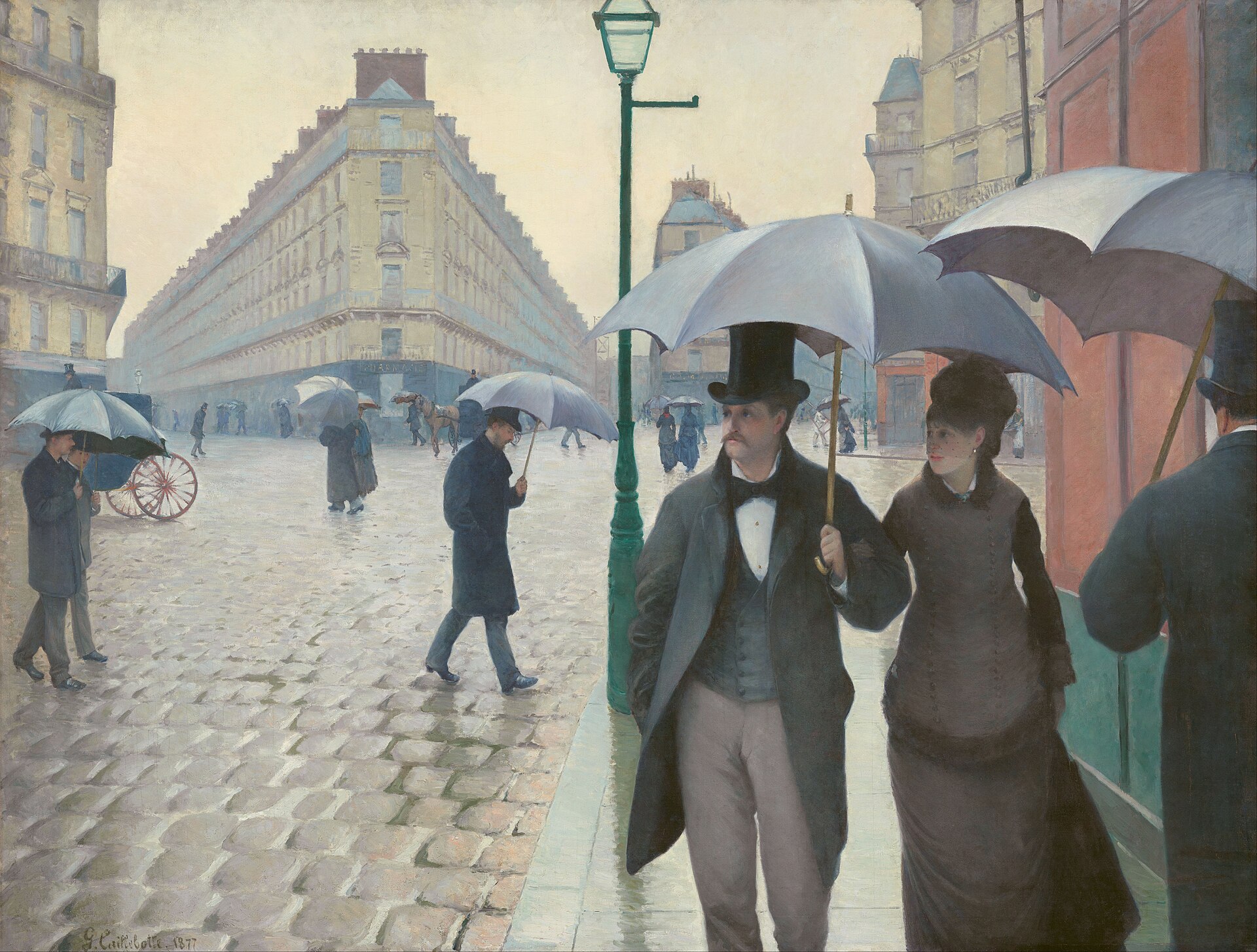
Art Note: Gustave Caillebotte, Paris Street; Rainy Day (1877). Wet cobblestones, black umbrellas, detached gazes — an expansive cityscape captured with the moving, observant lens of the urban stroller. Collection of The Art Institute of Chicago. Public domain.
