MAD GENIUS THE AGONIES AND ECSTASIES OF THE FATHERS OF MODERN LITERATURE: FLAUBERT, MAUPASSANT, BAUDELAIRE, RIMBAUD, ARTAUD By David Comfort *** The Montréal Review, August 2026 |
|||
After another tryst in a Paris brothel, the twenty-year-old Guy de Maupassant exclaimed, "I have the pox! Finally! The big one! I am proud of that by God!” The libertine would soon confess to a priest, “I am digging my grave with my cock.” At the time, the Golden Age of French brothels, syphilis was epidemic, claiming at least thirty-thousand victims in Paris annually. But, in Decadent literary circles The Great Distress, as it was called, was believed to be a steroid for the budding genius. As Maupassant’s colleague, Anatole France, remarked: “General paresis only makes great men.” In little more than a decade, Maupassant wrote three-hundred stories and six novels, going on to be hailed as the father of the modern short fiction. His early enthusiasm for his infection soon faded as he was afflicted by failing eyesight, nervous attacks, hallucinations, and migraines. His last short stories included “The Diary of a Madman” then “The Horla” wherein the hero kills himself to escape a fury haunting his mind. Meanwhile, Guy’s younger brother, Herve, died of neurosyphilis. Two years later, unable to write and stalked by his own ghost while on a cemetery walk, Maupassant stabbed himself in throat, raving that his brains were being devoured by flies and escaping from his nostrils. Like Herve, he spent his last days in an asylum where mercury and arsenic treatments only made his condition worse. Soon, incubating imaginary eggs and urinating invisible diamonds, he prepared for a train journey to purgatory with Lucifer. By the end of his stay, in the throes of tertiary paresis and “animalized” according to his doctor, he gnawed at his shackles while howling with laughter. His last words were, “Darkness! Darkness!” His pallbearer, Emile Zola, eulogized him as “one of the happiest and also one of the unhappiest of men.” At the time of Maupassant’s death, his colleague, Alphonse Daudet, was writing his autobiographical “The Agony” (La Doulou) about his own distress, concluding that the disease caused the "vast slaughter of a generation." The most esteemed member was Gustav Flaubert who called Maupassant his adoptive son. Flaubert’s closest friend, Guy’s uncle, Alfred Le Poittevin, was claimed by the Lues at age thirty-two. Death haunted the early stories of the devastated young Flaubert: “The Fiancée and the Tomb,” “The Dance of the Dead,” “The Last HourofurH H.” Even before Poittevin’s passing, Flaubert was battling his own infection while clinging to false hope for a cure. In 1844, at age twenty-three, he collapsed with his first seizure. Of the after-effects, he wrote: “All my nerves quiver like violin strings, my knees, my shoulders, and my belly tremble like leaves.” He tried to rationalize this as hypochondria: “One thinks about oneself and becomes ill, or one thinks one’s ill, which is the same thing,” he ventured. Flaubert later became so hopeless that he confessed, “I only want one thing -- to croak.” In 1880, suffering a fatal stroke triggered by his venereal infection, his wish was fulfilled. Like Flaubert and many others, Charles Baudelaire contracted syphilis from a prostitute at a very young age and at the outset was as cavalier as Maupassant had been. Flaubert published Madame Bovary in 1856, Baudelaire The Flowers of Evil the following spring. Both were charged with indecency. After Charles wrote a glowing review of Bovary, Gustav told him, “You entered into the arcana of the book as though my brain were yours.” He went on to praise The Flowers -- containing such poems as “Cupid and the Skull” and “Don Juan in Hades” -- for “celebrating the flesh without loving it.” Indeed, the dark themes and dispositions of the two geniuses were much the same, especially where the purgatory of lust was concerned. Baudelaire stabbed himself at age twenty-four. Two decades later, he surrendered to syphilis mute, paralyzed, and in his mother’s arms. Arthur Rimbaud called Baudelaire the king of poets. A thirteen-year-old prodigy when his idol passed, Rimbaud was already composing brilliant verse. Six years later, he dashed off A Season in Hell in a matter of months, explaining “I have tried to invent new flowers, new stars, new forms of flesh.” Despite his admiration for Beaudelaire, he considered The Flowers of Evil anachronistically romantic, “too aestheticized,” and even “trite.” He insisted that the true modern poet must be a “Seer,” inventing an alchemical language based on unflinching self-examination and a “rational derangement of the senses.” Never one to underestimate his gifts, he called his verse “irrefutable and oracular” and without precedent in French history. At age twenty, in one of the greatest mysteries of literature, Rimbaud abandoned writing entirely. After wandering throughout Europe, he spent his last decade as an ivory trader and gunrunner in Africa. “No more words. I bury the dead in my belly,” he wrote in Hell. “I sought voyages to disperse enchantments that had colonized my mind.” Prophetically, he concluded: “I return with limbs of iron, dark skin, and a furious eye. Women nurse those fierce invalids home from hot countries.” He returned to France on a stretcher, skeletonized, and, after being amputated, was nursed by his pious young sister. Paralyzed from late-stage syphilis, Rimbaud perished, denied Catholic last rites and praying to Allah. “Dead! You? You, the god among demi-gods!” wept his former lover, Paul Verlaine. The tempestuous affair of the two poets had lasted three years, climaxing when Verlaine shot Rimbaud and was jailed. After release, he wrote The Accursed Poets (Les Poètes Maudits) about himself, Arthur, their circle and “the elite, vulgar phalange who savaged us." Having no idea where his teen lover had vanished, but fearing him already dead, Verlaine published Rimbaud’s Illuminations in 1886, calling it “pure masterpiece, fire and crystal.” Hailed Prince of Poets by his contemporaries, the syphilitic Verlaine died penniless in 1896. Antonin Artaud was born then in Marseilles where Rimbaud had passed five years earlier. In “Fragments of a Diary in Hell,” Susan Sontag praised him as “the greatest prose poet in the French language since Rimbaud.” Like Rimbaud, Artaud aspired to create a new language -- one that he hoped would “derange men.” Calling himself the Tortured One, much as Baudelaire and Rimbaud had, he too strived to become a Seer by studying himself “microscopically.” He declared that no true artist has ever created except to get out of hell, a point that his predecessors surely would have found unquestionable. Artaud lived his last years in Paris’s Rodez asylum. He had been arrested and straightjacketed for threatening pedestrians with his magic cane which he claimed had belonged to both Christ and Lucifer. At Rodez, he endured what he called annihilation therapy: fifty-one unanesthetized electroshock treatments for what doctors had diagnosed as “hallucinatory psychosis and a bizarre metaphysical system.” Between electrocutions, he wrote feverishly, completing more than twenty-thousand pages. He spent his last days at the Ivry-sur-Seine hospice for the indigent, composing essays such as "Van Gogh: The Man Suicided by Society." Artaud died there in 1947, reportedly from colorectal cancer, though some claim that he overdosed himself with his pain medication, chloral hydrate. He had been treated for neural meningitis as a boy then, as a young man, for congenital syphilis. The last and most radical member of mad genius fraternity, Artaud often raved that it was not him but humanity itself that was “polluted and hopelessly syphilized.” Like Rimbaud, he too was denied last rites. As different as these artists were, all shared many of the same psychic and spiritual qualities. Fallen Catholics, all were atheists obsessed with evil and degradation. All were megalomaniacal, misanthropic, and misogynistic. Mother obsessed, they were reclusive bachelors. Each aspired to invent an incantatory new language. And, indeed, all were syphilitic. But the disease was far more a symptom of each tormented mind than a cause of it. So, how did they become the fathers of modern, avant garde literature? Despite their uniqueness, they were products of their time -- "the sickness of the century" (mal du siècle). *** In the late eighteenth century, Friedrich Maximilian Klinger wrote Sturm und Drang – Storm and Stress. Countering the collective “Happiness Dictatorship” of the Enlightenment, Klinger’s play dramatized disillusionment, dispair, and angst. Later, another German, Jean Paul, coined a complementary term weltschmerz -- world-pain. At the same time, yet a third term was popularized, embracing the literary nineteenth century: Geniezeit -- the Age of Genius. Expressing both Weltschmerz and Sturm and Drang, a colleague of both Klinger and Jean Paul became the Geniezeit paradigm and the forefather of modern literature: Johann Wolfgang von Goethe. European philosophers and writers elevated him to semi-divine status. The courtly genius didn’t condescend to boast but allowed that if “a crown were set upon my head, I would have thought it quite in order.” The novelist-poet-playwright-essayist-scientist exemplified the post-revolutionary Enlightenment king: the Genius. Goethe was most famous for his two semi-autobiographical novels, The Sorrows of Young Werther (1774) and Faust (1832). In the first, a hypersensitive poet, suffering unrequited love, commits suicide. In the second, a suicidal scholar sells his soul to the devil for divine knowledge and worldly pleasure. Both characters typify the depressed Romantic hero. Goethe published his poem “Prometheus” in the same year as Werther. In the classic influenced nineteenth century, ennui, egocentrism, and mental imbalance were considered signs of refinement, sensitivity, intellect. And, in special cases, of genius. During the fin de siècle, when Werther and Faust were still gospel for vanguard artists and when Geniezeit was at its peak, Cesar Lombroso published Man of Genius, exploring the connections between creativity and madness. The professor of psychiatry and former insane asylum director identified Wertherian depression, Faustian ambition, vanity, contempt for others, and feelings of persecution, as common traits of the artistic genius. For Lombroso, Prometheus personified both the genius’s theft of divine fire and the torture for ungodly ambition. Our fraternity of French artists, especially the poets, shared the traits of the three storied characters. Each was Wertherian in his melancholy, Faustian in his quest for sacred knowledge, and Promethean in his hubris. Goethe, too, shared these traits. But clinging to his own fragile sanity, he avoided the consumptive self-reflection of his successors. The Greek “Know thyself” mandate troubled him since he feared excessive introspection might eclipse what for him was the most important reality -- society and culture. “The world is so full of simpletons and madmen,” he declared, “that one need not seek them in a madhouse." Their admiration for Goethe notwithstanding, Flaubert, Maupassant, and Baudelaire rejected his idealism. Instead, they embraced the pessimism of their philosophical godfather: Goethe’s understudy, Arthur Schopenhauer. The misanthrope was famous for claiming “life is not worth living” and that the will of man is so perverse that he is “capable of slaying another merely to smear his boots with the victim’s fat.” Furthermore, he insisted that society superficialized the artist while introversion allowed him to reach new heights in the depths of his personal world. Unlike his mentor, Goethe, Schopenhauer failed to earn Geniezeit fans until after his death, during the rise of the Flaubert Realists and Baudelaire Decadents. Left to cast his pearls before swine (including his own mother, a popular novelist), he sniped, “Talent hits a target no one else can hit; Genius hits a target no one else can see!” Our fraternity of post-Goethe geniuses shared Schopenhauer’s arrogance and anger. Before his own talent was recognized, Flaubert, who called man’s stupidity “formidable and universal,” confessed “What supported me through all the storms was pride.” Indeed, he insisted that for an artist to be free, “he must think like a demigod.” Baudelaire agreed, saying that he avoided suicide by taking pride in his own “Olympian superiority” and becoming “a saint for himself.” Rimbaud, though early on he worshipped Baudelaire as “true God,” considered himself a “magus” and “an inventor more deserving by far than all those who have preceded me.” Artaud, the greatest megalomaniac of the group, dismissed most of his predecessors as bloviators and “jack-offs.” Not surprisingly, all, like Goethe, were vehemently anti-democratic, disdaining what they called the mob, the herd, the rabble. In addition to their feelings of rejection, all had suffered childhood traumas and humiliations. Flaubert was treated like the family idiot. Baudelaire was only six years of age when his beloved father died, then felt betrayed when his mother remarried. Rimbaud was the same age when his own father abandoned the family, leaving him alone with his tyrannical mother; then, running away, he was gang raped by soldiers. Suffering from meningitis and neurasthenia, Artaud’s parents left him in sanitariums. Today, mad usually just means angry. The work of these artists was steeped in anger. Flaubert said that even as a boy he had felt an aversion to mankind. Though labelled a realist, he insisted he hated reality and that his mood “would make ebony look pink.” Rimbaud cried to his muses: “O Misery, O Hate. To you has my treasure been entrusted!” Artaud, who called himself the Enraged One, believed that every man “could live forever, powered by anger,” adding that in every mad artist is a “misunderstood genius who frightens people.” Few spared themselves from their own fury. Maupassant’s character double imagines blinding himself and cutting off his hands. Rimbaud fantasized about going mad with rage, gashing himself and running amok. Baudelaire described himself as “the wound and the rapier, the slap and the cheek.” Where did such anger come from? It goes without saying that many geniuses throughout history have in their lifetimes been misunderstood, not understood at all, and -- despite struggling to communicate their purgatory -- dismissed as lunatics and destined to posthumous laurels. The poètes maudits were no exception. Baudelaire confessed to his mother, his closest confidante, that he feared his fate was to be eternally alone; in “The Abyss” he sees “above, below me, only depths… the bat-wing of insanity.” Rimbaud called himself the new Jeremiah fated to “endless lamentation.” Artaud described himself as “an absolute abyss” because “nothing bestializes a being like the taste for eternal happiness.” The abyss for all was morose introspection. As their contemporary and kindred spirt, Frederick Nietzsche, famously warned: "He who fights with monsters should see to it that he does not become a monster himself. And if you gaze long into an abyss, the abyss will gaze back into you.” Flaubert called the artist a “monstrosity, outside nature” -- including himself. Though the Hermit of Croisset found his isolation purgatorial, he insisted it was the only way for a true artist to live. His student, Maupassant, agreed, complaining that even close friends enervated him. Unlike the novelists, Rimbaud -- who divided humanity into three species: businessmen, simpletons, and cattle -- refused to even dabble in social life except to shock, insult, or attack people. The poet Seer, he wrote, had to endure “unspeakable tortures” while plumbing his depths until, as he revealed in A Season in Hell, he was “up his ass in introspection.” In his own notes from the underground, Artaud telegraphed his obsessive search in caps: WHAT THE FUCK AM I HERE FOR? But the poètes maudits were not truly alone. The companion of each was his muse. Rimbaud famously said Je est un autre --"I is another." Depicting himself as a kind of Jacob at heaven’s ladder, he wrote, “Many nights this demon would grab me and we would wrestle and fight.” Of his own dark angel, Artaud said, “He who invented this language isn't even me.” Before being diagnosed with schizophrenia, he starred in his own plays as the monstrous Emperor Heiogabalus and Count Cenci – his Frankenstein and Mr. Hyde. In the asylum, he raged that psychiatry was invented by an insane society “to defend itself against visionaries.” Like other artists under the volcano, he didn’t want to be cured of his madness, nor did he try to demystify it lest he lose his life’s blood -- his creative fire. As Baudelaire said, "I have cultivated my hysteria with delight and terror." The pioneering psychoanalyst, Carl Jung, a poet himself, claimed that the only way to treat a madman was to help him discover his creativity if he hadn’t already. Every great mind has a touch of madness, his daimon, as Aristotle said. Artaud and the others had more than a touch. For them mad genius was redundant: their divine disease, their double, their daimon, was their genius. Not unexpectedly, our self-creating, self-worshipping artists were atheists – Nietzschean supermen aspiring to replace a dead or absent God. Flaubert called himself a thinker and demoralizer: he found no divine breath in humanity but only “mud and shit.” The others agreed. They saw no evidence of grace much less of salvation, so were repelled by Romantic walks in beauty and odes to Grecian urns. As a schoolboy, Rimbaud scrawled SHIT ON GOD over the walls of his hometown. Of his first communion, he wrote, “My flesh crawls with the touch of Jesus’ putrid lips,” and later identified misfortune as his God. Artaud praised Rimbaud as a fellow holy man but blamed him for “committing suicide of the mind and spirit” when abandoning poetry. Again proving his bona fides as the alpha shockjock, Artaud called God a “low down corpse,” a “filthy old monkey,” and His creation “a foul-smelling turd.” For him, the Almighty was an escape artist: “He withdraws, gets the fuck out, leaves the cops to keep an eye on things.” The Atheist/ Defective Father theory seems to fit Artaud and his brethren: their fathers were either absent or remote, leading most to an intense love and/or hate of their mothers. Confirming Lombroso, most felt not just marginalized but persecuted. and Identifying with his Saint Anthony, Flaubert called his life “one long martyrdom.” In his journal, Rimbaud wrote, “I too bear a cross, a crown of thorns.” Crucifixion is one of Artaud’s favorite themes. All admired their tortured German colleague, Heinrich Heine, who said that every genius is a martyr. Ironically, while les misérables didn’t believe in salvation, they certainly believed in damnation and somehow found an upside to it. Most identified with Goethe’s Prometheus, the fire stealer, and with Milton’s Paradise Lost Lucifer, the light-bearing fallen angel. Admitting to being a “slave” of his baptism, Rimbaud declared, “I believe in hell therefore I am.” Repelled by the violent, foul-mouthed prodigy, lesser poets called him a “little Satan among the doctors.” He surely had read the “Litanies of Satan” by Baudelaire who called Lucifer his adoptive father, prayed for his pity and to be buried beside him. Eroticizing his own Faustian affection, Artaud described how “Satan's hot bellows blew me in and out by an ingrown coitus.” Spurning God, the succor and savior for normal men, the maudits were left alone to contemplate their deaths – the final reality that both attracted and terrified them. “I’m crammed with coffins, like an old cemetery,” said Flaubert. “God, have I had enough of living!” said Maupassant. “Come, Captain Death, weigh anchor and set sail!” said Baudelaire. “Shoot! Shoot me! I’m over here!” said Rimbaud. “I am no more than a living corpse,” Artaud told his mother. Artaud regarded the inevitability of death as the final bondage. “When the sky is ready to fall on our heads, who can dare talk to me about freedom?” he demanded. He insisted that the only way he could reclaim freedom was by committing suicide. To escape their own sense of social and personal imprisonment, his predecessors had either tried it or seriously considered it. The temporary escape for all was in art – the divine act of creating work that would survive them. Rimbaud worshiped only two goddesses: “the Muse and Liberty.” Flaubert claimed that art was rooted in “faith and freedom.” His adoptive son, Maupassant, agreed, declaring that literature above all was a “means of liberation.” Baudelaire relied on his poetry to overcome “anything that limits my freedom.” Thus, writing for all was nothing less than a defiant expression of life in the valley of the shadow which restored their souls, at least temporarily. *** Death wasn’t simply an obsession of the poètes maudit, but the obsession of the Weltschmerz age, especially during the Decadent period. The two most popular novels of the nineteenth century -- and today -- were about suicides: Flaubert’s Madame Bovary and Tolstoy’s Anna Karenina. Similarly, the most popular Gothic novels concerned the living dead. The first, Mary Shelley’s Frankenstein, The Modern Prometheus, was about a Faustian doctor who aspired to conquer death. The second, Bram Stoker’s Dracula, was about an immortal who subsisted on the blood of the living. In the nineteenth century, two epidemics claimed nearly half the European urban populations. Mary Shelley suffered from the first; Bram Stoker from the second. The first affliction, tuberculosis, one of history’s oldest diseases, accounted for more than a quarter of all fatalities. Sufferers included Goethe, Schiller, Keats, Poe, Balzac, Stevenson, Jane Austin, and the Brontes. They might have agreed with Kafka who called his own infection “the germ of death itself, intensified.” He confessed to his fiancée that his lung infection, which he called the “animal,” was “an overflowing of my mental disease." The year before The Metamorphosis author finally surrendered to the animal, Georg Groddeck, the father of psychosomatic medicine, wrote in The Book of the It that disease is often mentally borne especially in those for whom life is intolerable. King Charles II’s court physician, Dr. Gideon Harvey, had intimated this long before in one of the first studies of consumption, Morbidus Anglicus (1672). He argued that the twin causes were choler (yellow bile, arousing anger) and melancholy (black bile, arousing depression). Today, John Sutherland, a Victorian literature scholar, claims that TB and genius often went hand in hand. In The White Plague, Dr. René Dubos, a microbiologist, adds that that the intellectually gifted were among the most likely victims. The Poet’s Disease, as it came to be called, was romanticized in nineteenth century Europe. The cultured found the ethereal thinness and ghostly pallor of consumptives alluring, especially when they materialized in theaters or opera houses like Gothic novel or séance apparitions. Alexander Dumas observed that consumption, especially in poets, was so fashionable that “It was good form to spit blood after each emotion and to die before reaching thirty." Byron, who kept a coffin in his living room and drank claret from a monk’s skull, toyed with the idea of an infection "Because the ladies would all say, 'Look at that poor Byron, how interesting he looks in dying.’” Commoners failed to see the romance of an affliction characterized by anemia, exhaustion, confusion, migraines, depression, anxiety and, sometimes, psychosis. In the early stages, however, some claimed to feel spes phthisica, or hopeful euphoria. Samuel Coleridge, the Graveyard Poet founder of English Romanticism, claimed he felt a "freshness of sensation" under its influence. Shelley said his TB provided him “unnatural and keen excitement.” Perhaps enjoying the same, Mary Shelley finished Frankenstein in matter of months, while Stevenson completed Jekyll and Hyde in weeks. Burning it at both ends while wolfing coffee grounds, the consumptive Balzac wrote eighty-five novels in twenty years, often logging in fifteen to eighteen hours a day. Unlike TB, few found any allure in the second epidemic. Soon after an infected Columbus and his skeleton crew exported Treponema pallidum instead of gold from the New World to the Old, the Italian Dr. Girolamo Fracastoro coined a term for the disease in his poem "Syphilis,” about a cursed, god-defying shepherd of the same name. Four centuries before the bacterium was identified, scientists attributed the illness to a disharmony of the humors or adrift kidneys, while others believed it was a new form of leprosy, smallpox, or the bubonic plague. The Church, on the other hand, relied on older authorities such as the eighth century German archbishop, Rabanus Magnentius, who claimed that all disease was caused by vice, the deadliest by debauchery. Even outside clerical circles, the pox became known as Job’s Disease, Cupid’s Disease, and the Snake Disease (Morbus Serpentis). The worst cases were attributed to incest, sodomy, and/or demonic possession, especially by vampires. Treponema infection progresses in three stages. In the first, rashes or chancres appear on the genitals and/or mouth. In the second, the bacteria migrate to the nervous system, triggering fever, vertigo, migraines, hallucinations, vision loss, and seizures. In the neural tertiary stage – paresis -- bloody lesions, called gummas, blossom from skull holes, the nose sometimes collapses, speech is garbled or lost entirely, while paralysis and insanity set in. Between onset and climax, the disease incubates for years or decades, depending on the weakness or strength of the host’s immune system, which also determines the nature and severity of symptoms. Malnutrition, insomnia, alcohol and drug abuse suppress the immune system. So poor, self-medicating pre-twentieth century artists were particularly vulnerable to the most intense venereal experience. Many hypersensitives such as the poètes maudits were already ill at ease -- dis-eased, if not in-sane -- lacking mental hygiene. It was not yet known that stress hormones, adrenaline and cortisol, handicap the immune system while dampening pleasure-inducing serotonin and dopamine. In pre-penicillin days, the leading treatments for syphilis – mercury and arsenic – intensified rather than alleviated symptoms. Moreover, today’s pathologists claim that much disease is stress-related and that depressives are far more likely to suffer autoimmune and psychotic disorders, as well as hyperpathia -- extreme sensitivity to inflammatory pain. How, then, did some artists see a silver lining to syphilis? How is it that the young Maupassant celebrated his infection as if having been initiated into a skull- and-bones brotherhood? Like with TB, he and others claimed boundless creative energy, As Deborah Heyden points out in Pox: Genius, Madness, and the Mysteries of Syphilis, paresis victims can experience "mystical vision, messianic prophecy, grandiose self-definition, and clarity of expression." Thomas Mann whose novel, Doctor Faustus, was based on Nietzsche, wrote that the syphilitic philosopher was “blasted with ecstasy,” adding, “but there is another name for this genius: disease.” Before falling mute and breathing his last, the first Superman boasted of being the reincarnation of Dionysius, Alexander the Great, and Napoleon, while Maupassant claimed to be the son of the Virgin Mary. In his essay, “The Theatre and the Plague,” Artaud’s description of bubonic symptoms eerily matches those of syphilis. He claimed they can mirror the victim’s mental struggles, while some, especially poets, imagine things as never before. He called the plague a superior disease and an intelligent or psychic force that homes in on the brain, the seat of the will, igniting “cerebral explosions.” So, Artaud sought to recreate and galvanize theater by metaphorically infecting his audience in the same way. For ordinary mortals, though, the pox was not psychedelic, but an unholy curse. Victims took great pains to hide their symptoms lest they be branded as moral lepers. The very name syphilis was rarely uttered or written, especially on death certificates. To spare patients and their families humiliation, doctors often attributed symptoms to other diseases. Venereologist, Sir Jonathan Hutchinson, was the first to call syphilis The Great Imitator since it could be mistaken for or co-exist with the plague, meningitis, smallpox, leprosy, measles, typhus, epilepsy, neuro-tuberculosis, cancer and other illnesses. As such, it was vastly unreported. Flaubert’s cause of death was reported as cerebral hemorrhage; Maupassant’s and Baudelaire’s as general paralysis; Rimbaud’s as carcinosis; Artaud’s as colorectal cancer. The Lues was associated with degradation and debauchery because the main infectors were prostitutes. “A night in the arms of Venus leads to a lifetime on Mercury,” was a popular jest in London’s No-Nose Club and other fraternities. Flaubert’s friend, Maxime Du Camp, reported 155,000 registered prostitutes in Paris, not counting the many freelancers, all servicing at least 40,000 clients, or a quarter of the city’s gentlemen. In Madness: A Very Short Introduction, Andrew Scull writes that tertiary syphilitics accounted for nearly thirty percent of the Paris Charenton Asylum inmates. James Joyce, believed to be a congenital syphilitic and on the edge of insanity toward the end of his life, remarked, “I presume there are very few mortals in Europe who are not in danger of waking some morning and finding themselves syphilitic.” Baudelaire, for one, didn’t seem to see any disconnect between his love of Satan as a savior and his hatred of women as evil temptresses. In The Flowers of Evil, love is “a bed of nails,” women “queens of sin,” and prostitutes “perfumed skeletons.” He ventilates his screed with sonnets about “the spiritual flesh and fragrance of angels” -- the Helens and Beatrices who briefly infatuated him before disgusting him due to what he admitted were his “odious prejudices.” Flaubert and Maupassant shared them, but hardly to the same degree. Artaud also had women issues. In “Art and Death,” he confessed that his preoccupation with sex “rips out my blood.” Hoping for relief, he tells the alluring Anais Nin, “What a divine joy it would be to crucify a being like you.” As for Rimbaud, notwithstanding his love for Verlaine as one of the few who understood him, he was strongly attracted to girls as a teen but “as timid as thirty-six million new-born puppies.” In “My Little Ones,” he confesses to hating them for rejecting him, while also regretting that “womanly companionship was denied me.” Nietzsche, put everybody’s female hang-ups in a nutshell: love, he wrote, was impossible for a genius such as himself because “that would presuppose that I found -- wonder of wonders -- a human being of my rank.” In fact, the superman and his brethren felt debased in their need for mother surrogates, their lofty minds brought low by lust. The courtship rules of the time helped bring them down: as libidinous young men (by today’s standards Flaubert, Maupassant, and Baudelaire might have been called sex addicts) their only outlet was the bordello -- the Pandora’s box where all were infected with syphilis, prompting Baudelaire to call prostitutes poisoners and vampires and to confess: “As for love, I have never found anything but distress, rage, and despair in that supreme joy!” Even so, Flaubert called prostitutes a necessary evil. Maupassant agreed, bragging of sometimes exhausting six an hour (while, later, having no compunction about infecting his many mistresses). Baudelaire confessed to an “invincible taste” for forbidden fruit despite his belief that “To fuck is to aspire to enter into another, and the artist never wants to leave himself.” Surrendering to temptation, all bachelors paid the price for leaving themselves, feeding their gynophobia and misogyny. Might Baudelaire’s Flowers of Evil be imagined as cankerous syphilitic blossoms, transmogrifying once vital and handsome men? The Picture of Dorian Gray, by Oscar Wilde, another syphilitic, dramatizes such a transformation. As an Oxford student, the foppish prodigy who never tired of declaring his genius, contracted the disease after his “white soul first kissed the mouth of sin” -- a prostitute’s. He wrote his novella decades later, in 1890, when so many others were losing their bodies and minds. After years of infection and mercury injections, Wilde wasn’t feeling or looking his best either: describing his brain as a furnace and his nerves “a coil of angry adders,” he was bald, his teeth blackened and falling out, his eyes failing, his skin on fire. His alter-ego, the beautiful hedonist, Dorian, makes a Faustian bargain for eternal youth and pleasure with the Mephistophelian Lord Wooton. As he indulges in his wicked ways, his portrait in the attic develops “leprosies of sin." Finally, on the brink of lunacy, stabbing the picture, he stabs himself and turns into "withered, loathsome corpse.” A few years earlier, Robert Louis Stevenson, taking a break from escapist yarns, wrote The Strange Case of Dr. Jekyll and Mr. Hyde. As a young man, after another brothel fling, he had confided to a friend that his physician told him that “I succeeded in playing the devil with myself.” The syphilitic’s mad scientist hero is tall and stately; his devilish double a hideous dwarf. Unable to stop the monster’s murderous rampages, the doctor kills himself before he loses his Jekyll to his Hyde. Completing the Gothic trilogy, Bram Stoker published Dracula in 1897. His biographer, Daniel Farson, speculated he contracted the pox from a prostitute at around the same time. Victorian literature scholars have called the novel a "syphilologue” reflecting the paranoia of infection. Having made a pact with Lucifer, the undead Dracula is ghostly pale, allergic to light and, of course, to crucifixes. With sexual abandon, he nurses donors’ veins, then infects them with his own pathogens which slowly incubate leading to lethargy, pallor, then final possession. In attempting to check the victims’ descent into insanity, the psychiatrist Dr. Steward, on the brink himself, ventures that “all men are mad in some way.” Flaubert, Maupassant, Beaudelaire, Rimbaud, and Artaud didn’t read these horror stories, but lived them. In “The Passion and the Skull” Baudelaire raged, “What are you blowing away again and again, you murderous fiend, is my body, my blood and my brain!” He and the others became cadaverous and frightening. Artaud, resisting reality (his forte), insisted Baudelaire didn’t die of syphilis, but from losing faith in the hallucinatory revelations of his aphasia. In their anxiety-ridden solitude, these writers provided fertile psychic soil for infections. Disease of any kind is seldom experienced in the same way by the infected. Syphilis is no exception. Perhaps for some, especially those who ran on higher mental voltage, the creative juices flow more freely when the nervous system and brain are being eaten. But the greatest creative stimulant for artists such as Flaubert and company was likely the realization that the clock was racing, driving each to work more madly to realize his divine gift before being retired to an early grave. *** As we have seen, egotism, hypersensitivity, melancholy, anger, introversion, atheism, and death obsession were at the heart of these geniuses. The predispositions merged and deepened with age, becoming abysmal. Whereas the theist tourists, Dante and Milton, described external hells, the godless poets recreated the phantasmagoria of their own internal hells. Becoming Prometheuses of their own imaginations, they were purged and relieved, however briefly, of their sense of powerlessness, alienation, and doom. In mining themselves, they dug deeper and deeper: Flaubert and Maupassant broke the crust, Beaudelaire reached the mantle, Rimbaud and Artaud struck the molten core. Though said many times before, the truth bears repeating: if genius is boiled down to one thing, it is originality -- the gift to conceive and craft something unprecedented, or at least to synthesize the old in a way never before seen. The fundamental newness of our fraternity was this: they were the first introvert writers, the Columbuses of the exotic, if frightening, new worlds in their own heads. As insiders, they were society’s outsiders. Their godfather, Schopenhauer, called his philosophy of the perverse personal will “a new system that has never come into any human head.” In his story, "Beside Schopenhauer's Corpse," Maupassant praises the pessimist for refusing to sugarcoat the grim realities of mortal life. Flaubert, also a Schopenhauer fan, gave up on his quest for “the beautiful in the infinite,” finding Nature “ugly” in comparison to his replacement -- “the monsters of my fancy.” When public decency officials expurgated six monsters from The Flowers of Evil, he claimed to be unmoved if not pleased since, as he often remarked, the brilliance of any work could best be calculated by how much it is vilified. But critics did, in fact, acknowledge Baudelaire’s originality: they called him the inventor of “carcass literature,” an honor his colleagues shared. Despite their egocentrism, Flaubert and Maupassant wrote in the traditional third person. Both argued that an author’s personality should be absent in his work and, like God, he should be invisible but omnipotent. The claim seems disingenuous since of course many authors, yesterday and today, portray themselves in their heroes. Flaubert admitted that he saw himself in both Madame Bovary and Saint Anthony. Maupassant self-projected in his later work, especially in “La Horla” his account of encroaching madness. Their poet successors threw off the third person yoke and wrote almost exclusively in the first person rife with exclamation points. This evolution in European literature was complemented by the transition from Impressionist to Expressionist painting. Degas’ L'Absinthe portrays a forlorn woman like Emma Bovary, exiled in a dismal cafe. The syphilitic Toulouse-Lautrec specialized in prostitute portraits which Degas said "stank” of his disease. Calling his Night Café his ugliest picture, the syphilitic Van Gogh depicted a cavernous bar where you could "ruin yourself, go mad, or commit a crime." Months later, wasted on absinthe (aka the Green Fairy) he threatened Gauguin with a straight razor, cut off his own ear instead, gifted it to his favorite Arles prostitute, then painted “Bandaged Ear” just before being committed. Three years after he fatally shot himself, or was shot, his admirer, Edward Munch, blended the same lurid palette to create The Scream. Flaubert and Maupassant wrote what Degas and Lautrec painted; Baudelaire, Rimbaud, and Artaud wrote what Van Gogh and Munch painted. Rejecting classical perfection, Flaubert and Maupassant focused on forbidden subjects and the beauty of decay. While their predecessors produced doorstops, never sparing a modifier or an aside, they prized less-is-more precision, taking great pains to find le mot juste -- “just the right word,” as Flaubert put it. Baudelaire further condensed and personalized similar themes with melodramatic spleen. Coining the term “Modernity” in his essay, "The Painter of Modern Life," he contended that the writer’s primary goal should be to discover and express the timeless by plunging “to the bottom of the Unknown to find something new.” This, too, was Rimbaud’s grail. He concluded Hell with a mandate: the poet must be “absolutely modern.” Convinced that the Romantics were killing art, he assaulted their idol: “I sat beauty on my knee, found her bitter, and hurt her.” He’d had his fill of “milk-fed literary veal” and “floral wrangling.” Riffing off Rimbaud’s claim that old poetry wasn’t “worth a seagull’s turd,” Artaud dismissed all writing as “pigshit” because it “castrated” raw experience. Though in calmer moments, he exempted himself, Rimbaud, and few other ferals from the bullshitters, his preferred language was the scream. Perhaps recognizing himself in Munch’s painting, he called himself “a long scream,” proving it in his Theater of Cruelty performances not to mention, later, while being electrocuted. Unlike today, groundbreaking writers of earlier centuries were revered, some even deified – thus the cults of Homer, Dante, Shakespeare, and Goethe. Our mad geniuses aspired to be crowned originals in their turn, with only Flaubert and Maupassant being fully recognized in their lifetimes. The others were fated to become twentieth century monstres sacrés -- sacred monsters. But each stood on the shoulders of his predecessors: would there have been an Artaud without a Rimbaud, a Rimbaud without a Baudelaire, a Baudelaire without a Maupassant and Flaubert? The influences of the five were deep and far-reaching. The father of the modern novel, Flaubert, had a profound influence on Tolstoy, Chekhov, Joyce, Pound, Beckett, and Borges, to name a few. Today’s critic, James Wood, believes novelists should thank him “the way poets thank spring” because, without pontificating, he pursued the truth, “even at the cost of repelling us.” Maupassant is hailed as the father of the modern short story for the same reason. Baudelaire has had an equal impact on poets. Though considering him perverse, even “insufferable,” T.S. Eliot -- no stranger to the dark side himself in Wasteland and Prufrock -- called Baudelaire "the greatest exemplar in modern poetry." Abandoning rhyme, meter, and line breaks, he was the first important prose-poet. His successor, Rimbaud, considered the co-founder of 20th century European verse, introduced hallucinatory, stream-of-consciousness description. The lionized Victor Hugo called him an “infant Shakespeare” and, like so many others, was baffled that he abandoned his art when it seemed to be in its infancy. Proust was inspired by Rimbaud as a “superhuman creative force.” Lauding him as the poet’s poet, Allan Ginsburg wondered how anyone could even try to equal him. In “The Time of the Assassins: A Study of Rimbaud," Henry Miller, who saw himself in the rebel poet, hailed him as an assassin of materialism and stultifying social mores, while marveling at how he grew otherworldly flowers from the "filth and muck" of pedestrian life. At last, we come to the darkest flower of the poètes maudit fraternity. In “Approaching Artaud,” Susan Sontag’s introduction to her collection of his work, she argued that, having suffered more than anyone else in the history of literature, the author became the most “daring mapmaker of consciousness in extremis.” Having also fathered both the Theater of Absurd and Guerilla Theater with his Theater of Cruelty, Artaud had a profound impact on his successors, Brecht, Beckett, Ionesco, and Genet. Equally important, all five artists, especially the poets, foreshadowed the two great philosophical schools of the early twentieth century: Existentialism and Phenomenalism. Along with their philosopher counterparts, Schopenhauer and Nietzsche, they shifted focus from an abstracted outside world to the dynamic consciousness and imagination inside the mind. Since this included the vast, unexplored realm -- dreams and the “irrational,” or, better, the arational -- they paved the way for one of the most original literary movements of the next century: Surrealism. In
this, the twenty-first, our attention is overwhelmed by mass media focused
exclusively on the collective, marginalizing the exceptional individual. The
solitary artist or thinker is no longer defined by his or her unique inner
world, but by his or her color, creed, nationality, politics, and social
network. While a few writing in the vein of the maudits are recognized, their
appeal is esoteric due to its complexity and darkness. But there is light within
it never before or after so bright as in this bygone age. In that extraordinary
time, these five artists burned in their own Promethean flames, leaving behind
their words as phoenixes. As their kindred spirit, Nietzsche, the Superman,
cried, “Build your cities on the slopes of Vesuvius!... Burn yourself in your
own flame -- rise anew!” And so they did.
|

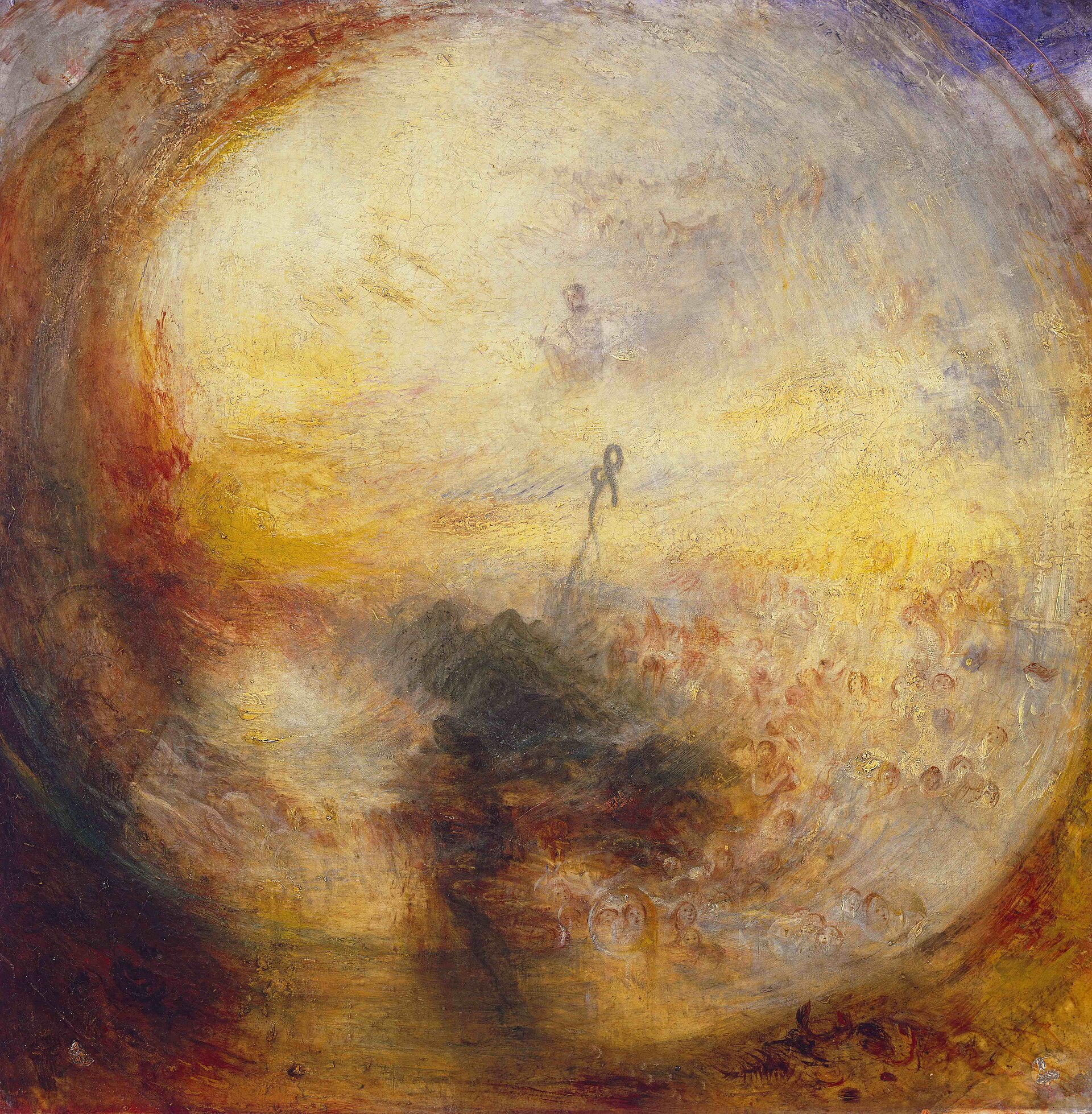
Art Note: J.M.W. Turner, Light and Colour (Goethe's Theory) — The Morning after the Deluge (1843). Painted with Goethe's Theory of Colours open on the easel — yellow, Turner believed, is the color nearest to light itself. Five Frenchmen would soon find the flood more interesting than the morning after. Collection of Tate, London. Accepted by the nation as part of the Turner Bequest, 1856.
