FOOLISH CLEVERNESS By Steve Davidson *** The Montréal Review, November 2026 |
|||
There’s no question that humans have far and away the highest-ranking cognition in the animal world. Chimpanzees? Dolphins? Parrots? Nolo contendere, baby. Where is the chimpanzee Eiffel Tower? Where is the dolphin nuclear submarine? Where is the parrot moon rocket? Cleverness, thy name is humanity. But it’s beginning to look like humans also are far and away the most foolish animal on the planet. Most animals adopt a very pragmatic philosophy of living, traditionally termed live-and-let-live. No wolf says, “Let’s go kill all the mountain lions”. No mountain lion says, “Let’s go kill all the wolves”. But humans say that kind of thing all the time. The non-human approach to life is something like this. Some identifiable territory contains food. The animal stakes out (marks) that territory, so it has control over its food supply, thus can survive, a primary objective. Other animals of the same species respect that claim. For the most part, they are not going to get in a fight, risking a fatal injury, over one piece of land, or one section of water, when they can just move on down the line and have their own territory. That may not be clever, in the sense of creating complex structures, but it’s certainly intelligent, in the sense of survival sagacity. However, it gets better. Every living system depends on a particular context for its survival. If that context radically degrades, it’s sayonara, children. No other animal is in the process of destroying the Earth, the essential basis of all our existences. No one has yet checked with the animals to get their take on our blithe destruction of the Earth, but presumably they would shake their heads, and say something like, “There you go… that is soooo human”.
The Solution to the Problem of Rank Madness
The classic Artificial Intelligence, by Patrick Henry Winston, makes it clear that intelligent behavior is shockingly straightforward. Pick up Block One; bring it over Block Two; put Block One down on Block Two; now there is a tower consisting of Block One resting on Block Two. Thereby, generalizing from essentials, life can be seen as a sequence of simple decisions, one after the other, arriving at an objective. Life, thus, is an accumulation of reasonable choices. The problem everyone faces in living intelligently is getting all enamored of clever constructions which then end up killing us. Tobacco is a good example. Time was when everyone smoked. Everywhere. Cigarette girls used to walk around restaurants and bars with a rack of smoking material in front of them, saying, “Cigars? Cigarettes?” It took a long time and a lot of data collection to determine convincingly that tobacco was a likely cause of cancer. Then it took a lot of legal work to substantially corral smoking. Similarly, many Americans, in visiting places like Finland and France, are impressed by the urban convenience of extensive trolley and train lines. They come home and wonder why America doesn’t have that same set up. (Although, Europeans come to America and are stunned by the power and efficiency of the interstate highway system, and wonder why Europe can’t be crisscrossed by huge highway connections, making everything accessible by car.) Well, the story (perhaps apocryphal) is that once upon a time in America Henry Ford made cars, and Harvey Firestone made automobile tires, and they saw all those brash trolleys and fast trains as a threat to their livelihoods. So, together, these giants of industry lobbied the government to prioritize highways and automobiles over trolleys and trains. Which happened. It took a long time for everyone to realize that mondo automobile use is, uncannily, associated with global warming. (And the slow dying off of the human species. As those snippy scientists have remarked, “The bugs are winning”.) An effective legal challenge to the forces of oil and gasoline appears to be, as yet, but a gleam in idealistic attorneys’ eyes. The solution to dealing with this Faustian bargain of human lethality traded for human ingenuity is simple, but, as usual, not easy. The trick is to perpetually ask, regarding options: Is this good for humanity? And, truly, is this good for me? It can take a while for the truth (aletheia) to arise, as the philosopher Heidegger pointed out, but if, eventually, the answer turns out to be no… then don’t do it. Ergo… time was when America decided that illegal drugs were a good idea. Bands like the Grateful Dead institutionalized drug use. The Harvard psychologist Timothy Leary recommended it. Rolling Stone magazine encouraged it. What’s not to like? Well, America, and the world, is in the throes of recognizing that those peremptory adult know-it-alls in the 1950’s were right… street drugs kill, and should be shunned. Hundreds of people die unnecessarily from drug deaths every day. As much as this fact may warm the hearts of Malthusians, it breaks the hearts of mothers and fathers, and children, everywhere.
The Tragedy of Addiction
The phenomenon of people getting hooked on various kinds of technology which are gloriously entrancing but which shoot people in the foot is fundamentally an issue of addiction. Now, addiction is a tragedy filthy with glamour, tripping, as it does, the light fantastic, so it’s a little hard to address pragmatically. However, familiarity with addiction cases suggests the following pattern. Parents are derailed from parenting by their own interests (and often their own addictions). Children feel neglected, and unloved, and, in fact, are missing out on necessary affection, information, and guidance. Eventually, they feel destroyed. As Carrie Fisher remarked, “Sometimes I feel like my life ended, and I’m still here”. But all is not lost. Children about 12 years of age discover drugs. Shazam! Life is good. They are not just happy, but powerful. The world is their oyster. They are king of the hill. Until the day arrives when the piper must be paid. In the individual case, the piper might be the police, or a judge, or an overdose. In society’s case, it might be fire or flood, destruction of habitat, and multiple deaths from drowning or burning. Technological genocide. Once in good recovery, ex-addicts, as they used to be called, are often flummoxed, and embarrassed. “How could I have thought that thing was so important, while my life was going up in smoke?” Their problem is that absent the addiction, they must face life on their own, and they are poorly equipped. They often feel overwhelmed. That’s where, not surprisingly, Stoicism comes in… a philosophy of shrewd coping and cheerful endurance.
The Stoical Mind Frame
Strictly speaking, the primary sources of Stoicism are ancient: Marcus Aurelius’s Meditations; Seneca’s How to Do the Right Thing: An Ancient Guide to Treating People Fairly; and Epictetus’s The Art of Living: The Classical Manual on Virtue, Happiness, and Effectiveness. But the philosophy of Stoicism can be seen as a broadly applicable approach to getting along with others, managing discomfort, and living well. The primary life pain, in the case of foolishly pursuing glittering technologies, is living happily without those exotic stimulations, which trigger all those self-destructive illusions of power and superiority. The challenge, of course, is to emotionally distance the self from the immediate industrial, technological stimuli. That amounts to (1) tamping down (suppressing) those arrogant, intoxicating emotional reactions, and distilling, for consideration, their good-bad essence; then (2) placing onto the situation a rational framework of facts, logic, and objectives.
Panic on the Mercantile Streets
Now, this stoical approach to temptation is not how merchants want the public to be interpreting potentially money-making situations. The whole mise en scène of merchandising is (1) create a product of riveting emotional appeal (which is not quite the same as saying that it is valuable to the purchasers); (2) crank up a hypnotic drumbeat of promotion idealizing the product, emphasizing the necessity of purchasing the product to ensure personal and social survival; then (3) collect the money; and (4) get rich; then (5) buy the big yacht. The merchants’ counterargument to sensible buying and living is that if the public doesn’t perpetually plunk down gazillions of dollars on a wide range of impulse items, the economy will collapse, and everyone will die. Not so. As the Finns have sagely pointed out, merchants hold on to socially destructive manufacturing and selling practices because it’s cheaper than adjusting in healthier directions. But if the public and the government stick to their guns, so to speak, the merchants, of necessity, will adjust. Then all will be well. (Or less bad, anyhow.)
Golden Mean Societies
Incongruous as it may seem, in the throes of a public hyper-kinetic consumerist illusion, some of the very best and most beloved of all societies are notable or their profound simplicity. For example: Greece. Sure, Athens has cars and big buildings. But Hellas has a deep allegiance to simple living. The picnic with the extended family under the olive trees. The handmade plaid tablecloth on the simple wooden table. The plain wooden chairs with the rush seats. The simple white crockery. Candles. A glass of local wine, a loaf of bread, fresh fish, and the sound of a distant bouzouki playing Theodorakis’s “Agapi Mou”. It doesn’t, in some ways, get any better. Japan. Sure, the Land of the Rising Sun is a technological powerhouse, but their angle on technology is to make it practical and reliable. That may partly stem from a longstanding tradition of design which is utterly simple (shibui) and natural (katsura). The Japanese have an inordinate love of nature, expending much time and money every year to visit the cherry blossoms in the spring, and the maple leaves in the fall. (They don’t do that in Beverly Hills.) Even Japanese classical music, played on the koto, is austere and elegant. Polynesia. Who doesn’t love Tahiti? Yes, the Polynesians have luxurious cruise ships and modern communications. But they show an abiding love for eternal, traditional simplicities. The ocean is the heart of Oceana… an adventure, a meal, a home. The luau under the banyan tree, looking out to sea. The healthy food incorporating chicken and fresh fruit, ginger and cinnamon. The drums and the rhythmic dancing. The endearing natural style of architecture, incorporating wood, palm leaves, woven grass, and open windows. The straightforward, welcoming warmth of the people. Paradise.
Putting It Together
So, the sum of the crisis is that technology has a tendency to advance well ahead of compassionate rationality and fair judgment. Then it starts killing us. There’s a simple reason it works that way. It’s like cars. There is more profit to be made manufacturing cheap dangerous cars than in manufacturing safe ones within the same price range. Every corporation, and every CEO, is under intense pressure from all sides to make a profit. Therefore, when push comes to shove, in the dark of the night, the decision often is made to place the profitability of the corporation above the possibility, or even certainty, that a product will end up damaging people, the plants, the animals, the fish, the sea, and the air (not to speak of humanity being in the process of adding the Moon and Mars as collateral damage in profit-seeking). Ergo, global warming, pumping toxins into the environment, bribing scientists to commit scientific perjury by publishing favorable pseudo-studies, suing problematic objectors, launching PR campaigns to smear honest people and canonize co-conspirators, sending death threats to journalists, academicians, and government officials, and all the rest. The primary counterweights to runaway (irresponsible) economics are government and the legal profession. The government is actually something of a help to business in its high-wire act balancing profit against public interest by leveling the playing field. For example, if some safety feature would be a good idea, but would cost extra, while not adding to the salability of a car, a manufacturer typically will not add that feature to a car. But if the government mandates that all manufacturers add the feature, then everyone can do it without loss of competitive position, without infringing on profitability, threatening corporate survival. Victims of corporate malfeasance can unite and take manufacturers to court. The legal profession thus can weigh in on behalf of the public, and the judicial system, hearing the facts vigorously presented, can arrive at fair decisions which address the needs of corporations, but which protect the public. That’s what happened with tobacco, though it was a long slog to an eventual victory. Humanity is just too clever by half, as well as too foolish by another half. What to do?
The Castalia Level of Society
The beloved Swiss writer, Hermann Hesse, reached the culmination of his life’s work in Magister Ludi, a story of celestial brilliance set in an ideal society called Castalia (the Castalian Springs being adjacent to the ancient Oracle at Delphi). Many individuals canonize people at what they conceive to be the upper, ethereal level of society… the poets, the philosophers, the saints, the seers, the Doctors of Letters, the heroes who resolutely raise the goodness of society above any possible personal material gain… those idealists who hold high the torches at the head of humanity’s queue which should be leading to greater sanity, and to a healthier world. Sometimes, we have a hard time dealing with a concept in the absence of a name. So, it might be useful to give that incandescent, even romantic, level of society a name… Castalia. With a name, aspiring idealists have a target to aim for, have a social hearth around which to gather, have a club to which they can invite others. Yale has its Skull and Bones, Harvard has its Hasty Pudding… why not a Castalia? The UK has its Booker Prize, the US has its Pulitzer Prize… why not a Castalia Prize? The West has its NATO, the world has its UN… why not a Castalia? A straightforward configuration of like-minded individuals, seeking a simpler world based on love and respect, employing cleverness in the service of wisdom. Is that so hard? A new aircraft carrier costs more than 100 billion dollars. Surely, if that much money can be found for war, the capstone of clever human folly, a commensurate amount can be found for peace, the summum bonum of every major religion. Go in peace, and in wisdom.
Into the Woods
“I went to the woods because I wished to live deliberately, -Henry David Thoreau
|

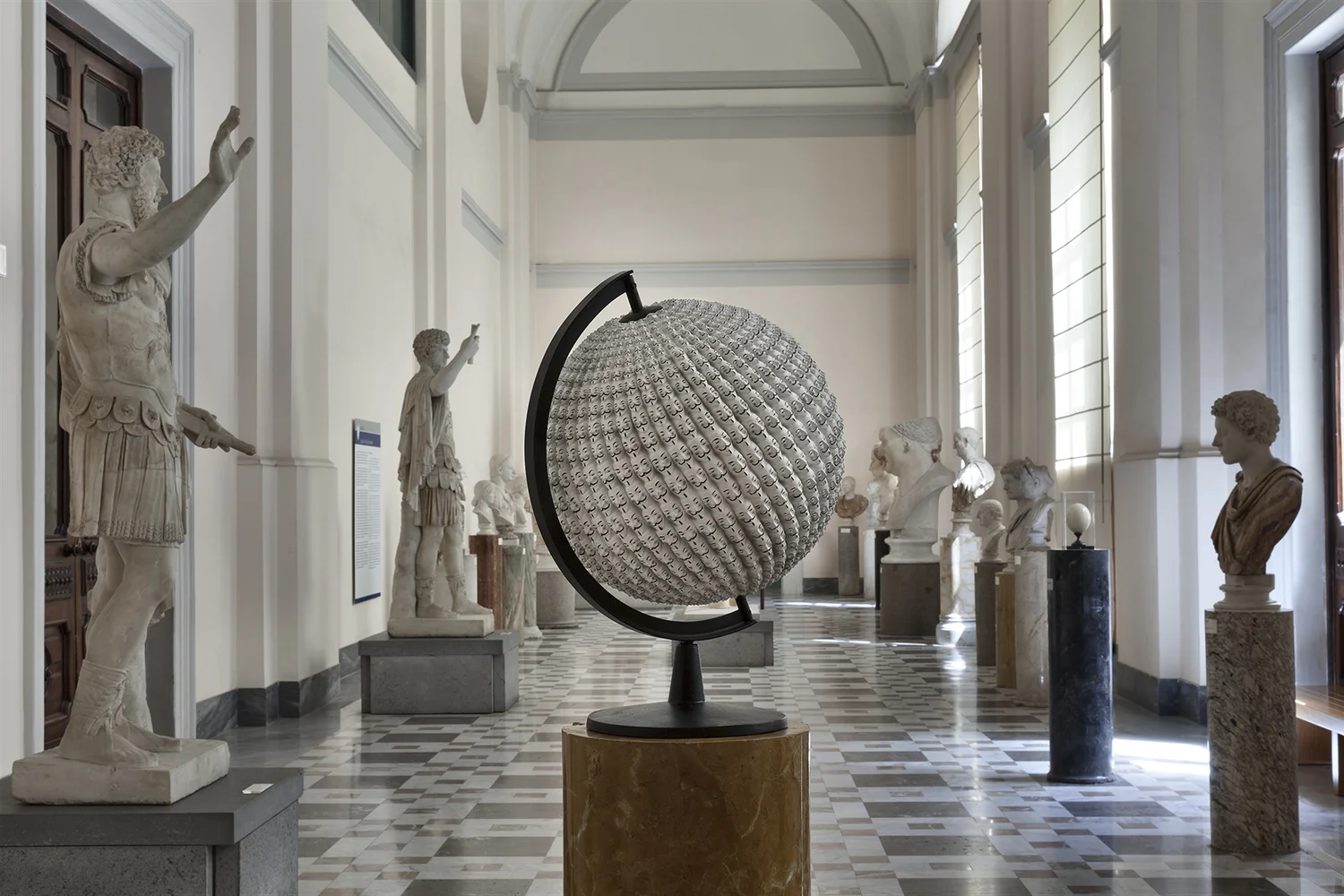
Art Note: Adrian Tranquilli, After the West (2016), installation view at the National Archaeological Museum of Naples, a city the Greeks founded. The planet, rebuilt from one borrowed face: a world in which no one signs the work, set among empires turned to marble, and somewhere near the spring. Artwork © Adrian Tranquilli; photograph © Claudio Abate / Archivio Claudio Abate.

