SIX LITTLE SONGS By Alfred Nicol *** The Montréal Review, November 2026 |
|||
LISTEN
NOTES FOR "SIX LITTLE SONGS" TO GO WITH "SIX MOMENTS MUSICAUX" 
—Geörgy Kurtág Geörgy Kurtág's music is difficult; and these poems that I've written to go with his "Six Moments Musicaux" don't attempt to make it any easier. The poems too are enigmatic: they are six enigmas to pair with Kurtág's six. They too will make demands on the listeners' attention—but my poems share a whole lot more with his "moments musicaux" than surface difficulty. Kurtág's first piece, "Invocatio," sets the tone for those that follow. An invocation is the act of calling upon a deity for help. The great epic poems all begin with invocations: The Iliad with "Sing, goddess, Achilles' rage…;" the Odyssey with "Sing in me, Muse, and through me tell the story." Virgil writes a dozen lines on his own before asking for help: "Muse, tell me / the cause why Juno the queen of heaven was so / Aggrieved…" The English poet John Milton includes three invocations in Paradise Lost, at the beginning of the first book, the third, and the seventh, but he doesn't trust the ancient muses with his big project. While he makes reference to the muses invoked by Homer and Virgil, he takes pains to Christianize them. At the beginning of book three he calls his muse by this name: "Hail holy Light, offspring of Heaven's first-born," adding "since God is Light." He acknowledges his sources but insists that, while following their lead, he's doing something different. A contemporary poet or composer who writes an invocation is trying to bridge a gap at least as great as the one between Milton's Christian God and Virgil's pagan muse. First, he can't be confident that his audience recognizes any kind of deity at all. Secondly, even if he were a person of faith himself, he would find it hard to justify asking God to give him a hand with the poem he's writing. If there exists a Creator with an interest in the world we live in, He's probably got his hands full at the moment. To the contemporary ear, an invocation will sound archaic; it will seem either absurd or pathetic; at best it will go unnoticed, like a baseball player using his bat to draw a cross in the batter's box before stepping in. But Kurtág doesn't intend that any sound or silence in his work go unnoticed. His invocation is purpose-full to bursting. He means to acknowledge his debt to the great composers of the past, especially Bach, while insisting on a new and very different idiom for a very different time. Beyond that, he strives to find a way to make the invocation itself meaningful, as invocation, not merely as a way of referencing the past. This entire work, all six moments musicaux, works toward that goal. Kurtág's way of acknowledging the inspiration he has taken from other composers is to integrate their voices with his own. One of the moments is written "in Janácek's manner;" another is written "in memoriam György Sebok." A third moment is clearly written in the manner of Olivier Messiaen, and yet another one shares its title with a play by Samuel Beckett. To whom is Kurtág's "Invocatio" addressed? To all of these predecessors, teachers, and friends —his fellow creators. This is not to dismiss the idea of one Creator as irrelevant; it's simply a kind of spiritual realism; he asks for help from those on whom he knows he can rely, because they've already been of great help to him, and continue to be, even having left this physical world. I've taken Kurtág's example in writing my poems. Because his work comprises six short pieces of music, I've chosen the sonnet —literally, "little song"—as my form. There is another reason for my choice: the sonnet is so central to the tradition of poetry in English—from Shakespeare to my dear friend Rhina Espaillat—that I feel confident in using it as a symbol of the tradition itself. By way of synecdoche, the sonnet stands for tradition. However, if I write in the spirit of Kurtág, I can't simply use the form as it was given to me. Kurtag's gratitude for the gift of tradition issues its own directive: shape and re-shape that gift to make something meaningful in the here and now. – I've also taken Kurtág's example in choosing to write my sonnets "in the manner of" my friends and other poets I admire. It's their example that suggests ways of re-shaping the sonnet to my purpose here. Only one of my sonnets strictly follows the rules of a Shakespearean sonnet. The first—my own "Invocation"—scrambles the rhyme-scheme of the first three stanzas, replacing the standard abab cdcd efef with this pattern: abcd adbc dacb. The stanzas don't rhyme with themselves; they only rhyme with the other stanzas. The rhyme, however, is complete: the same four rhyme-sounds occur in each of the stanzas. The stanzas depend on each other that way. The first stanza tries to dismiss the idea of invocation as pathetic, but right away, the speaker—the "I" of the poem [1]— has to admit that it's an enduring part of literary tradition. What's more, in quoting Milton, he taps into some very powerful stuff. The second stanza doubles down, insisting that it's cheating to invoke the aid of a deity, citing two demeaning examples: the use of AI, and dependence on Mom to do your homework for you. In the third stanza, the speaker reasons that his particular invocation is different from those he's been mocking—though no less abject. He resorts to writing "in the manner of" Milton, using his elevated language to beg, "Advise me, fix what's flawed…" We don't yet know to whom he's speaking, however, only that this "plea" is "entered in the highest court." The unconventional rhyme-scheme leaves the closing couplet on its own, as the one place in the poem where the rhyme is immediately recognized. I want those two lines to strike the ear like a cry for help. An invocation, after all, is precisely that — a call for help. As it turns out, the speaker is sending his plea up to Heaven, not unlike Milton. The difference is that he's not asking for help in writing a poem. That would be pathetic; he's already said as much. He's asking for something different: "remind me how to pray." It would not be presumptuous to ask for that kind of help. That's not asking mother for help with your homework; that's pleading with Father, "Show me how to talk with you." - Kurtág gave his second piece the name "Footfalls," which is the title of a play by Samuel Beckett, a lifelong influence on his work. In the play, we see a woman pacing heavily between two doors, one of them slightly open. The sound of her heels touching the ground is distinctly audible, almost hammer-like. A voice comes from offstage: "There is no sleep so deep I could not hear you there." The woman onstage takes precisely nine steps, then "wheels" and takes nine steps in the opposite direction. That action continues throughout most of the play. There are echoes of Beckett's minimalist play in Kurtág's brief composition. About 50 seconds in, the instruments subside and we hear the sound of one footstep. I brought that sense of someone "putting her foot down" —making a decision—into my poem, titled "Standstill." I also carried forward the ghostly sense of becoming conscious of one's own invisibility, which is palpable both in Beckett's play and in Kurtág's piece. The poem's Latin epigraph translates as "To be is to be perceived." The form of this sonnet splices together a Shakespearean octet and a Petrarchan sestet. In keeping with Beckett's minimalist aesthetic, I've added a stricture that neither form requires. In fact, it runs contrary to the practice of writing poems in general. I've tried not to use any images —tangible things, things perceived by the five senses. There's mention of "wheeling the carriage" in the third line, but even that might only be a figure of speech. The narrative takes place in a "grey November," but that's merely an indication of time with the most colorless of colors attached. The Latin epigraph translates as "To be is to be perceived." - Kurtág's third piece is titled Capriccio. Mine too. It's a cat poem, a moment of lightness, set in the first light of morning. It's a "Berman Sonnet," a form invented by my dear friend, David Berman (1934-2017), a gifted poet who studied with Robert Lowell and Archibald MacLeish while a law student at Harvard and went on to argue cases before the Supreme Court. He loved his own cat with all of his great heart. I think David was still mourning the loss of that cat right up to the moment when we began mourning David. But the cat in my poem is very much alive and well. - The fourth poem in my Kurtág Project, "Homage to Harry T. Schultz," is the only one that faithfully follows the pattern of an Elizabethan sonnet, because it is written in memory of an English professor I deeply admired, who showed me great kindness. Kurtág's piece, In memoriam Sebök György, eulogizes a friend and fellow composer with whom—and from whom—he'd learned a lot about their shared art. There is difficult emotion in his music; there is loss and something else uneasy in it, a regret, as though something important has been left unsaid. That is how it is with me, too. I cannot simply look back in admiration at this wonderful man who opened a great library door to me— who introduced me to my literary ancestors!— because I never thanked him. In the years after graduating from college, I felt embarrassed at having done so little with his gift that I couldn't acknowledge it, until it was too late. That's what I think I hear in Kurtág's piece: the burden of unexpressed gratitude. - In his fifth piece, "Rappel des oiseaux: étude pour les harmoniques," I think that, once again, Kurtág is writing "in the manner of" a composer he admires. He does not feel the need to mention Olivier Messaien by name, because the connection is so obvious. If Kurtág, once a student of Messaien, is not actually quoting his old professor, both composers are drawing from the same source —the birds of the air, an inspiration because of their actual, physical making of song, but also because of what they represent in terms of the spirit. The title of this piece, "Rappel des oiseaux," would probably be translated "Bird Calls," or "The Call of the Birds," but it could also be translated, "the calling back" of the birds—as when a tamed bird is called back to its master's hand. I preferred that interpretation, envisioning a "flock of flocks" heeding the call of their Maker. I can easily imagine Messaien, a devout Christian, sharing that vision. Is it wrong of me to attribute the same vision to Kurtág, a skeptic? I'm not one to make things up out of whole cloth; I would swear that I only wrote what I "heard" in his music, but that question worried me. That's when I found the quotation placed at the beginning of this essay, where Kurtág says, "if I look at Bach, I cannot be an atheist. Then I have to accept the way he believed." Somewhere else —I think in the same interview — he said that one must approach Bach's music and his faith "with humble regard." It struck me that he would not approach Messaien's work any differently. And sure enough, I discovered another composition by Kurtág, titled "Humble Regard Sur Olivier Messaien." Kurtág's humility is like a superpower. It allows him to enter entirely into the spirit of another. Let's go back to that quote. He asks, "How can I get closer [to Bach] if I look at him from the outside?" Well, what other option has he got? He's got the option his superpower gives him. When he looks at Bach, it's not Bach over here and Kurtág over there, looking at him. Kurtág's humility is such that he effaces himself, erases himself, entering so entirely into the spirit of the other person that he himself is no longer there. Messiaen titled one of his works "L'apparition de l'église éternelle." It is a work for organ—certainly not an imitation of birdsong — for which he wrote a poem of his own, describing in words the vision the music was meant to evoke: the apparition of a church made of "living stone." Each of its building stones is the soul of one of "the chosen." As wild as that sounds, it's right in line with Catholic teaching. Because the Church is not its buildings but its members, we can think of l'église éternelle along the lines of Edmund Burke's "community of souls, joining the dead, the living, and the as-yet unborn," which is probably a version of "the communion of saints" in The Apostles' Creed. I plucked that phrase from Messiaen's title and replanted it in the closing line of my poem, titled "The Birds are Called." This one is written in the manner of my friend, A. M. Juster, from whom I've borrowed its hybrid form: a sonnet written in Anglo-Saxon alliterative verse. The Old English meter, with a caesura cutting every line in half, is perfect for making lists, and that is what I set out to do. It should read like a role-call of birds flying in from the four corners of the earth. Think of it as the list compiled by a watcher of the skies on an evening near the end of time. - The poem I wrote to go with "Les adieux [in Janáčeks Manier]," Kurtág's final piece, is set in an actual church, only because I couldn't resist juxtaposing the most down-to-earth, ordinary small parish church with the otherworldly église éternelle. It could as easily have been set in a recital hall, or a town meeting hall, or any place where people come together, from which they leave when the program ends. This is a farewell piece. Of course, when a man as old as Kurtág writes a farewell piece, it's not a simple goodbye. It's not "I'll see you later." It's like the epilogue in Shakespeare's The Tempest. The church in my poem's title, "L'Église Saint-Quotidien Lets Out," will seem, at first glance, to be named for an obscure saint, but I mean for it to be translated, "Church of the Blessed Everyday." When that church lets out, we say goodbye for good. I've peopled this church with my weekly neighbors in the pews at St. Anne's in West Newbury, Massachusetts, but I've given them names that sound French-Canadien, so they might as easily be people I sat near as a child. The form of this last sonnet was handed down to me from Robert Frost. The form is a cross between Dante's terza rima and the sonnet. Frost used it in his poem, "Acquainted with the Night." —Alfred Nicol, September 23, 2025
|

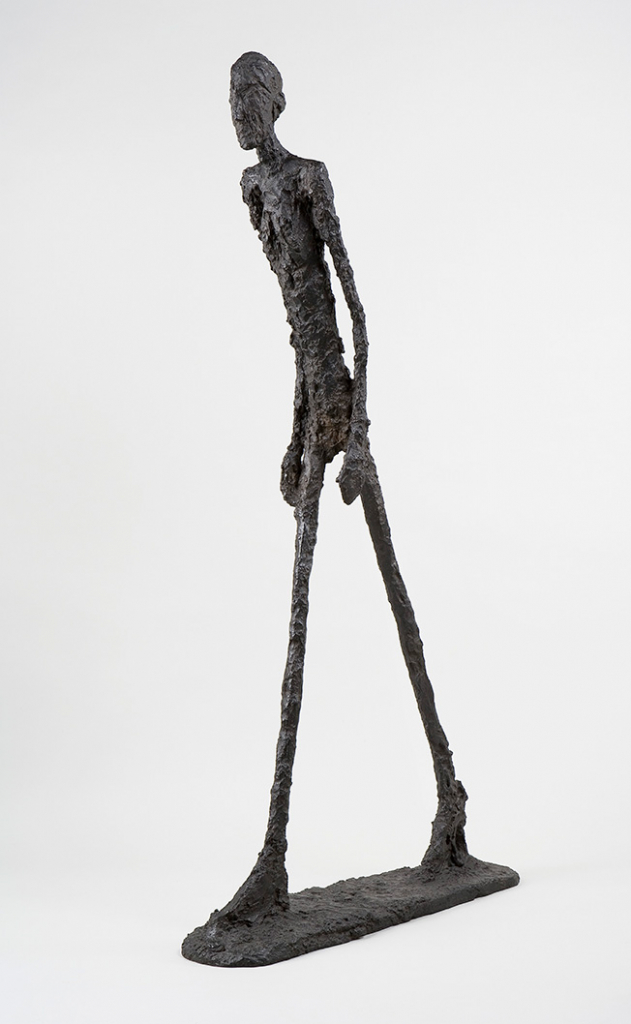
Art Note: Walking Man I (Homme qui marche I), Alberto Giacometti, 1960. The figure came to Giacometti as he watched a friend grow smaller with distance, her presence undiminished: the instant when a person begins to dissolve but has not yet vanished. Each step lands nowhere. The man who designed the tree for Beckett's Godot knew the sound of a footfall. Bronze. Image via Guggenheim Museum Bilbao. © Succession Alberto Giacometti (Fondation Giacometti, Paris + ADAGP, Paris).
