Max Weber (1864-1920)
Max Weber (1864-1920)
REMEMBERING MAX WEBER By Haim Marantz *** The Montréal Review, October 2025 |
|||
In his well-known essay on Tolstoy the late Isaiah Berlin famously distinguished between two types of thinkers whom he labeled hedgehogs and foxes. A thinker whom is a hedgehog tends to explain things by relating them to single central vision and/or idea. A foxlike thinker, on the other hand, tends to explain things one at a time without trying to show that they form part of a single system. Most of the famous social and political thinkers who have achieved some popularity, Berlin suggests, have tended to be hedgehogs. Underlying their work, which might otherwise be considered far-reaching and diverse, is a set of basic notions or ideas that they use creatively to shed light on the nature of the social world and the place of the individual within it. This set of basic notions I shall from now on refer to as an “artifice”. It is my contention that often the invention of new artifices, often is the basis of its inventor’s fame in the humanities, as well as in the social and political theory. During the twentieth century two of the most influential artifices were the Freudian interpretation of culture as a function of unconscious instinct-based forces and Marx’s doctrine of historical materialism. I shall begin by saying something briefly about the conceptual nature of artifices. They can be conceived as universal positions, more or less complex, of the form “All Xs are Ys”, e.g., “All manifestations of culture are determined by the political-economic complex of social power relations”, or “All types of individual human behavior are responses to largely unconscious vicissitudes of instincts”. The difficulties, which one encounters in trying to establish the empirical tenability of such propositions, are notorious and it would be tedious to repeat once more the Popperian litany about them, which is, in any case, well-known. If conceived as purely empirical proposition, that is, as unambiguously verifiable and/or falsifiable, artifices do not make the grade. Yet, it is difficult to deny that, despite their dubious status, if conceived as something like empirical propositions, artifices are important in at least two quite different ways: (1) as general pragmatic injunctions concerning the general orientation of research in humanities as well as in the sciences of human behavior; and (2) as basic constituents of social and/or political, and/or religious, and/or aesthetic ideologies. Their influence on the development of social and psychological science is due to their function under (1). Once the notion that artifices must be reducible to testable empirical propositions of the form “X is Y” in order to have any empirical relevance whatsoever, it is possible to relate to them as pragmatic rules of injunctions that identify certain concepts the researcher is employing in his and/or her research. Following such reductions, artifices are often expressed as rules like “Whenever confronted with a manifestation of human culture, try to relate it functionally as one dependent variable to the various independent variables that tend to make up the politico-economic complex of power relationships”. Once re-defined in this manner, the peculiar empirical “force” of many artifices on one hand, as well as their logically necessary resistance to empirical falsification on the other hand, tend to become immediately apparent, and so cease to appear contradictory. By stating and/or implying that empirical research should travel a certain avenue, each artifice relates itself to its empirical subject matter. This amounts to a recommendation that certain concepts be employed and/or related to in a certain way only, because someone decided that it is their general intellectual policy. If conceived only as a pragmatic function, the artifice will not necessarily lose its empirical relevance, even if it fails to “pay off” in one or more particular research instances. The pragmatic injunction of historical materialism will therefore not necessarily be “falsified” merely by not working in a restricted number of instances. To determine its “range of fertility”, each artifice is itself merely another empirical research problem to be solved in ambulando. Yet, I would be gilding the lily, if I suggested that what I have identified as artifices can function only as pragmatic injunctions or that it is the only feature to which they each owe their fame. In fact of course, artifices have often owed their popularity to their bogus standing as “eternal truths”. The ideological devotee of a particular social theory often regards its artifice as the key to understanding the universe. An individual may delude himself and/or herself into possessing such a key by treating artifices as universal propositions and by safeguarding them against falsification. The devices used to prevent falsification of eternal truths include systematic ambiguity of meaning, in-built conceptual contradiction and empirical triviality. It is in this manner that Freudian theory has often been and still is sometimes transformed into an ultimate truth about human existence and that historical materialism was sometimes elevated to the status of a definitive “super science” of history. The ambiguous logical status of artifices — as pragmatic injunctions and/or as universal propositions — explains why it is that what appears to be in one sense little more than a system of delusional ideology, while in another sense their use does often yield interesting and fruitful research programmes. My central thesis in this essay is that the most striking feature of the sociological work of Max Weber is that it lacks an artifice. To put it another way, Weber’s basic outlook cannot be characterized in only one sentence. To characterize Weber outlook very many sentences would be necessary. Thus, Weber is the man who not only identified how and why Capitalism and Protestantism are correlated; he also identified significant relations between economic organizations and music. He wrote an enormous amount on the social and economic significance of religions. He also wrote a lot about various philosophical and methodological problems connected with social research. He developed the notion of an “ideal type” as a research device in the social science. The list could be continued for some considerable length. Yet, if we consider all of Weber’s achievements, we shall not find that they exemplify the development of one central vision or one central idea, that is, one central artifice. But it is my contention that there is nothing in Weber’s work, which could be identified as the comprehensive redemptive key to his intellectual outlook. In Weber’s work what one finds is a plurality both of intellectual methods and of artifices. This, then, is the first important fact about Max Weber’s sociological work: methodological and pragmatic pluralism in conjunction with a complete absence of potentially chiliastic pronouncements. There often is tremendous passion expressed in Weber’s writing — it is not the usual examples of dry academic writing — yet it is guided by an explicit plea for unconditional sobriety. Weber’s zeal is related to that of the ideologues as the passionate commitments of the devoted psychiatrist to the passionate ravings of his demented clients. Weber’s work is the product of an empirically informed, diversely gifted, tough and brilliant mind of absolute integrity, searching for the truth in an intense self-conscious manner: Weber’s analysis of the relation between value judgments, which cannot be empirically true or false and the activities of social scientists are among his most important contributions to sociological knowledge. The absence of a single central artifice, as well as the enormous scope of Weber’s work, renders it impossible to give a short yet comprehensive “summary outline” of his overall significance as a sociological thinker without neglecting crucial parts of his intellectual output. What follows is, therefore, a sketch of three fragments of his work, selected merely because at present they each happens to interest me:
Like many of his contemporary neo-Kantian thinkers, such as Dilthey and Simmel, who were active in Germany at the beginning of the twentieth century, Weber held that the process by which knowledge is gained in the social or 'cultural' sciences differs from that in the natural sciences in certain fundamental ways. The cultural sciences are centrally concerned with human action. Human actions cannot be understood as human actions without the researcher first arriving at some empathic feeling, in some way, of the underlying motives of the actor who, in turn, must also be conceived of as capable of possessing some such understanding of himself and/or of herself. For Weber, all the different cultural sciences are concerned with “value-orientated” and “value-relevant” behavior within their specific historical context of specific value-based human cultures. The cultural sciences are not primarily concerned with organisms but with self-conscious persons. To try to reduce the study of culture to a “science of behavior”, to a doctrine of pricks inflicted on organisms and their resultant motor twitches, in the sense of some social variation of the stimulus-response psychology, like those of Watson, Skinner and Hull, would, in Weber’s view, reduce it to tedious triviality. Consider a nod. In one cultural context it means “approval”, in another it may convey an insult or express disapproval. It may be emitted to encourage and/or to mislead. If we consider it merely as a motor response, it is unintelligible as a human act. Any specific nod acquires its particular meaning and/or significance only when it is related to a system of values of interacting human persons. Weber insists that students of human behavior are necessarily concerned with “value-oriented” behavior and not with mere motor-like responses. But he is equally emphatic that social science investigators must also consciously attempt to proceed in a “value-neutral” manner. That is, they must not, as social scientists, allow their own personal moral, political, religious and aesthetic values to distort their factual judgments. They may defend or proclaim a moral and/or political, and/or aesthetic, and/or religious position. But, if they do so, they should state quite explicitly that they do so. But, when they do so, they do so not as social scientists, but as ordinary individual persons. (Crudely but, I believe, accordantly Weber believes that academic researchers should behave, in a way like inverse Catholic bishops, never making ex-cathedral pronouncements of faith and morals.) Weber’s position may be characterized, in the jargon of “analytic” philosophers, as one which permits and even requires the mention of value-concepts, yet bans their use in scientific transactions.
Raymond Cazelles et Johannes Rathofer (préf. Umberto Eco), Les Très Riches Heures du Duc de Berry (Detail focusing on the winged serpent flying over the Château de Lusignan)
Weber’s famous Protestant ethic thesis is a good example of his method, illuminating both his stress on the need for concentration on the “value-oriented” aspects of behavior, as well as his stress on empirical research. If Weber’s thesis consisted merely in asserting that Protestant religious zeal and development of modern capitalist society are correlated, nothing very striking would have been achieved. (As a matter of fact, the purely empirical correlation between the two variables, Protestantism and Capitalism, some historians have argued, is not as universally valid, as Weber argued it was.) Yet, Weber went much further than this: he made the correlation between the two cultural variables — Protestantism and capitalism — intelligible by showing how the forma mentis of the grace — that the seeking by individual Protestant aspirant for sainthood “clicks in” with the mentality of the ascetic, abstemious, but also with detached and yet simultaneously operationally involved economic entrepreneur. Weber’s thesis owes its fame to the fact that the correlation of the two cultural factors can often be made intelligible by a test of intuitive understanding of motives and values of typical social actors. In developing the thesis Weber proceeded not by the way of pure psychological fantasy or intuition, but by empirically drawing on evidence from sermons, prayer books, memoirs, statistics and other documents. The set of intellectual operators exemplified in Weber’s “Protestant Ethic” — correlation of empirical social data combined with and act of intuitive understanding — the academic scholar “feels himself and/or herself into” the state of mind of the “typical social actors” — was used by Weber in a variety of diverse fields, ranging from the study of modern bureaucracy to his inquiries into the nature and function of prophecy in Biblical Israel. This method constituted a powerful tool for the study of religious institutions. Far from violating the norms of empiricism, Weber’s method is much closer to it than the self-conscious “empiricist” positivistic philosophies of science. Insofar as Weber appears to adhere a methodological principle, it seems to say: collect interesting data and enlarge your knowledge and understanding of human society — and damn the ontological consequences and restrictive metaphysical postulates of physicalist positivism. Weber’s objective was that of nearly every working social and psychological investigator: to enlarge human knowledge and understanding, and not to “satisfy ontological requirements” (be it of materialism, empiricism or any other “ism”.) Weber's conception of "ideal types" is related to his polemic with historical materialism, of which he was a sympathetic critic. It is a notion, which is not easy to analyze, since Weber’s chosen interests were overwhelmingly factual and historical, and he often displayed less fastidiousness when dealing with complex logical and epistemological problems, even when they were of fundamental importance. His concept of ideal types amount to roughly this: the social scientist is not and cannot be interested in the “totality” of the human person or of a human culture, since both the number of possible variables is infinite and also because his and/or her individual research is directed to answering specific restricted questions. Thus, the academic economist is interested in the transactions people make as buyers, sellers, producers and so on, and not in other aspects of their personalities, for instance, in their religious and sexual behavior, unless these aspects can be shown to be causally significant to the economic lives of the specific actors, whose specific lives they are trying to further understand. Economic and other social institutions were conceived by Weber to be comprised of specific sets of standardized transactions between schematized idealized social actors and not real-life actors — Calvinist seekers of divine grace, protestant entrepreneurs, charismatic leaders, status groups, social classes, churches, sects, etc. “Ideal typical” social organization can be conceived as schematized transactions between schematized sociological dummies. They are models or constructs highlighting specific social relationships singled out on the basis of their value-relevance, either in relation to the values of the different individual social actors or in relation to the values of investigator himself and/or herself and his and/or her own social milieu and, sometimes, in relation to the values of both. Weber does not prescribe the use of ideal types in social science practice. He conceives of the ideal type as a piece of descriptive rather than prescriptive metaphysics of social science. Historical materialism is for him but one ideal typical representation of the development of society and, while often enlightening, is not always so. It should be noted that Weber’s notion of “ideal types” may be used to interpret one important function of artifices, that is, those specific social theories that are based on artifices can be conceived of as functioning something like ideal typical models of social organization. In this sense, the ideal typical theory of, say, historical materialism could be viewed as a model exemplifying a pragmatic function. The injunction is as follows: always search for the basis of culture in the economic and political complex of power relationships. This injunction is exemplified by an "ideal typical" model of non-existing society, in which all relationships are constructed from, or are functionally dependent upon, different relations that are identifiable in actual economic-political power complexes. Weber’s central criticism of historical materialism is based on the charge that the supporters of historical materialism often confuse an “ideal type” with social reality, which led them to assert that they have discovered the ultimate cause of history. He does not blame Marxists for using an “ideal type” but rather for misconstruing its function in scientific explanation. It should be noted that Weber’s notion of “ideal types”, when applied to what I have identified as artifices, precludes their interpretation as universal empirical propositions and it is, therefore, also a safeguard against any chiliastic misuse of humdrum formula, which is also inter alia an explicit disavowal of the possibility that a social scientist can discover a master-key to the human destiny. There are important respects, in which “ideal typical” theories of social organization approximate hypothetico-deductive theories in natural sciences, and one is tempted to equate the two. Theories in natural sciences initially use empirical concepts with an open texture, which are restricted by arbitrary definitions. The analogy that suggests itself is that between the “body” of common linguistic usage on the one hand and the “ideal typical” social actor and the “real person” on the other. The frame of reference of hypothetico-deductive theories is restricted (e.g., to macroscopic properties, conditioned reflex, inheritable properties) and so is the range of “ideal types” (e.g., to political power, economic transaction, etc.). It is generally recognized that the properties and magnitudes deduced within a specific theoretical context will never completely correspond to results of measurement or accurate observation: there will always be a “margin of error”. Analogously, there is no existing social actor or existing social organization that is ever completely “typical”. The deviation of real from “ideal typical” behavior can be conceived, in the language of natural science, methodologically as a margin of error, the effect of unknown factors and uncontrolled variable. Yet, there is at least one important aspect, in which “ideal types” differ from scientific theories. The later rest upon an empirical base of observable data. “Ideal typical” concepts are often, though not always, of human persons and human transactions, which often can only be understood by introspection empathy and/or by intuitive grasp of significant human’s situations. This type of understanding is not simply of the visible behavior, that is, the physical and observable movements of human bodies, but of human actions, of what different individual humans are doing in various situations, when they move their bodies, i.e., what is he doing when he is nodding his head. Unlike hypothetical constructs in behavior theories, “ideal types” are not, as Watson, Skinner and Hull believed, logical constructs erected on a foundation of measurable motor responses. Weber’s analysis of modern political processes is given in terms of his basic “ideal typical” concepts of action, power, status groups, classes, interests and domination. Action may either be irrational (for instance, a response induced by emotion) or an almost reflex-like response to the requirements of tradition. It may also be rational, based on means-ends calculations. Modern industrializing bureaucratic states are characterized by a preponderance of rational, calculated “scientific” behavior, transacted in the most effective, scientific-like, way through bureaucratic administrative machines. The latter are regarded by Weber as the most efficient means of large-scale social action. They stand to other, pre-bureaucratic, forms of social organization as modern machine production stand to simpler forms of handcraft. Bureaucracies existed in pre-industrial societies. Weber held that, while bureaucratic modes of domination are possible in pre-industrial societies, they are necessary in industrial ones. Modern bureaucratic political structures are characterized by impersonal, highly standardized, formal (and so “cold”) modes of domination, as against the personal, informal (and so “warm”) relations that characterize human social relations in traditional feudal or patrimonial societies. The “normal” history of bureaucratic structures is occasionally punctuated and directed by powerful demagogues claiming a mission, whose psychological appeal is sometimess based on the appearance of some kind of what Christians call a “gift of grace” (charismatic leaders). Different groups of bureaucrats possess their own status, as well as their own conceptions of honor and propriety. Weber analyzed brilliantly the interaction between groups of bureaucrats and politicians. Different groups of politicians are identified by the different interests they each promote and defend. It is important to realize that the term “interests”, as used by Weber, does not refer exclusively or ultimately only to material and economic interest. For Webre, any institutional commitment generates an interest sui generis, which does not reduce to, or is derivable from, economic interest in the Marxist sense. Thus, an individual person, who accepts the Catholic faith and the Catholic doctrine of the sacraments, has ipso facto an interest in the maintenance of the Catholic Church. There is no necessity to look for hypothetical “real” interest hidden behind the “superstructure” of the prima facie religious commitment. An interest, for Weber, is a disposition to protect and defend by political and other action some institutional or social arrangements that may, or may not, have “spiritual” or “material” roots. Hence, Weber’s suggestion is that, instead of attempting to reduce one interest to another, social scientists should always try establish empirically — historically — how the different institutional commitments have each been generated.
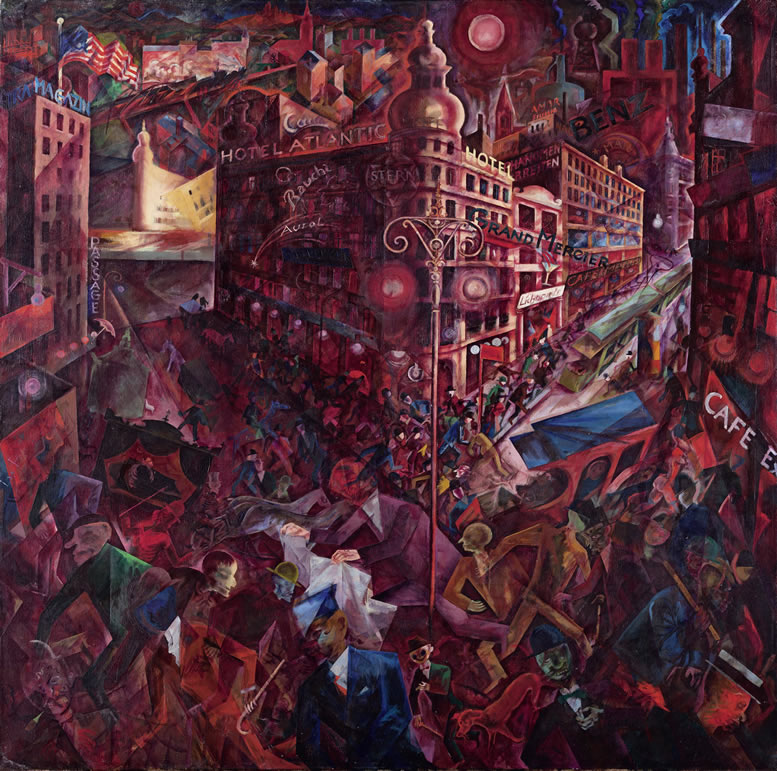
Metropolis (1916 - 1917) by George Grosz © Estate of Georg Grosz, Princeton, New Jersey / VEGAP. Museo Nacional Thyssen-Bornemisza, Madrid
Weber died in 1920. The modern industrial bureaucratic society, based on contractual, rational and impersonal relationships, and administered bureaucratically, with politicians vying for power to defend manifold “interests” was a reality in his day. Weber believed that “disenchantment”, rationalization and contractualization of society are inevitable, since they correspond to the development of common practices observable in all forms of human conduct. Yet, unlike some other social theorists, who are committed to a doctrine of “progress”, Weber himself did not express any explicit enthusiasm for this “growth of reason”. Many Weber scholars have identified expressions of overtones of romantic regret implicitly expressed in his writings for the passing of “warm” traditionalist society, even though these regrets appear to have no effect on the general tone of his scholarly writings and also on his explicitly expressed political attitudes. In his celebrated essay Politics as a Vocation Weber discussed in a terse and penetrating manner the relation between politics and morality, and he spoke in it quite frankly as an individual, who himself was committed to specific moral and social norms. He distinguished between an “ethic of absolute ends” and an “ethic of responsibility”. The terminology which he used is, in my humble view, rather clumsy and, as it stands, his thesis can be easily savaged by any competent second year philosophy student. Nevertheless, the thesis, which he does explicitly argue for is at once interesting and important. Weber argued that the Christian ethic, exemplified for him by the Sermon on the Mount, requires the absolute acceptance of certain standards of conduct on the part of every sincere individual Christian believer, irrespective of social consequences. Acts satisfying Christian norms are viewed by each sincere Christian as intrinsically good and those violating these norms as intrinsically evil. They cannot be judged on the ground of any secular teleology. The Christian ethic, as Weber viewed it, is deontological. The politician, on the other hand, undertakes to defend certain specific interests — those of a specific class, group or nation — in the here and now. However, in some cultural contexts the politician will be, in one way or another, also find himself and/or herself influenced by deontological Christian morality. A situation may therefore arise, and it does indeed frequently arise, in which a particular politicians’ responsible commitments to social goals will conflict with the requirements of his and/or her Christian ethics, which, in Weber’s view, amount to the renunciation and total abstinence from the use of force for the pursuit of political purposes. In posing the “Dilemma” Weber says nothing new — but his “solution” was original. For Weber, the dilemma, although real, is insoluble. That is to say that any individual caught in it must choose before he or she acts. And yet, he and/or she cannot choose once and for all people and/or all occasions on principle, as it were, but only from case to case, because, strictly speaking, there is no one internally consistent principle. Weber holds that all individuals in our modern industrial cultural societies pay homage to “many gods”, that is, in fact a culturally integrated amalgam of incompatible, logically non-integrated norms and moral doctrines. The internal plural organization of Catholic Church reflects this to some extent and makes allowances for it by its complex system of internal specialization — unworldly mystics, through Christian knights and warriors, worldly clerics — all possessing their own institutional niches, which have been adapted to allow individual Catholics to give expression to their own special skills, which give a peculiar sociological twist or favor to their own specific Catholic sub-cultures. Weber explicitly disavowed the possibility that the “means-ends” problem in politics can be “solved”. It has to be tackled “existentially from case to case by each conscious social actor absorbing the pressures of his and/or her culturally united yet morally incompatible demands. Any politician, who accepts the Sermon on the Mount as a moral doctrine, which can under no circumstances be violated, will in certain situations be forced to betray his political trust. Conversely, a mere self-seeking pragmatic “operator” is repellent to our sense of humanity and propriety. The complex amalgam of brutality, gentleness, asceticism and more or less sublimated sexuality, which make up the “perfect Christian Knight”, is not constructed on a moral-philosophical recipe. Rather, it is more like a recipe found in a moral-philosophical cookery book, which attempts to come to grips with the complex cultural anagram, supplying what are in fact ex-post-facto rationalizations. A view of Christianity or, more specifically, of those versions of Catholicism, which represents it not only as a “way of life”, but rather as a product of a stateable set of arguable and consistent doctrines, would come as near to Weber’s view of the matter as possible. Weber — who wrote the essay Politics as a Vocation quite frankly as an occidental man of the world and not as a value-neutral scientist — rejects both the irresponsible quietism of the committed moralizer and also the posture of the completely pure operator. The best statesmen and/or stateswomen will necessarily constantly live in a state of tension between two “gods” — power-responsibility on the one hand and forgiveness-renunciation on the other. Individual stateman’s and/or individual statewoman’s cultural “know-how” informs him and/or her as to how far he and/or she can go in either direction. The unconditional adherent of the ethic of absolute ends should keep right out of politics. Yet, some have argued that Weber’s answer to the means-ends dilemma is simply no answer at all. From the perspective of those who seek clear-cut answers to the question “What should be done?”, Weber holds that there cannot be clear answer to this question, because moral codes are, in his view, internally inconsistent. Hence, what is regarded as “right” in some cultures will often appear to be logically “confused” to members of other cultures. All those who adopt absolute ethical positions in the political sphere would be well advised to spend some time reading and/or re-reading and thinking about Weber’s Politics as a Vocation.
Weber did not live to see emergence of full-blown totalitarian movements, though he anticipated them. It is a tribute to his influence that the instruments of analysis, which many scholars have used to understand these movements, were developed by him. The “disenchanted” bureaucratic world based on contract imposes great psychological stress on the person. This stress becomes fuel for explosions amenable to manipulation by charismatic leaders, who exercise power also through the routinized charisma of the totalitarian “apparatus state”. This is particularly true in many post-World-War II developing countries in Asia, in Africa and in the Middle East, where artificial formal legal-bureaucratic structures were imposed on a traditionalist-patrimonial societies. Large quantities of frustration and mass alienation are made available for manipulation by totalitarian charismatic leaders. Weber saw the possibility of alleviating the stress of alienation in a “disenchanted” society by a return to traditional religion. He personally rejected that solution, though he displayed both some understanding as well as sympathy for those who chose it. Yet, for those, who chose what we today call “ideology” and also to what he referred to as “academic prophesy”, Weber displayed nothing but scorn. The last two paragraphs of his celebrated essay Science as a Vocation powerfully and beautifully sum up his stand on this issue:
***
*** MORE FROM HAIM MARANTZ
IS THERE A RELIGIOUS MESSAGE TO KAFKA’S THE CASTLE? The Montréal Review, September 2024
DOSTOYEVSKY’S SOLUTION TO KANT’S PROBLEM OF RECONCILING BELIEF IN GOD WITH THE RECOGNITION OF THE EXISTENCE OF EVIL The Montréal Review, July 2024
READING SOLZHENITSYN FOR THE FIRST TIME The Montréal Review, May 2024 *** POLITICAL FOOTNOTES TO EUSEBIUS CONTRIBUTION OF THE EARLY CHURCH TO POLITICAL THOUGHT The Montréal Review, December 2024 *** The Montréal Review, December 2024 *** |
PAPER EDITION
|
||

The Montréal Review © All rights reserved. ISSN 1920-2911