INDIVIDUAL TERROR IN THE FAUSTIAN AGE By Brian Patrick Bolger *** The Montréal Review, February 2025 |
|||
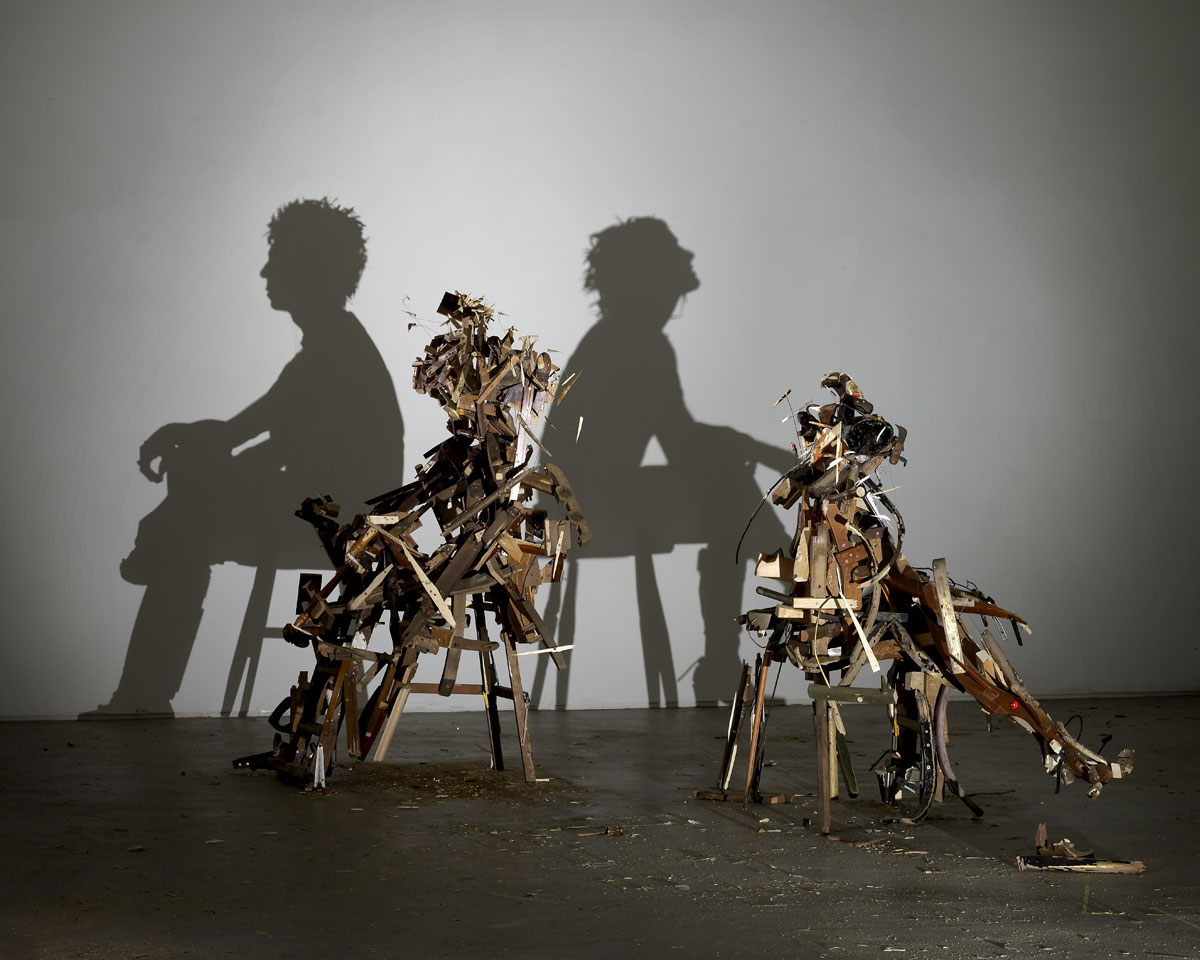
Wild Mood Swings (2009–10) by Tim Noble and Sue Webster The number of terrorist attacks has dramatically risen in the modern age1. It is no longer Gavrilo Princip flinging a bomb in Sarajevo, or Stalin robbing a bank. Its demonic growth is from the embryo of technological society. The birth of the individual narcissist is the surrogate form of the shift out of collective narcissism. Industrial society, technological entrapment, and a sense of nihilism in the wake of the atomisation of existence- all contribute to a profound switch in recent times. Previous spiritual, aesthetic and democratic pathways are excluded for the majority; there is no longer the solacing fall of religion washing up on the shore. Nietzsche said that we had killed God. Yet nothing has replaced God. Liberal democracy is the workshop for the discontented. The poet TS Eliot noted the nihilism of the twentieth century in his commentary 'Christianity and Culture'. He anticipated the degeneration of democracy into something of a wasteland:
Democracy, degraded into representative democracy, became the token voice of the twentieth century. Scientism and technology became the governing rationality which delegated ethics to a background role. This obscurity was akin to a Shostakovich symphony; in the darkness attempting to shine a light on the cave wall, amidst the 'Engineer of human souls' (Stalin's phrase for the role of the artist). The twenty first century inherits this Polemos of night and society becomes sick in collective narcissism. The phenomena of virtue righteousness ('woke' in popular terminology) is a response to this. It is only, however, one of the responses. At heart, it signifies a loss of something or other, a hearkening back to the pre-Socratics and a sense of being. It is non other than the strange echo of primordial 'being' and a democratic ethic. This was a pretheoretical knowing of ethics, never formalised or put into Platonic categories. Virtuous narcissism gives form to the prevailing social and democratic impotence of the generations in post- industrial society. Redundant in the realms of work, democracy and family, the collective narcissism becomes a surrogate child. 'Being', having been stripped of qualitative ethics, is replaced by another vicarious, representative form, governed by the administrative class of Brahminites. Liberal ethics is non-negotiable, it is a given, a Kantian category. Yet the disturbing natures of this virtue representation are nihilistic rather than ethical. The Apollonian replacing the Dionysian. It is only a mirage of virtue for it is controlled and regulated. In any ethos the prevailing ethical norm becomes legislated. Ethics becomes destructive and anti-life. The law is delimiting of life. The dispossessed, clutching for meaning, see the state 'controlling' ethical life with legislation switching off 'Parrhesia', the Greek term used by Foucault for heroic and free speech. So, democracy, bludgeoned and deformed, limps on into the twenty first century. The democratic form and industrial panopticon gave rise to its substitute: nationalism. The twentieth century of ideology (Fascism, Communism, Liberalism) were built on the remnants of the collective narcissism of nationalism. The collapse of the Holy Roman Empire and the ensuing proselytising of nation eventually gave structure to commercial elites at the expense of religious elites. The victim was democracy as participation in direct democracy declined. The new drug of nationalism became the form and precursor to the total mobilisation of the modern era into industry and war; into rationalisation of the economic realm. With the collapse of the industrial ethic, society fell into nihilistic entropy; value- less, nation- less. The possibilities for a new Nietzschean age are there, but hidden, glimmering apparitions on the cave wall. Perhaps a god can save us. When collective narcissism is revealed as illusory and breaks down ( the present impasse), then begins the era of individual narcissism. The perpetrators of millenarian crimes against society are the sons of Bakhunin and Ted Kaczynski. Their mentors are not Marx , Rawls or Habermas. They are Dostoyevsky, Hermann Hesse, Junger, Nietzsche and Heidegger. The former are 'reformers' in that they believe in industrial and technological society- their aim is to reform it, yet it is within the same materialistic realm. The true millenarians, however, recognise a deeper longing for being, one that is not reformable from the ashes of industrial society. Kaczynski described leftists as 'mainly socialists, collectivists, 'politically correct' types, feminists, gay and disability activists, animal rights activists and the like'. For the new millenarians, leftism is compatible with the destruction of being, of the environment. The enemy of the outsider is technological society. Kaczynski prophesised that genetic engineering will make man a creation of technology, not by God or nature. Therefore, man loses himself and is utterly transformed. The underlying causes of transformation are ignored as the only remit is the reformation of the current order; rate of return on profit, structural efficiency, regulation. Yet the individual is not a universal Cartesian subject. This is the profound mistake of modernity. The existential individual is a unique and historical being. In a different time and era Kaczynski may have been a Franciscan or a Crusader, a peasant farmer. The exponential rise in deviance; terrorism, nihilism, suicide, drug abuse is a response to a world out of sync, where the individual, condensed into a liberal Cartesian subject, finds no solace, but forever changes:
The state, whether the planned economy or versions of neo-liberalism refuse to understand the origin of the turn of individual violence or political violence. The state, as the old adage goes, has a monopoly on violence. A monopoly on discourse and language. Language is the house of being said Heidegger. Language simplifies existence, experience, and places it into categories, verbs and nouns. Modernist liberal thought uses correspondence theory as the signifier of truth; it simplifies and debases language. There are only 'terrorists' and 'criminals'. Good and Evil. Society, since the Enlightenment, has failed to realise its goal or 'social contract' agreement of a collection of rational animals. This was never feasible as the world cannot be judged through Platonic forms or Kantian categories. The reality is an antagonistic realm of different conceptions of politics and being. A naturalistic phenomenon of a multipolarity of ethics. Collective narcissism bred a form of Community terror which was the first step in the reification of murder into individual terror. This came out of the industrial age en masse. It was facilitated by what Hannah Arendt termed the 'Gleichschaltung':
So, you are coordinated in two ways: the first is being 'thrown into the world', a temporal existence, of a certain time, of which there is no choice. The second is the conditioning of the present. In our contemporary era this uniformity of thought, driven by technology and atomisation creates a yearning for bonding with something tangible yet always ephemeral and not real. What Guy Debord called 'Society of the Spectacle'. For example, the consciousness of liberal 'woke', of the gang, political parties. They all infantilise behaviour and participation, a veneer of group to replace authenticity. This rise in individual terror comes out of the collective coordination of life, the polarisation within nations and in the world. The lone wolf, the 'Steppenwolf', does not find succour in the Kantian ethical refuge of a universal law or the infantilisation of spectacle. Or in the valorisation of 'das Man'. This is because the lone wolf 'cares' about ethics; he knows we are always in a particular historical world. He cares so much he is prepared to kill in its defence. He feels the empathy of the underdog. For killing has been coordinated into the social code of behaviour. This profoundly ethical response originates out of a desperation within technological society, and constraints on participation and freedom . It appears shocking because it is visceral and visible unlike bombing in Gaza or Vietnam. That is what brought Kaczynski out of his log cabin in Maine to bomb the Institutions. Soren Kierkegaard outlined his two premises of modernity; 'dread' and the 'demonic'. Dread involves a type of fear. We see the abyss of modernity all around us but are strangely attracted, obliged to this mode of loathing. We embrace the dread in collective fits of pathos. The party, the football team, the 'Panopticon'. It is the comforting blanket of the familiar, like the habitual prisoner who yearns to return to the prison cell. Now the 'demonic' is how we respond to the alienation. Previously the 'demonic' was regulated through the invisible hand of the 'polis', public expectation of 'duty' and ethics, based on a feeling of spirit and belief. Today, the demonic is our retreat into escapism and irresponsibility. Rather than becoming an ethical superman, aka Nietzsche, individuals retreat to superficial existence through the Internet, drugs and TV and a form of group virtue. They lose feelings for ethical issues. This trivial scintillation becomes the norm; fear and loathing becomes the norm. As Marcuse posited in 'One Dimensional Man', it is not necessarily a 'bad' existence, it lays down a material level of comfort, yet not an authentic one. However, whilst the sardonic everyman takes refuge in the 'Magic Mountain' ( the modern era being the time of Freud and psychoanalysis), the noble type, having a preontological hatred of 'Das Man' attempts to vault the Rubicon. This can be through superlative achievement ( the 'Fountainhead' of Ayn Rand) Alexander, Rockefeller, Van Gogh, Napoleon. The ones bordering the crisis, in a formless nether world between the two realms of Superman and Das Man, turn to a form of individual spectacle for satisfaction, for inner nobility. These are the subjects of individual terror, the ethical millenarian who strikes out. The New York Times stated that they had seen an internal NYPD account of killer Luigi Mangione's 'manifesto' in which he 'appeared to view the targeted killing of the company’s highest-ranking representative as a symbolic takedown and a direct challenge to its alleged corruption and ‘power games,’ asserting in his note he is the ‘first to face it with such brutal honesty.’' 5 The lone wolf is symbolic of the greater weaknesses of Liberal Democracy which is, by its very nature, insecure. More so it breeds the type of resentment and demonic acts visible as a response to it. This can be populism, 'woke' manifestations, racism, elite governance. Liberal critiques of modernity, have been preoccupied with one strand of this response: fascism. This is a wilful Oedipus missing the point. Yet Adorno, in 'The Authoritarian Personality' was wise enough to see authoritarianism as emanating from everyday life. Adorno criticised those who saw fascism as the only modern pathology. The pathological disease, in fact, is Liberalism, for it is neither here nor there, it is ambivalent, attracts violence.
Liberal democracy and rationalism (standardisation), through commodities, saw entities and human subjects as exchange. Undifferentiated individuals condense into a one dimensional mass that cannot recognise freedom. The atomisation we see in post-industrial society creates this need for inclusion. Adorno felt that fascism remains inherent in bourgeois psychology. However, the adverse is also true- that distortions of liberalism ( 'equality', 'rights') are its leftist equivalent. 'Liberal democracy' is only a language phrase. Most regimes exist on a sliding scale of authoritarianism and materialism; the dialectic producing variants on rebels and terrorists. The age of the Unabomber is upon us. ***
*** Notes:
*** |
PAPER EDITION
|
||

The Montréal Review © All rights reserved. ISSN 1920-2911