GARY SOTO’S RECENT TRIO OF MIDDLE-GRADE NOVELS By Ron McFarland *** The Montréal Review, August 2026 |
|||
It would be accurate to say that Gary Soto has never not been prolific, and the reasons for that are not far to seek. While he maintains that his first love is poetry, he has written books in all the literary genres (poetry, fiction, nonfiction, drama) for all ages, from pre-school to adult. His first collection of poems, The Elements of San Joaquin, appeared in 1977 and evolved from his MFA thesis in 1976; a revised and expanded edition of that book was published in 2018. In 1974, the year he received his BA from Fresno State (California State University, Fresno), where he studied under Philip Levine, his poems appeared in the Iowa Review and Poetry. That year the Chicanx poet who grew up in a Fresno barrio turned twenty-two. His early books, published in the Pitt Poetry Series, suggest he would follow somewhat in the mode of Levine, renowned as a blue-collar poet, but Soto’s voice, or voices, has evolved as his prosperity has increased; he now lives with his wife of fifty-one years, Carolyn Sadako Oda, in Berkeley. Much of that prosperity owes to Soto’s decision in the late 1980s to turn, by no means exclusively, to writing for young readers. The first indication of his talents in that direction appeared in the autobiographical essays of Living Up the Street, published by Strawberry Hill Press in 1985 and intended for adult readers; they concern coming of age in the barrio of southeast Fresno during the 1950s and 1960s. It won an American Book Award and was quickly recognized as a book of interest to young adult (YA) readers, and it has been kept in print ever since by Laurel Leaf, an imprint of Penguin Random House. Soto’s next collection of essays, Small Faces, appeared in 1986, and it also appeals to both adult and YA readers. His first book intended specifically for young readers (ages 7-10, therefore juvenile rather than YA), The Cat’s Meow, came out in 1987 and, like Living Up the Street, was published by Strawberry Hill; a revised edition appeared in 1995 from Scholastic Press. As Soto indicated in an interview conducted in 1992 and appearing in Hungry Mind Review, “Yes, I’m a poet first. But prose pays the bills” (C-6, McFarland 84). By that date he had written what has proven to be his most enduring book for young readers, the short stories of Baseball in April (1990), published by Houghton Mifflin Harcourt (Clarion imprint). Reviews were overwhelmingly positive; the book garnered several awards, and it remains in print, usually designated for readers ages 8-13, which indicates that it will appeal mostly to middle-grade readers, therefore Juvenile rather than YA. Questioned in that interview by Becky Bremner as to his focus on prose for young readers, Soto suggested that differentiating between books intended for youth as opposed to adult readers was a matter outside his control, but he said he did not find “children’s books as compelling or as powerfully written as some of the best American fiction” and “There’s a greater depth of artistry in adult literature” (C-7, McFarland 85). He added that he considered his best writing, presumably his poems, was intended for adults. In an email dated June 28, 2019, to me concerning the impact on his literary reputation of his decision to write for young readers, Soto wrote, “regarding whether writing for the younger audience hurt my presence in the adult literary world. Yes, without a question. But it was something I had to do” (McFarland 28). In a subsequent email in 2020, Soto reflected on that sense of obligation that he had “a plan to provide a literature for Latinx youth and to do it at a high (or sometimes high) art. I did succeed for a while and the responses had been eye opening and tender—the stories I could tell. [. . .] It was not a business plan but a plan to elevate young people. It was really difficult and I failed” (McFarland 198). Others have offered contrary evidence regarding his supposed failure. In her foreword to Frederick Luis Aldama’s Latino/a Children’s and Young Adult Writers on the Art of Storytelling (2018), Jamie Campbell Aidoo, reflecting on Soto’s picture book Chato’s Kitchen (1995) and his gritty YA novel Buried Onions (1997), reported that an ESL teacher used his illustrated books to “scaffold their English language skills” and that boys in particular “engaged” and “flourished” from reading his books: “Gary Soto’s work provided the first opportunity for her Latinx students to culturally identify with the setting and the characters in a book” (xiii, McFarland 27). As to the numbers, McFarland’s bibliography, despite some oversights and allowing for books published in the four years since his writing, numbers at least eighty with the release of his nonfiction volume, for adults only perhaps, Books as Drinking Buddies (Limberlost Press, 2026). A brief summary is in order: 23 collections of poetry, including seven aimed at young readers, the most recent book (for adult or general readers) being Downtime (2023); 34 books of fiction or nonfiction intended for preschool to young adult readers, from the popular picture book, Too Many Tamales (1992), stage adaptations of which continue to be performed, usually at Christmastime, to the somewhat dark YA novel Buried Onions (1997), an indie film of which was produced in 2025; 9 books of nonfiction mostly in the form of personal essays, including the collected essays, The Effects of Knut Hamsun on a Fresno Boy (2001), Why I Don’t Write Children’s Literature (2015), which he still does, and Behavioral Medicine (2021); 3 books of adult fiction starting with a trilogy of novellas published as Nickel & Dime (2000); and half a dozen plays along with 3 edited anthologies and some less classifiable writing like Meatballs for the People: Proverbs to Chew On (2017). The dominant voice of these books, though with significant departures, is comedic. If as Horace Walpole wrote in 1776 “The world is a comedy to those that think, a tragedy to those that feel,” then Gary Soto is a thinking man. In any event, any serious consideration of Soto’s literary impact should properly concern his fiction for young readers, and his three most recent titles offer a good sense of where he is now, at age 74 and a grandfather, as a writer of popular fiction: Gabe (2019, originally published in 2011 as an eBook under the title “When Dad Came Back”); Puppy Love (2023); and Gone Viral (2026). The three books are intended for middle-grade readers, a fairly loose category that could start as early as age eight and extend to age fourteen, at which point the target audience would be for young adult readers, to as late as age twenty. As I observe at the end of Gary Soto: A Career in Poetry and Prose, the trend in settings for Soto's poetry and prose over his fifty-year career has been from field to urban street or barrio to middle-class neighborhood, and the 'major thematic focus of the children's and young adult fiction has been on the importance of familia' (191). With his novella Gabe, however, Soto returns to the setting of many of his poems and much of his prose, the industrial barrio of Fresno where he grew up. The city of more than half a million is 50% Latinx or Hispanic. In addition to predominantly Hispanic surnames, Soto sprinkles Spanish throughout the novella, from Gordo (fatso) the cat to nalgas (buttocks, butt) and vatos locos (crazy dudes, who are sometimes gangbangers). A few of Soto’s early books intended for young readers, including Baseball in April, include glossaries. His primary target audience is Latinx, but while he has maintained that focus, which he believes has encouraged that population to become readers, it should be noted here that Anglo and other non-Hispanic readers may profit from this exposure to the vibrant subculture next door. Soto’s thematic focus remains on family. Thirteen-year-old Gabe Mendoza lives in a single-parent family, his mother working as a cashier at Walmart. His father, who deserted the family when Gabe was eight, appears on the opening page of the 107-page novella, a homeless alcoholic dragging a large suitcase wherever he goes. Throughout the book Soto reminds readers of the urban summer heat, which averages close to 100° (on page one the temperature reading is 104) and Gabe’s Fresno is not air-conditioned. He rejects the dirty, smelly “vagrant” he reluctantly recognizes as his long delinquent father, and when he tells his mother about their encounter, she responds by threatening to request a restraining order. Despite his initial rejection of his father, Soto shows Gabe’s compassion toward the homeless when he sometimes, albeit not always, offers tomatoes from his mother’s garden, and he soon warms to his father’s plight. But when his father fails to show up when he promised, Gabe again repudiates him. At the same time, Gabe endures the mean streets of Fresno in the form of bullies like Frankie Torres, who confront him always with allies, and unlike some of Soto’s protagonists in other juvenile and YA novels, Gabe gives as well as he gets when it comes to fists. His allies in the streets include Coach Rodriguez, of his softball team (Gabe’s mother can’t afford the costs connected with Babe Ruth baseball) and a couple of Black brothers. One of the more memorable episodes occurs when a pair of “shiftless older teenagers” he refers to as “vampires” threaten to beat him up (56). Soto’s humor shows up even as Gabe fears the bullies as the “slim vampire” has “grilles in his red mouth—blood or the juice from a red-colored Jolly Rancher?” (57). But the violence escalates when one of the bullies rams Gabe’s bike into his knee and slaps him across the face. At that point Gabe hears a “thundering voice”: “I said, ‘What you doin’?’” the brother asked the vampires. “Jacking up my friend?” (58). “I see what’s happein’,” his rescuer explains as the bullies mount their bikes and ride off. “Those cholitos be going to the grave early” (59). The word cholitos could be translated as “little guys” or in this context perhaps something more like “little punks.” Two-thirds of the way through the novella, Gabe’s mother sends him for a couple of weeks to his Uncle Matthew, who lives about thirty miles away in the country, where he maintains a subsistence living by gardening and selling the produce from a couple of acres and raising chickens. There, during a brief recess from the threatening world of the barrio, Gabe learns how to work hard, and his uncle’s lady friend offers the standard (cliché) advice, that “Violence won’t get you anywhere” (94). As the book ends, Gabe meets a new man in his mother’s life and discovers that his father has found a job at a local supermarket. In the various worlds of middle-grade fiction, completely happy denouements may not be assured, but comfortable or at least hopeful resolutions are guaranteed. The borderline poverty, unease, and occasional violence of the barrio is ameliorated in Soto’s 2023 middle-grade novel, Puppy Love, the title of which plays on the colloquial term for love between boys and girls who find themselves on the threshold of romantic attraction and protagonist Jordan Mendoza’s love of puppies he rescues from drowning in an irrigation canal. Although the novel is set in Fresno, that location is apparent only from occasional street names like Tulare, and Jordan’s family is intact and loving. His father is a successful plumber with a healthy sense of humor, and his mother is a conventionally happy housewife who delights in teasing her lovestruck son. A bit on the saccharine side? Perhaps so. In her review published in World Literature Today, Suzanne Manizza Roszak reaches a similarly warm verdict, praising the novel's appeal to both child and adult readers. The Latinx world is presented here as in Gabe, but it is much less apparent. Aside from occasional doses of Spanish (nada, nalgas), that world is most evident in the frequent reference to food, from churros and enchiladas to quesadillas and tortillas. Soto hedges his bets, though, by having Jordan and his friend Antonio discuss upcoming dinners of meatloaf and spaghetti respectively. In one playful scene that reveals a fact of life perhaps unfamiliar to some readers but common to many Mexican Americans of the second or third generations, Jordan is doing his Spanish homework, and he’s far from fluent. Like Gary Soto, a self-confessed mediocre student in high school who was not fluent (he describes himself as a “pocho”), Jordan struggles to find the correct expression to express his love, and he considers “Yo adoro,” which would translate as “I adore” (minus the “you”) and the correct “Te amo,” but since he doesn’t want to go quite that far, he thinks, “Tengo hambre.” Fortunately, he realizes “That’s gotta be wrong,” and it is. It means “I’m hungry” (45). Some readers will be surprised that the given names of many if not most of Soto’s characters are distinctively Anglo. Soto has explained that his father, a second generation Mexican American, wanted to raise his children as Americans, so Spanish was not commonly spoken at home, and so too his own Anglo name (his boyhood nickname was Goyo). The object of Jordan’s early adolescent passion, however, is Sierra Mendez. Hispanic enough. The novel opens with Jordan’s failure to make a basket that would’ve won the game, and he struggles doubly from that embarrassment because his would-be girlfriend Sierra was in the stands. Predictably, he makes up for that missed shot by scoring the winning bucket in a later game and is acknowledged as the “hero.” His major heroic feat, however, stems from his love of animals, notably dogs. Like Gabe Mendoza, Jordan is a compassionate, good-hearted kid, an apt role model for middle-grade readers. When he comes across a homeless man by the murky canal where he rescues a second puppy early in the novel, Jordan gives the man his banana. But like Gabe as well, Jordan is not the sort of boy to back away from a fight, so when his tall Anglo teammate Ryan Greene, the team’s star, taunts him, they exchange blows after school with Jordan getting the worst of it. Throughout the novel, Jordan is alternately teased or haunted by dreams, most of them involving Sierra, and after one that occurs near the middle of the book, he feels drawn to the canal where he rescued the two puppies. In the early morning he comes upon a half-submerged Honda, which he wades up to fearing he’ll find a body. He notices a black plastic bag floating downstream but does not go after it. Cold and soaked, Jordan encounters the same homeless man, and he has been thoughtful enough to have brought a banana in case he saw him again. The man hands him a third puppy. Fortunately, his parents prove to be accommodating, but Jordan pays for his kindness by catching a bad cold on the eve of the championship game. Of course, the reader feels confident Jordan will get to score the redemptive basket, but before that happens, a pair of detectives turn up to haul him into juvie, as his fingerprints have been found on the doorhandle of the Honda, which was stolen and was involved in a drug crime. He is momentarily saved from an additional interrogation by the sarcastic detectives by another dream involving Sierra, who reminds him he should have told the police about seeing the plastic bag. Soon enough, he bikes to the canal where he retrieves the bag, which is full of stolen cash and other items and which he returns to the rightful owner when he finds her address. When the pair of snarky detectives take him to juvie, they reject his story about finding the bag and returning it. Two days later, however, the true story comes out, and Jordan is praised not only as a basketball hero and a top student (which he is not), but also as the honest boy who returned the money to an elderly widow. The edgy realism that defines Gabe makes only a slight impact on Puppy Love, although some concession is made to it at the end when Sierra announces that she is moving away to Glendale, more than two hundred miles from Fresno. Jordan pours sand from his hand “like an hourglass,” and thinks, “That was what love was—time slipping away until eventually you forgot” (229). But Soto refuses to allow this “feel-good novel about a boy’s first love” to end discordantly, as the reviewer for Kirkus (June 13, 2023) observes. A cute girl Jordan’s own age shows up holding a plastic trash bag because, like Sierra, she has volunteered for litter pickup, and of course he joins her in this expression of civic responsibility. And finally, Soto indulges in the sort of happy coincidence that perhaps a writer can get away with only in novels intended for young readers: Her name is Dawn, the same name as the third puppy, which would have been Sierra’s if her new apartment in Glendale allowed pets. Just how seriously an adult reader might take a middle-grade text like Puppy Love is implicit in Suzanne Manizza Roszak’s review in World Literature Today (May 2024) mentioned above. Formerly an assistant professor at the University of Groningen in the Netherlands and presently associate professor of literature and creative writing at NYU Abu Dhabi, Dr. Roszak begins, “As a career evangelist for cross-reading, that magical practice in which adults allow themselves to gleefully devour books that are supposedly intended ‘for children,’ I always find it a reason to celebrate when Gary Soto publishes another middle-grade or young adult novel.” She proceeds to direct attention to a passage that exemplifies Soto’s vivid writing: “The surface of the canal was golden with light. Occasionally, a fleet of fallen leaves floated by like unsinkable boats. Two birds quarreled in a faraway tree” (52). After which, the professor observes, “In reversing the dynamics of anthropomorphic comparison as a narrative device, Puppy Love deploys a decolonial, transnationally American method of decentering human-exceptionalist thinking that adds texture to the novel’s depictions of ‘litter patrol’ as a nascent form of adolescent environmental activism.” To which sentiment I can only respond, “So much for the fruits of critical theory.” Roszak then reflects perceptively on “ethnoracial profiling” with respect to the police interrogation of Jordan; on “translanguaging” with respect to the easy movement between English and Spanish in the dialogue; and on Soto’s use of music as “a particular locus of class commentary” in the novel. The latter refers to Antonio playing the piccolo in the new pep band in which Sierra plays the glockenspiel and to Jordan’s decision to try his father’s harmonica. At the end of her review, Ms. Roszak abandons the critical rhetoric, concluding that the novel “is also just plain fun to read and to cross-read, for child and adult audiences alike.” Of Soto’s three most recent novels written for middle-grade readers, surely the most delightfully playful and often the downright silliest is Gone Viral (2026), appropriately billed by Amazon as “An Uproarious Middle School Adventure About Two Friends, Mindfulness, and Fame.” The Kirkus review for January 6, 2026, accurately refers to the humorous, action-packed episodes as “zany adventures” and compliments James Otis Smith for his eighteen illustrations, including the cover. The reviewer also notes the “racially diverse cast.” The text of the 278-page novel offers no apparent evidence of racial diversity, but Smith’s color cover clearly does. In fact, aside from the two protagonists’ love of burritos, they might as easily be Anglo as Latinx. The twelve-year-old boys, for whom Soto supplies no surnames, are Jason and Sean, and he moves the hometown setting 42 miles south of Fresno to Visalia, a city of more than 140,000 also located in the agricultural San Joaquin Valley. Like Fresno, the population of Visalia is over fifty percent Hispanic, so frequent readers of Soto’s poems and prose might assume that one of the boys is Latinx, or perhaps both of them. Writer and illustrator Smith is known for the graphic stories (cartoons, comics, or “toon graphics”) of Black Heroes of the Wild West (2020). The story begins with Jason’s discovery of John Cage’s experiment in musical silence dating to his performance of 4’33” in 1952. Conceived as early as 1947, the piece has become something of a standard feature of Modernism, with commentators reflecting on its connections with Surrealism, Zen Buddhism, and other movements. For Jason and his pal Sean, who lack any musical talent at all and are notoriously dismissive of school and happily immature, the notion of proclaiming themselves to be a rock band that celebrates silence proves irresistible, and quite implausibly profitable. They achieve instant fame and fortune, and predictably they lose both in another instant. But before they do, Jason (who renames himself as Metallic Z) and Sean (whom Jason denominates Half-Lo) form a group called Gormax, a created moniker that some pharmaceutical manufacturers might regret not having unearthed for a brand name. The novel immediately becomes a comic fantasy when their middle school vice principal, Mr. Kidman, agrees to their proposition that they should drop out of seventh grade to “discover” themselves and “mature” by seeing the world: “In their hearts, though, they knew that mature was something that happened to a banana or an avocado. But to rockers? No way” (24). If seeing the world is the first thing on their minds, maturation is surely the last. By the time the delightful, or possibly just goofy, story ends, Gormax has performed in an array of countries, from Germany to Liechtenstein, from Iceland to Japan, and from Peru to Canada. In writing Gone Viral, Soto might well have been looking back to his 2005 book of poems for young readers, Worlds Apart: Traveling with Fernie and Me, where two eight-year-old boys improbably travel the world from San Francisco to Hawaii and Australia, and on to various countries in Europe, Africa, and South America, proceeding to Mexico and Tucson where their third-grade teacher gives them a ride back home. I suggest their travels amount to 'a celebration of multinationalism and diversity' (130). Throughout Gone Viral, Sean’s and Jason’s ignorance takes center stage. Presumably, for middle-grade readers, most of whom will probably not confuse Bolivia with Bulgaria and will not greet their fans in Lima by calling the city llama, that’s more than half the fun. Are Sean and Jason simply stupid? Presumably not, but they do appear to be more blissfully ignorant than the average twelve-year-old boy (if there is any such “average”). About a third of the way into the novel, Chase “White Socks” Stravinsky, the sixth-grade marketing genius and “geek” who becomes their highly competent manager, sends attractive eighth-grader Samantha from Tulare, a few miles from Visalia, to take control of Gormax. The boys are intimidated as she scorns their immaturity and takes control, but their group experiences even greater fame and fortune. After all, Samantha, who renames herself Skylark, can sing, and she comes with a talking white cockatiel named Zeppelin (Zep) who can not only speak but is multilingual. In the final sixty pages of the novel, everything goes wrong, beginning with Zep’s disappearance and Skylark’s departure to join her girlfriend Priscilla, who turns out to be Vice Principal Kidman’s daughter. Gormax subsequently bombs in Atlanta, the group’s venues dwindle to community college gyms in the Midwest, and despite somewhat successful visits to Japan and Liechtenstein, they find themselves in a “fleabag motel” in New Mexico when Chase calls to inform them that the Caribbean island where all their wealth, mostly in Bitcoins, was cached has sunk after a catastrophic storm. Soto undertakes something of a risk as the novel ends when Samantha (Skylark) turns up with her girlfriend Priscilla, obviously in the early stages of a lesbian relationship. When the girls kiss and then kiss again, the boys turn away. They have acquired some maturity, but how much is unclear, and they are destined to repeat the seventh grade, while their former manager Chase jumps the seventh into the eighth (he is destined for Cal Tech), and the girls head into high school and perhaps the world of Young Adult fiction. James Otis Smith’s cover featuring the three smiling members of Gormax along with Zep includes bubbles that assert the novel’s obvious messages: Fame is fleeting, but friends last forever. In a brief epilogue, Soto reports that Chase (White Socks) formed a Gormax tribute band that performed locally and Jason and Sean took up the tuba and joined the marching band. Reflecting on the other
two of Soto’s middle-grade novels that appeared between 2019 and 2026, he takes
his readers on an exodus of sorts from the grimy realism of the barrio with its
single-parent family, gang violence, alcoholism, and homelessness in Gabe;
to a comfortably middle-class family, reflecting some of the best elements of
Latinx culture (familia) in the playful teenage rom-com of Puppy Love;
culminating in Gone Viral, a novel that expands into a wide world that
never proves threatening and that is as comically diverse as readers might wish
it could be in reality. How serious is this most recent novel? One might
propose that Gormax is at least in part a satire on the raucous world of heavy
metal. Or perhaps Soto intends it as a cautionary tale, warning slackers like
Jason and Sean to stay in school. But finally, Gone Viral basks in the
glow of its own frivolity. Take it or leave it, Gary Soto seems to say.
|

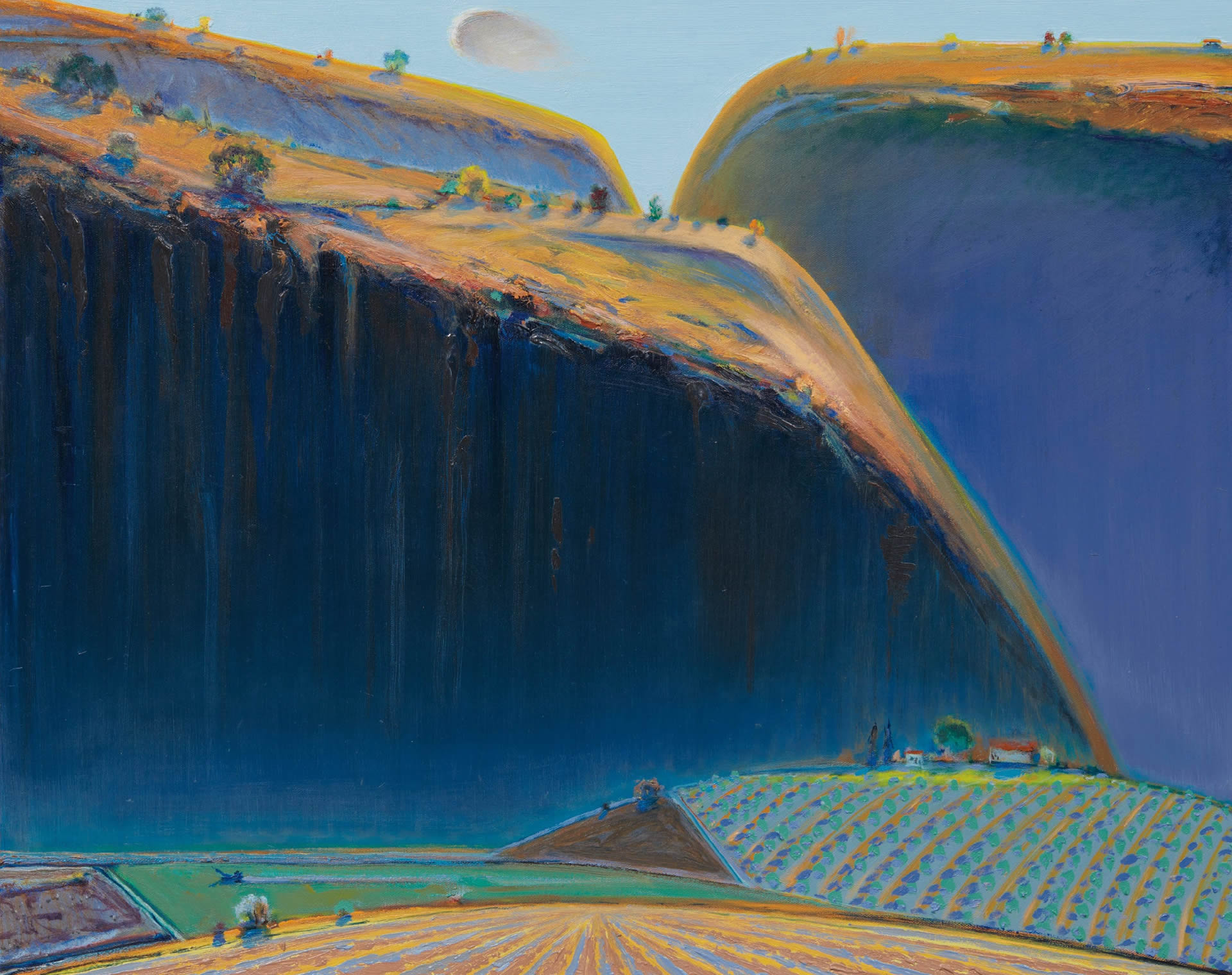
Art Note: Valley Ranch (2001), Wayne Thiebaud. Foothills climb into high bluffs under a kaleidoscope of light; a ranch, a fence line, a scatter of human marks, all dwarfed by the ground they sit on. Oil on canvas, 61 x 75.9 cm. Private collection — Wayne Thiebaud Foundation.
