FOUR YEARS SPENT READING THE WORLD’S MOST COMPLEX BOOKS By James Elkins *** The Montréal Review, September 2026 |
|||
There’s something beautiful about a novel that’s succinct and yet seems to contain a universe of feeling and experience. My favorite is Sándor Márai’s Embers (1942) where an entire lifetime of regrets, misgivings, and forgiveness unfolds in just over two hundred pages. But there’s another kind of beauty that can only be found in novels that are long and complex, that just keep going, up to the 1,000 page mark and beyond, as if we had nothing better to do than devote all our waking hours to living in the author’s world. A long, complex novel has the capacity to capture not only a personality that seems as intricate as a real person—Raskolnikov, Clarissa Dalloway, Humbert Humbert—but also places as textured as ones we know—Halldór Laxness’s Iceland, Dickens’s Chancery Lane in Bleak House, Anna Burns’s unnamed Belfast in The Milkman. What makes a novel complex in this sense? The French novelist Romain Rolland won a Nobel Prize for Literature in 1915 for his multi-volume novel Jean-Christophe, which is longer than War and Peace. He coined the term roman-fleuve, river-novel, for works like his and Tolstoy’s that overspill the banks of an ordinary novel, filling thousands of pages with “solid storytelling and unforgettable characters” as Jeffrey Archer says, spanning wars and generations, carrying its readers along in a flow of prose. But a long timeline and an enormous cast of characters doesn’t necessarily make a novel complex in the sense I’m after. There are over five hundred named characters in War and Peace, and an online encyclopedia to help if you’d like more information.[1] Both Cao Xueqin’s Story of the Stone (紅樓夢) and the earlier Water Margin (水滸傳) have hundreds of characters. But in those books you’re not expected to remember every character as you go. The situation is less clear in David Foster Wallace’s Infinite Jest, and on a first reading you may struggle to remember all the people Wallace introduces. (The designer Sam Potts drew a frightening-looking diagram of all the characters.[2]) Plots can complicate novels, but many complex novels have simple storylines. Beckett’s novel trilogy Molloy, Malone Does, and The Unnamable is complex to the point of opacity, and there are a number of characters (and at least one murder) but nothing much happens in most of it. In the third volume, The Unnamable, the unnamed main character may or may not be dreaming, might or might not be recalling parts of his life: there’s no plot to speak of, but the narrator’s mental state is extremely difficult to describe. There are several plots in Lucy Ellmann’s Ducks, Newburyport, but I think they’re mainly to remind readers that the main character’s monolog—told in a single, run-on sentence that lasts a thousand pages—is not, in fact, endless, but happens at a particular time and place. On the other hand novels with intricate plots like Jennifer Egan’s A Visit from the Goon Squad or David Mitchell’s Cloud Atlas can be like puzzles, and once they’re solved, much of the apparent complexity disperses, leaving us with a feeling of admiration for the author’s skill. I prefer my novels puzzlingly long, sometimes annoyingly so. That’s because length is a promise to the reader that nothing had to be omitted, that whatever was of interest found a place. Not just the clues to the mystery along with a judicious collection of misleading and distracting detail, as in Conan Doyle or Agatha Christie, but an entire encyclopedia’s worth of observations, facts, particular places, and peculiar things. Yet length isn’t a sufficient criterion for the sort of complexity I have in mind, because there’s also repetitive length, unnecessary length, underutilized length. Eleanor Catton’s The Luminaries, Hanya Yanagihara’s A Little Life, and Garth Risk Hallberg’s City on Fire, which Boris Kachka called “freaking enormous,” all seem paced and well edited. Jon Fosse’s Trilogy and Septology, on the other hand, don’t seem to notice their length.[3] Despite his recent Nobel prize, and my own weakness for thousand-page novels, I’m not convinced his dilations are always necessary or even expressive. The dozen longest novels ever written are between one and two million words, that’s roughly 3,000 to 6,000 pages. Not all of them are especially complex. Madeleine de Scudéry’s 6,500 page Artamenes, or, The Grand Cyrus: An Excellent New Romance, finished in 1653, is endlessly inventive, as they say, but it’s inventive in a way that is quite familiar to contemporary readers. It’s all online, if you’d like to try it. (de Scudéry was also an early feminist; there’s a good introduction in English to her work, edited by Jane Donawerth and Julie Strongson.) Complexity is usually imagined as a result of adding plot elements or new characters. That makes it sound as if any author can build interesting complexity by multiplying stories or settings. But you can’t set out to construct the sort of complexity I’m talking about, because it isn’t entirely rational. An expensive watch with lots of “complications” like extra dials, lunar phases, and triple calendars isn’t complex in this sense: it might be better to say it’s intricate. (The watch is entertaining, but there are people who understand it completely, and it keeps ordinary time.) The ancient Greek antikythera device, forever rusted solid and resistant to full analysis, is complex. The complexity and difficulty I’m advocating can’t be achieved by constructing interlayered plots or jamming the novel with obscurities. Intricate films like Christopher Nolan’s Tenet or Memento don’t count as complex in this sense, because they work perfectly, down to the smallest detail. For complex films you need Ingmar Bergman, Michelangelo Antonioni, or Robert Bresson. Real complexity just happens, because it’s partly the result of meandering thoughts.
A simple definition of complexity
Here is a simple model of complexity: a novel is complex in the way I mean if it fails repeatedly and in several different ways. In Randall Jarrell’s famous formula, “The novel is a prose narrative of some length that has something wrong with it.” His remark comes in the middle of a sentence at the end of his essay “An Unread Book,” about Christina Stead’s novel The Man Who Loved Children, and he was saying how it’s so full of love and a sense of family that its lack of success, and its many flaws, don’t matter. The first part of his definition (“a prose narrative of some length”) signals that the novel has no obligation to end, and therefore no limit to the details it can accommodate. In popular fiction the structure is clear and the suspense is the details—how the puzzles will be solved, whether the romance will work out. The other half of the formula (that there’s “something wrong” with every novel) comes in when the novel goes on beyond its minimal length. As Montaigne knew, thought goes where it wants and won’t be contained. Form and structure are perennial issues, and not all thought is at home in genres and formulas—and that’s why, as Jarrell says, every novel also “has something wrong with it.” Or lots of things. If you’re reading a novel and you spot an inconsistency in the plot, an anachronism, or a factual error, and if it ruins part of the book for you, then the novel isn’t complex in the sense I mean. In a genuinely complex novel small failures accumulate like snow: different sorts of infelicities, obtrusive digressions, odd ellipses, surprising and apparently uncontrolled lacunae, shifts in tense, solecisms, inappropriate asides, unwarranted assumptions about your interests or knowledge, unnoticed borrowings, anachronisms, clichés, factual errors, surprising slang, uncontrolled shifts from tragedy to satire or comedy, a million sorts of awkwardness, lapses in tone, imperfect word choices, failures of depiction, lags and douleurs, sudden rushes, jump cuts, unnecessary bursts of poetry, unconvincing details of all sorts. In the snowfall individual lapses no longer matter. Correcting them wouldn’t help—that was one of Jarrell’s points about The Man Who Loved Children—and there is no longer any one flaw that might make you put the novel down. Complex novels fail in complex ways, and they do so continuously. It’s different in nonfiction. If a scientific essay lacks a “Methods” section, or an essay in the humanities has no bibliography, those flaws can simply be corrected. But because a novel can fail many times, in many different unfixable and even indescribable ways, it becomes impossible to keep track. Perceived flaws form a cloud in the reader’s mind, and that cloud is the novel’s weather, the experience of reading it. In a review it’s usually unhelpful to articulate more than a couple of a novel’s principal problems. Listing all the things that made the reader pause would produce a kind of endless and unreadable microcriticism. Novels are so deeply woven into their authors’ ways of thinking that each lapse or misjudgment is inextricably knotted to the next. What sense would it make to criticize Knausgaard for the five hundredth mention of coffee? All the compulsive coffees are chained to one another and to all his uncountable decisions about what, exactly, to mention. Only the most patient and skillful reviewers, like Adam Mars-Jones, can conjure more than a few of a novel’s distinct problems, and even then it takes him many pages to do so. His account of William Gaddis’s Recognitions and J R in the London Review of Books, 23 September 23, 2021 (cut down by the editors from its original length) is an example of exacting criticism in the snowstorm of small writing lapses. It’s effective, because the individual writing lapses suggest ominous larger conclusions. Another way to put Jarrell’s definition might be: if a book that calls itself a novel has nothing wrong with it, then whatever it is, it’s not a novel. Christie’s novels succeed in this sense because they are so tightly constructed, and that’s why I’m not interested in them any more than in Maurits Escher’s prints. The best novels, I think, fail in bewildering, entangled, and multidimensional ways: incrementally, one stumble at a time; slowly, like a tower leaning before it collapses; continuously, like a person tumbling down a hillside, unable to stand, unable to stop. Failing over and over means that a long, complex novel will unfaithful to its type. It will stop working as a thriller, a memoir, an autofiction, a mystery, a travel account, or anything else I can name. If I’m interested in real complexity, then I’m apt to lose interest once I know how to read a book—when I see how the author’s reasoning goes, what details count, how they imagine plot and character development—then I can sail along, and even though sailing can be fun, I don’t want my reading to be easy. Smooth sailing makes some long books longer. After a few hundred pages, I felt that way about Luis Goytisolo’s Antagony, Miklós Szentkuthy’s Prae, Julián Ríos’s Larva, and Adam Levin’s The Instructions. One of the best things about Ducks, Newburyport is the preposterous mountain lion subplot, which really has nothing to do with the main monolog (although it’s woven in at the end). I love the moment when I put a book down and think, Wait a minute, what kind of book is this? Wallace once told Michael Silverblatt that Infinite Jest is structured according to a Sierpinski Triangle, a shape in fractal geometry that can never be fully visualized. As you move through the book, you’re never sure where you’re going next, but you’re also increasingly sure that everything’s not going to come together at the end. A genuinely complex book has a new structure, a form that fits the occasion. Joyce was one of the masters of traditional forms, in Dubliners, and also one of the first to ruin expected forms, in Ulysses. A reader can feel especially lost in the “Oxen of the Sun” episode in Ulysses, which recapitulates the development of English prose from Middle English through the nineteenth century, or by the abstractions of the “Ithaca” episode, which Joyce once described it as “a mathematico- astronomico- physico- mechanico- geometrico- chemico sublimation of Bloom and Stephen.” I love complex novels, and I love them more the longer I read. For most of a decade I had a fairly ordinary reading habits: I read on the order of a book a week. Eventually it occurred to me that I was making things easy on myself. I was avoiding longer and more difficult novels, or, worse, I was speeding through them. I decided to focus on the most challenging books I could find, to figure out what it feels like to read slowly, patiently, with full attention to the book’s complexity. Here are two examples of what it can be like to read unrepentantly long, aggressively complex novels as slowly and carefully as they demand. The two cases are different, because each such novel is its own world. If you haven’t tried reading these books, get ready for a surprise. Reading complex books can get very complex.
James Joyce
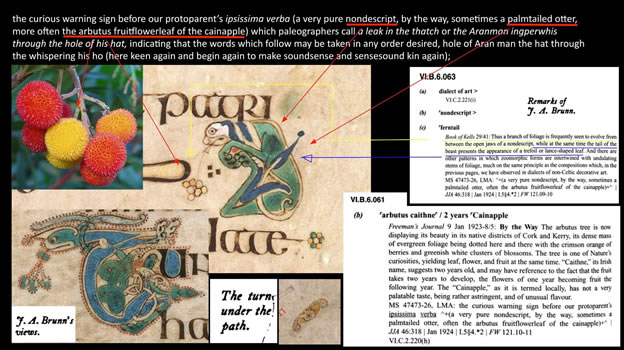
In 2020 I started an international reading group on Finnegans Wake. For a famously unreadable book, Joyce’s book inspires a continuous small stream of devoted readers. There may be about a half-dozen reading groups currently running, including one that finished a 28-year read in 2023.[4] There’s a “Joyce industry,” which basically amounts to lots of college courses and less than a half-dozen people who have managed to make Finnegans Wake their principal reading and use it to support themselves. I advertised by sending emails to literature departments in about forty countries and posted announcements on a number of social media sites. At first it looked like the group would be almost a hundred people, but Finnegans Wake is more an aspiration than a reality for most people, and eventually we settled on about a dozen members. We were a wonderful group. One of us was in Turkey, two more in Germany, one in England, one in India. A member in Japan woke himself up, after a couple hours’ sleep, to join us at 1 AM his time. Some of us were academics, and one or two were aspiring writers, but most were just dedicated readers. Our group wasn’t content to read page by page, as some Finnegans Wake groups do. The book asks its readers to do that, but it also wants readers to thumb back and forth, compare passages, watch for themes and stories, and ask how the whole thing fits together. It asks readers to think about the history of fiction, the avant-garde, modernism, and other large subjects that can’t be accommodated by going page by page. And in 2025, Finnegans Wake is more than just the book that Joyce wrote: reading means thinking about the generations of scholars who have read the book, so we read widely, counting anything with a reference to the book as part of the book. In a practical sense, the mountain of Joyce scholarship might be considered to be an extension of the book itself, because there are few readers of Joyce outside academia, and because reading in the Joyce literature is necessary for any sustained engagement. We had the main text online on a site called Perusall, which lets people post comments. In our meetings we’d share the screen with the Joyce text and all our comments. Sometimes a single word would provoke a search and we’d all contribute different perspectives. You can also post pictures on Perusall, and we found images of books, places, and people Joyce mentions. Our marginal notes bristled with links to other passages in the book and to many other books. After a couple of months, some of us developed graphical representations of Joyce’s puzzles and motifs, which we posted on mind-map sites, eventually settling on a collaborative whiteboard app called Miro. Soon our Miro board, as they’re called, began to look like a map of Middle Earth, with exotic-looking graphics and diagrams. Other people preferred spreadsheets, comparing different scholars’ interpretations of passages, and we developed a shared Google drive folder for those resources. One of us even started making videos to capture the complex meanings of certain passages. Each week we’d meet online and make our way slowly through part of the text, stopping at every marginal comment, following the links we’d found, considering our spreadsheets and graphics. It was an intense and astonishing reading experience. Most of our graphics, spreadsheets, and tables are too complex to reproduce here, because the print would be tiny. Here is a slide from a video made by Arthur Kolat, which dissects a couple of pages in Finnegans Wake that have to do with the Book of Kells. Joyce had a book about the Book of Kells, and he wove some of that scholar’s ideas into his own retelling. Here the Finnegans Wake text is at the top, and some details from the Book of Kells (and an actual fruit) are below. On the right are passages Joyce lifted from the book he read about the Book of Kells.
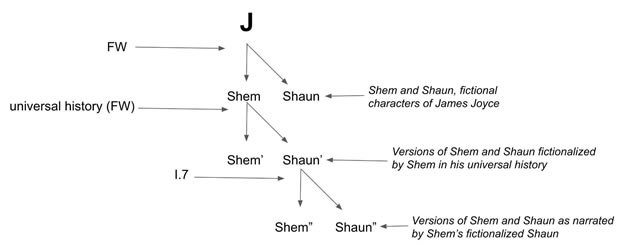
Here’s part of a graphic showing Shem and Shaun, two brothers in Finnegans Wake, and how they ramify into multiple personas. Shem tells a story about the two of them, and within that story, Shaun tells another story. Each time the characters change.
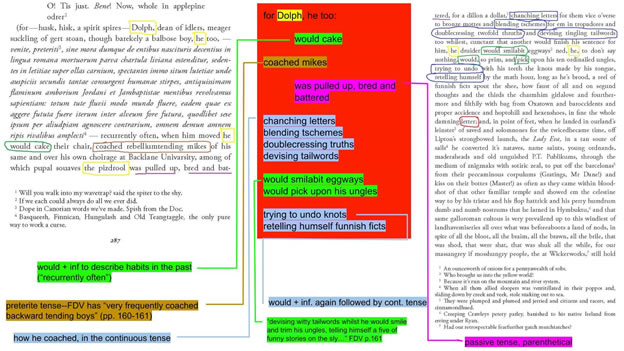
The next image is two pages of Finnegans Wake, color-coded by Kolat to show different grammatical forms and phrases. With rare exceptions, the grammar is intact in Finnegans Wake. The idiosyncratic spellings work largely because they happen in sentences that are grammatically well-behaved. A couple of us got interested in the ways Joyce used correct grammar to keep the book (occasionally!) readable.
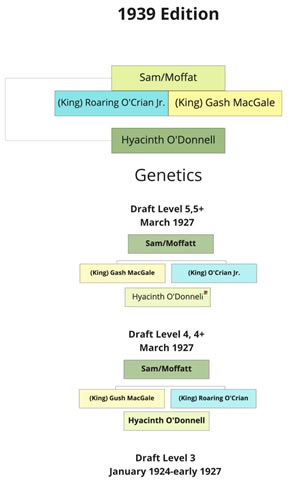
And here’s a very small part of an enormous graphic, showing how character names changed in just one short passage as Joyce revised his manuscript, from January 1924 to the final publication in 1939.[5]
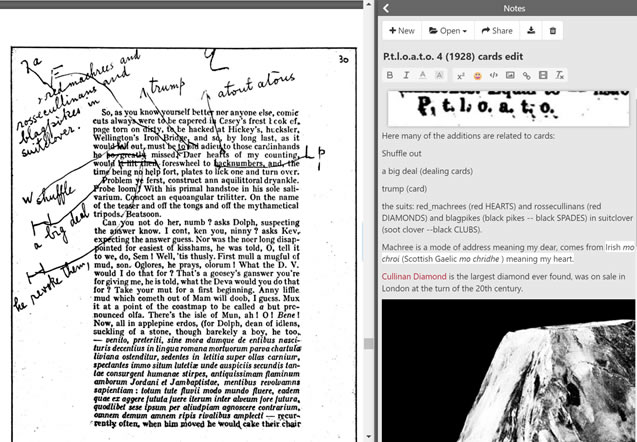
These are just the tiniest samples. We gathered most of what we did and kept it online for future Finnegans Wake groups, and some of us also published a paper about our use of digital media.[6] Like any complex book, Finnegans Wake leads its readers to other tests, so reading quickly proliferates. It’s possible to read Finnegans Wake with just a couple of carefully chosen cribs, for example Danis Rose’s James Joyce Digital Archive or Roland McHugh’s Annotations to Finnegans Wake. But sooner or later readers have to take deep dives into the ocean of Joyce literature. We did that, beginning with David Hayman’s A First-Draft Version of Finnegans Wake (1963), which usefully gathers earlier and simpler versions of different sections of the book, and we read Hayman’s own theory that the book is structured according to what he called “nodes.” Then we dove deeper, reading dozens of books and essays on Finnegans Wake, discussing and comparing them, and even deeper, into the many notebooks Joyce left behind, including the Garland Publishing volumes of his drafts, typescripts, and proofs. (Unless you work in a university library, this kind of reading is expensive. Some of the Garland Press volumes are $800 or more.) We studied the “Buffalo notebooks,” so called because they’re kept at the University of Buffalo, which are his notes on things he’d read that he might put into his Work in Progress. The abyssal depths of the Joyce scholarship can be surprising. The series of books (also quite expensive) called The Finnegans Wake Notebooks at Buffalo has photos of Joyce’s notebooks, transcriptions, and commentary showing exactly what he did with each scribbled note. He had people read them to him, and he added words he liked to his Work in Progress. Scholars have identified the books, newspapers, and magazines Joyce was reading, and found the places in Finnegans Wake where he used the words. Consider that accomplishment: Joyce wrote nothing but isolated words, and scholars have managed to find the exact newspapers and books he read. There’s even a Joyce scholar who suggested, half-seriously, that the next step will be to study the missing Buffalo notebooks, to deduce what Joyce was reading by finding evidence of unattributed words scattered in the novel. Sometimes we went, like James Cameron, all the way to the bottom of the ocean. Here’s a page from Perusall, showing one of our member’s comments on the right margin. In this case we were reading one of the galley proofs that Joyce corrected and identifying the meanings of the words he dictated in the margins.
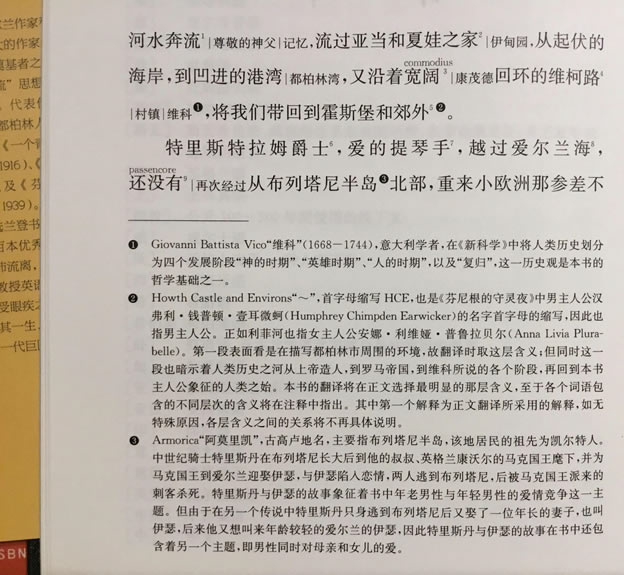
And that wasn’t the end of it. When a book is translated, the new versions become part of the book itself, especially if the author was involved in producing the translation. For several months we had a spin-off group, which studied translations of Finnegans Wake. Joyce’s Italian was good enough to distinguish Triestine from other dialects, and he helped write the Italian and French translations. Those and others have been fastidiously compared by Patrick O’Neill in the book Impossible Joyce, and we compared a number of translations and translators’ accounts of their difficulties, including the two Japanese translations and the fascinating and eccentric German and Dutch translations. Finnegans Wake is currently being translated into Chinese by Dai Congrong, an indefatigable and under-compensated Chinese academic in Shanghai, and we invited her as a guest to talk about her unlikely celebrity when the first volume of her translation became a best seller in China. The photo shows the opening lines of her translation of Finnegans Wake. Note she uses large- and small-print in her main text, and English language glosses above the lines. (If you know the opening of Finnegans Wake, you’ll recognize “commodius” and “passencore.”) There are also two sets of footnotes, ordinary ones and white numbers in black circles. Her translation might just be the world’s most difficult book to read.
We could tell when we’d gotten to the very
bottom of the ocean when we found things the scholars have overlooked, or—even
more fun—mistakes they’ve made. We bought some of the obscure books Joyce
perused, like Les éléments de l’écriture des canailles (Elements of
the Handwriting of Scoundrels), in order to double-check the scholars who
edited The Finnegans Wake Notebooks at Buffalo, and we found dozens of
errors: material for the next generation of scholars. I think our best discovery was a new reading of an especially problematic passage, one of several in which it seems Joyce was thinking about his daughter, Lucia. There is some contentious work about Joyce’s relation to his daughter, who was diagnosed with schizophrenia. In Book I, section 5, on p. 115, there’s a particularly dense passage, so opaque that the principal scholars who wrote page-by-page glosses for Finnegans Wake largely skipped it. We developed a reading that suggests Joyce was remembering an episode in Lucia’s life with an intense and unresolved guilt. These kinds of readings take a lot of patience, especially when they are directed at passages where Joyce was deliberately obfuscating things he’d thought or written. I could just describe what we found, but it’s important to show what a really close reading is like. Otherwise I’m just generalizing and abstracting, like people do in journalism. The passage starts out in perfect ordinary English:
Then it veers into some dense thicket, signaled by an exceptionally creepy word, “incestuish”:
There’ a famous phrase here, “when they were yung and easily freudened,” but the rest is, to quote another part of Finnegans Wake, “the muddest thick.” It doesn’t take a prurient mind to feel something’s wrong, with words like “bisexycle,” “pudendascope,” and “nympholept.” But what is actually going on? Who is confessing to whom? The pages around this passage are especially dense even by the sky-high standards of Finnegans Wake. Danis Rose, one of the principal Joyce scholars and often the most thorough, offers only brief glosses, and he omits several pages entirely. For our passage he has this:
This seems especially reticent, like an expurgated version of a confused and heated testimony. The “virgin most hurt” has become a prostitute, and the “specialized” vocabulary”--words like “lubricious” and “priapic”--have been removed. A fair amount of Finnegans Wake turns on a letter, and it’s reasonable to suppose this passage is part of the endless interpretations of the letter, but even in Rose’s gloss the point is what actually happened. We read the passage more like this:
In our reading, Lucia is imagined or remembered in a bathtub, and something happened that Joyce buried and reburied until it was as close to illegible as anything in English. Our group kept close to the text, and we didn’t take the passage as evidence of an event in Joyce’s life. Finnegans Wake itself is eloquent about its narrator’s torturous guilt and embarrassment, his strong sense of wrong, and the restless revisions it prompted.
On beyond Joyce
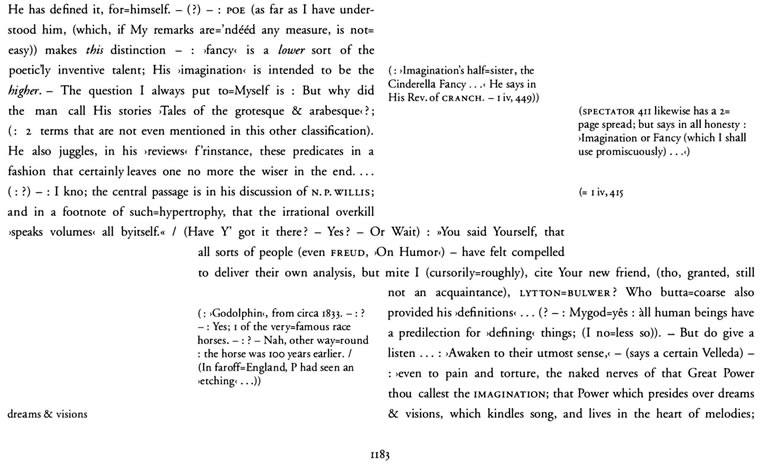
A few years ago I might have said that Joyce is at the limit of how much attention can be paid to long, complex novels. I am no longer so sure. In 2021 I began moderating another reading group, on the German novelist Arno Schmidt and his 1,300 page novel Zettel’s Traum, translated as Bottom’s Dream. Schmidt is a major postwar novelist, better known in German-speaking countries than elsewhere. He was fascinated, challenged, and vexed by Finnegans Wake. He was also a committed student: he had a copy of Finnegans Wake that he annotated in tiny German and English script, and he even tried translating some of it. The earlier author is a ghost in the later one’s book, starting with the title: Finnegans Wake should be spelled Finnegan’s Wake, and in German Zettel’s Traum should be spelled Zettels Traum. From there, the relation just gets more complicated. Schmidt’s book is 1,300 pages, but in effect it’s much longer, because it is typed on large sheets of paper, European A3, which is about 12 by 17 inches. It’s been typeset, and the English translation is typeset, but the original is a “typoscript” of those large typewritten pages. That book is quite expensive, hovering around $1,500. Schmidt estimated each of his pages is the equivalent of four ordinary pages, so the book is really 5,300 pages long. I think that number should be increased to something more like 10,000 pages, because Schmidt disturbs the page in ways that even Joyce didn’t. He misspells words, like Joyce, and truncates dialogue so it can be difficult to decide who’s speaking (as Joyce did in Ulysses), but he also plays with the typewriter keys to produce a kind of typographic playland or chaos. Here’s a short excerpt, taken entirely at random, from the page our group happened to be studying this week.
It’s in three columns, shifting here to the right. The main topic of the entire book is Edgar Allan Poe. Schmidt capitalizes proper names in references; Poe’s name is on the top line of this excerpt. In this passage one of the characters is talking about Poe’s distinction between imagination and fancy. He speaks in the left column, but at the same time a marginal note records what he’s thinking:
At first it might seem this is the painter Lucas Cranach, but it’s typical of Schmidt that it’s someone much more obscure: Christopher Pearse Cranch (1813-1892), whose book of poems Poe reviewed in a collection called “The Literati of New York City.”[8] Schmidt is citing it from his favorite edition, vol. I, iv, p. 449. It may be hard to believe that the narrator remembers not only the citation but the page number of Poe’s review. It’s made more incredible by the implication that he also remembers a page from the eighteenth-century magazine The Spectator—in the other marginal note—at the same time as he’s speaking in the main column. And utterly unbelievable once you notice he’s raising his main question—about why Poe preferred “grotesque” and “arabesque” as names for his tales, even though he wrote at some length about imagination and fancy—at the same time as he’s thinking of imagination and fancy in Poe’s review of Cranach and a passage from The Spectator. Schmidt also continuously plays with typography. Both these marginal thought-notes are in parentheses, which is common, but notice the first ends with an extra close-parenthesis, which might mean something like “the thought definitely ended there,” but may also indicate levels of awareness in the speaker’s mind. Note too that the passage begins with a colon, set apart from the German-style quotation mark, and that half-sister is spelled half=sister. Schmidt likes equal signs to bind two words together, although it’s not clear in this case why he does that. Colons with spaces on either side sometimes indicate brief pauses. In the main text, there’s a pause in the first line, indicated by a dash. Then another character expresses doubt or uncertainty: (?) and after another pause — : the narrator answers. In spoken dialogue that playfulness makes it possible to picture the people talking and gesturing. But in the marginal thought-note, it’s an unspoken pause, and it’s difficult to know how to understand that. The main subject here—what Poe meant by “imagination” and “fancy”—continues for several pages, citing a dozen sources. Both words have long histories, which Schmidt knows, but it’s typical that he bypasses a major source, Freud—his name is in the short middle column—in favor of “LYTTON=BULWER.” That’s Edward Bulwer-Lytton (1803-73), a once-famous novelist. He wrote plays, poetry, and over thirty novels, most of which Schmidt read. If we don’t take time off to read Bulwer-Lytton, we’ll lose a fair number of Schmidt’s allusions. The quotation that ends this page is from volume 6 of the entirely forgotten multi-volume novel Godolphin. This is a tiny sample of what it’s like to read Schmidt. The discussions of Poe and the endless obscure citations go on for hundreds of pages without breaks. When the narrator, Dän, gets tired of one theme, like what Poe thought of “imagination” and “fancy,” he goes on to another with no warning. Dän has a theory about all of literature, and he out-Freuds Freud by reducing all of language to a mostly uncontrolled echo chamber of unnoticed allusions to sexuality. His three friends listen and argue for 1,300 (or 10,000) pages. There are brief stories woven into the book, and fleeting portraits of the villages and countryside in Dän’s part of Germany, but they don’t matter as much as the books, and in the end very little happens. The arguments about Poe are ferociously difficult to disentangle, seldom convincing and never enriching or enlightening, and they usually end by reducing Poe to obscenities and sexual obsessions. To get through even one page, it’s necessary to stop a dozen times to look up often obscure authors and read enough to see why they were cited. Schmidt does not seem to care at all about his characters’ inner lives, or even believe they have inner lives. There are no soliloquies, no reflection, no sense of self-awareness. The outer world is literature: it is what is real, what counts. Yet Schmidt’s taste in literature is very difficult to understand. He likes eighteenth and nineteenth century German and English writers, and he excoriates what he calls “poet-priests” —intuitive writers, given to illogical images, visions, and swamps of feeling. He almost never quotes passages from writers he likes, and when he does, it’s hardly ever clear why he likes them. Schmidt has one of the bleakest outlooks on humanity that I’ve ever encountered: he’s darker than Strindberg or Ecclesiastes, and much more detailed than Beckett (whom Schmidt considered too easy). When Schmidt says he doesn’t want humanity to continue on into the future, he means it. And if all that wasn’t enough, the book is drowned in unthinking sexism and adolescent toilet humor. And yet Bottom’s Dream is an astonishing achievement. It has kept our group going for nearly four years. There’s a force of conviction here, about how to talk about literature, about how literature can be the anchor to what is real even when the rest of the world, and people, and love, have all been ruined. It is an impossibly long and complex monument that will not be sidelined by any ordinary objections about readability or accessibility.
Why spend time this way?
Why do I and the other people in these reading groups torture ourselves when there are so many friendly and enjoyable books to read? Partly because we’re tired of fiction that can be consumed in a gulp, and curious what happens to novels when they are as challenging as their authors can make them. And there’s a wider reason. Given the desperate politics of the moment, the hard rain of anxiety and distractions, I think we appreciate doing something that requires a very different kind of attention, one strong enough to quiet the world for a while. The Finnegans Wake groups were the best reading experiences of my life, including seminars back in college and the many conferences and books I’ve read since then. The groups showed me that the world of books is more than the cycle of prizes, bestsellers, and literary gossip. It’s more than the usual life of rapid reading, going from one novel to the next, skimming reviews in Bookforum and the New York Times. Newspapers and social media are glutted with warnings about dropping literacy rates, book censorship, ADHD, and screen culture, but there are precious few examples of actual slow reading. I hope this essay gives a taste of that. Reading a novel is usually like hiking. You start at the beginning, and the trail of pages takes you from point A to point B. When you reach the last page the book’s over. Reading the world’s most complex novels is like swimming in the open ocean: you can’t see where you’re going, there’s no path and no place to rest. Swimming in the ocean can feel like treading water. Are you moving forward? Or are the ocean currents just pushing you around? No one finishes books like Joyce’s
or Schmidt’s. You never get to the last page and say, Ah, that was great. Now I
can get on to the next book. The most complex novels are endless projects of
rereading, each deepening the last. Over months and years you get to know it,
slowly and imperfectly, over the years, like a person.
|

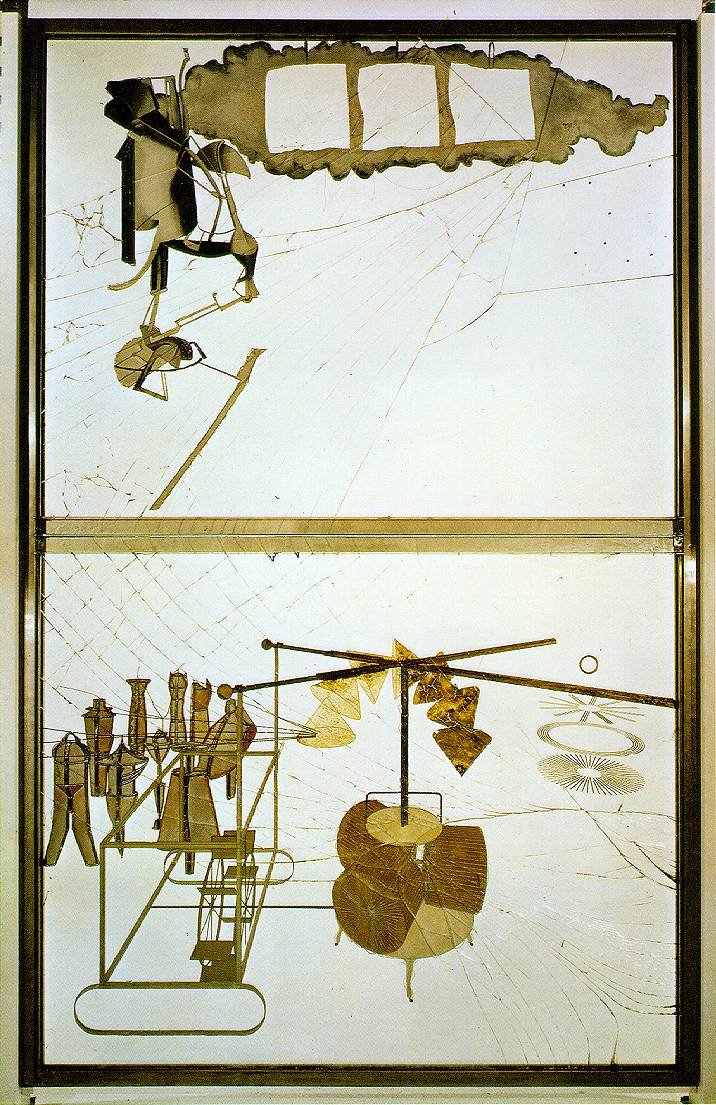
Art Note: The Bride Stripped Bare by Her Bachelors, Even (The Large Glass) (1915–1923), Marcel Duchamp. Lead wire, oil, dust, and cracked glass, built not to solve a geometry, but to let the engine of meaning stumble over its own blueprint. It asks to be read continuously, slowly, and without the comfort of a final landing. Oil, varnish, lead foil, lead wire, and dust on two glass panels, 277.5 × 177.8 cm. Philadelphia Museum of Art — Bequest of Katherine S. Dreier.