CULTURE, INSTITUTIONS, AND ECONOMIC GROWTH
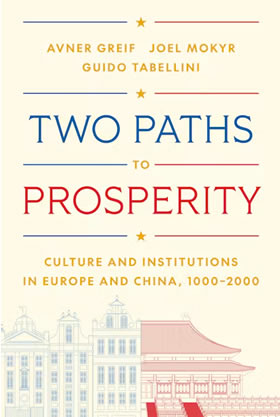
TWO PATHS TO PROSPERITY: CULTURE AND INSTITUTIONS IN EUROPE AND CHINA, 1000–2000 (Avner Greif, Joel Mokyr, and Guido Tabellini · Princeton University Press, 2025) By Xu Xiaonian *** The Montréal Review, November 2026 |
||||
China and Britain lie at opposite ends of the Eurasian continent. At a time when Chinese civilization reached a medieval peak in economic and technological development during the Song dynasties, Britain remained comparatively poor and underdeveloped. Yet from the mid-seventeenth century onward, Britain embarked on a path without historical precedent. Beginning with the Agricultural Revolution and culminating in the Industrial Revolution, it laid the foundations of modern commercial and industrial civilization. Over the following centuries, Britain came to dominate the world economy and shape the international order. China followed a markedly different trajectory. During the Ming and Qing dynasties, it became increasingly inward-looking and conservative. The economy stagnated. In the Opium War, China suffered a decisive defeat at Britain's hands. This reversal in the relative economic fortunes of East and West is what the California School, above all Kenneth Pomeranz, terms the “Great Divergence.”[1] Why did the Industrial Revolution occur in Britain rather than in the Qing Empire—a vast polity endowed with abundant resources and a large population? Few questions have generated more sustained debate among economic historians. In 2025, Joel Mokyr and his coauthors published Two Paths to Prosperity: Culture and Institutions in Europe and China, 1000–2000 (hereafter Two Paths), offering a new systematic answer to this puzzle. Unlike conventional accounts that posit unidirectional causality, the book frames historical development as a process of mutual interaction and co-evolution among culture, institutions, and economic outcomes. The result is a perspective that departs in important respects from more conventional accounts.[2] Viewed against the broader evolution of growth theory, the analytical focus has shifted from physical capital to human capital, and then to institutions and other forms of social capital. Mokyr extends this line of inquiry by placing knowledge at the center of the analysis. In his view, the production and accumulation of knowledge constitute the ultimate source of economic growth and the principal explanation for the emergence of the Industrial Revolution in Britain (a theme discussed in greater detail below). That same year, he received one half of the Nobel Memorial Prize in Economic Sciences “for having identified the prerequisites for sustained growth through technological progress.”[3] Notably, Peter Drucker popularized the concept of the “knowledge economy” in The Age of Discontinuity (1969). He treated knowledge as a fourth factor of production alongside land, labor, and capital—arguably the most fundamental of all.[4] From the sixteenth century onward, Europe experienced an explosion in the production and dissemination of knowledge. Its defining feature was the integration of science, technology, and commerce into a single evolving system. The Industrial Revolution emerged from the interaction and mutual reinforcement of these three spheres.[5] The rise of science benefited from what Mokyr calls the “Republic of Letters.” Commercial demand stimulated technological development and thereby indirectly promoted scientific progress. Scientific achievements, in turn, strengthened the belief that nature was intelligible. Encouraged by this belief, people increasingly explored both nature and economic life. They developed new technologies and transformed them into engineering and commercial applications. These activities generated substantial economic returns, which were subsequently reinvested in scientific research and technological development, creating a self-reinforcing virtuous cycle. Ming–Qing China never developed a system of modern science comparable to that which emerged in Europe. Technological innovations rooted in practical knowledge were also far less numerous than during the Song period. The production of knowledge entered a state of stagnation, and in some respects, even decline. More importantly, China never developed a socio-economic order in which science, technology, and commerce became mutually reinforcing. Yet China's extraordinary economic performance since Reform and Opening-Up poses a serious challenge to what would otherwise seem a compelling account. Since culture and institutions typically evolve slowly and exhibit strong historical persistence, a natural question arises: why did broadly similar cultural and institutional arrangements impede economic development in Ming–Qing China, yet support one of the most extraordinary episodes of economic growth in the modern era? Two Paths attempts to address this difficult question. Yet a careful reading suggests that the book ultimately falls short of providing a fully satisfactory answer. Although it moves beyond the assumption that modernization must follow a uniquely Western path, the evidence remains thin at several critical junctures, and the argument contains tensions that are not easily reconciled. To present the analytical framework and conclusions of Two Paths more clearly, it is useful first to introduce several basic concepts of economic growth and then briefly review the evolution of growth theory.
From Material Factors of Production to Knowledge
Economic growth is ultimately about improvements in living standards. For this reason, economists generally focus on per capita income or per capita GDP rather than aggregate output. The objective of economic development is not simply to produce more goods and services, but to raise the living standards of individuals. Crucially, only efficiency gains—not output expansion driven by increased factor inputs—can sustain long-run growth. Throughout this essay, therefore, “economic growth” refers to sustained increases in per capita GDP or labor productivity unless otherwise specified. Throughout the long agrarian era, virtually all societies were trapped in what economists later came to describe as the Malthusian cycle. Given a fixed stock of arable land and unchanged production technology, population growth reduced the amount of land available per person. Although the labor force expanded, diminishing returns to labor caused per capita output—and therefore per capita consumption—to decline.[6] Malnutrition weakened resistance to disease. Epidemics spread more easily. Competition over scarce resources frequently generated social unrest and warfare. Disease and conflict then reduced the population, increasing the amount of land available per capita and allowing economic recovery to begin anew. Yet the prosperity that followed merely laid the foundations for the next crisis. The historic significance of the Industrial Revolution lies in the fact that it broke this cycle permanently. For the first time in human history, sustained growth in living standards became possible. Recognizing the fundamental differences between agricultural and industrial production, economists increasingly shifted their attention from land and labor to capital. Industrial production appeared capital-intensive, whereas agriculture remained predominantly labor-intensive. Accordingly, the question of why modern growth first emerged in Britain was recast as one of why large-scale capital accumulation took root there first. Douglass North and Barry Weingast famously argued that the Glorious Revolution of 1688 established parliamentary supremacy and fundamentally altered the institutional foundations of the English economy. Constitutional government and an independent judiciary constrained the Crown's ability to expropriate private property and strengthened the credibility of property rights protection.[7] As a consequence, the emerging middle classes developed secure expectations about future returns, fueling an unprecedented wave of entrepreneurship and investment. Landowners, tenant farmers, merchants, artisans, lawyers, judges, and other participants in England's expanding commercial society invested accumulated savings and profits in overseas trade, large-scale agriculture, cotton manufacturing, mining, metallurgy, and a wide range of other productive activities. By the middle of the eighteenth century, these developments had evolved into the broad economic transformation that later became known as the Industrial Revolution.[8] Secure property rights not only encouraged investment but also facilitated finance. Public debt markets emerged. Private debt and equity markets expanded. Financing costs gradually declined. Capital markets became an indispensable component of the modern economy. Without secure property rights—including the rights of shareholders and bondholders to the returns generated by their assets—the existence of modern capital markets would be difficult to imagine. Capital accumulation was indispensable to the Industrial Revolution. Yet it could not, by itself, generate sustained economic growth. Like land and labor, capital is subject to diminishing returns. Holding all other factors constant, the return to an additional unit of capital declines as the stock of capital increases. Purchasing a second computer does not double productivity. Beyond a certain point, additional investment merely creates excess capacity and ceases to have any effect on output. This insight lies at the heart of the Solow model.[9] The implication is straightforward. Sustained growth ultimately depends on technological progress. Yet in the Solow model, technology arrives from outside the system. It appears, as it were, as manna from heaven. The model explains why growth occurs, but not where technological progress originates or how it is generated. To address this problem, economists such as Paul Romer developed endogenous growth theory. In this framework, the central driver of growth is no longer capital accumulation but the accumulation of knowledge.[10] Unlike conventional factors of production, knowledge exhibits increasing returns. For example, secondary-school knowledge contributes more to labor productivity than primary-school knowledge, while university education contributes still more. More importantly, knowledge possesses a characteristic absent from land, labor, and physical capital: it is non-rival. Physical capital is rivalrous. If one worker uses a machine, another cannot simultaneously use the same machine. Knowledge is different. Once created, it can be used by many individuals at the same time without being depleted. Machines wear out. Knowledge does not. This non-rival character generates spillovers. The benefits of innovation extend well beyond the original innovator. Not only do individuals such as Isaac Newton or Steve Jobs benefit from their discoveries; society as a whole does as well. Building on this insight, economists such as Paul Romer (a 2018 Nobel laureate) and Peter Howitt (a 2025 Nobel laureate) examined the market mechanisms through which knowledge is produced. Their conclusion was that monopolistic competition is indispensable to the innovation process.[11] The relationship is paradoxical only at first glance. Monopoly and competition are not opposites but complements. Monopoly profits create incentives to innovate. Competition continually threatens those profits. New entrants challenge incumbents, erode established rents, and disrupt existing market structures. To survive, market leaders must innovate continuously or risk being displaced by what Joseph Schumpeter famously termed “creative destruction.” Endogenous growth theory carries policy implications that differ fundamentally from conventional macroeconomic wisdom. If knowledge creation is the ultimate source of growth, governments should strengthen the protection of intellectual property rights to encourage innovation. Fiscal policy should focus on funding research, development, and education, thereby expanding society's stock of knowledge. Monetary policy, by contrast, serves primarily as an instrument of macroeconomic stabilization and has little, if any, bearing on long-run economic growth. Traditional Keynesian policies operate largely through the demand side of the economy. Yet neither higher consumption nor higher investment necessarily produces new knowledge. Demand can stimulate spending, but it cannot by itself create knowledge. Endogenous growth theory therefore places greater emphasis on productivity gains rooted in innovation and knowledge accumulation. The relationship between monopoly and innovation also invites a reconsideration of antitrust policy. Monopoly has long been demonized in both economic discourse and popular imagination. Yet one of the central insights of endogenous growth theory is that innovation often creates temporary monopoly power—and that monopoly power can itself become a powerful engine of further innovation. Governments should therefore be cautious in using administrative and regulatory measures to reshape market structure. In many cases, competition in open markets provides a more effective check on monopoly power than direct administrative regulation. So long as markets remain open, any monopoly is bound to be limited in scope and temporary. Building upon these foundations, Mokyr investigates the nature of knowledge, the mechanisms through which it is produced, and the cultural and institutional environments that facilitate its accumulation and diffusion. From this perspective, he offers an explanation for one of the central questions of modern economic history: why the paths of East and West diverged so dramatically after the early modern period.
Knowledge Production
Mokyr begins by distinguishing between two forms of knowledge: propositional knowledge and prescriptive knowledge. The former concerns what the world is and why it works as it does; the latter concerns how things can be done. Together, these two forms constitute what Mokyr calls “useful knowledge.” They correspond broadly to science and technology, although Mokyr is careful to distinguish propositional knowledge from science and prescriptive knowledge from technology.[12] Science seeks to understand the world and the principles that govern it. Technology seeks to put that understanding to work. The former is driven largely by curiosity and the pursuit of knowledge; the latter by the desire to solve practical problems, improve efficiency, and create value. Scientific discoveries can profoundly reshape our understanding of the world. Newtonian mechanics, Einstein's theory of relativity, and Darwinian evolution are powerful examples. Technology, by contrast, is directed toward application. Its purpose is not merely to understand nature but to harness it. Mokyr's conception of knowledge extends beyond the natural world. It also encompasses knowledge about human society, including institutions, organizations, and systems of management. At the same time, he emphasizes that knowledge of nature and knowledge of society differ fundamentally in character and evolve according to different mechanisms. In Chinese, these two distinct concepts are unfortunately often bundled together under the single term keji—literally, “science and technology.” Yet the distinction matters. Science provides direction for technological development and accelerates the pace of innovation. Technology, in turn, generates new questions, new instruments, and new opportunities for scientific discovery. The relationship is reciprocal rather than one-directional. Mokyr illustrates this interaction through a series of historical examples. During the early stages of the First Industrial Revolution, science had not yet assumed a dominant role. Skilled craftsmen such as Newcomen and Watt improved the steam engine largely through experimentation and practical experience. Yet the technical challenges encountered in building and improving steam engines stimulated research in thermodynamics, while subsequent advances in thermodynamic theory made further technological breakthroughs possible. The Second Industrial Revolution unfolded differently. Here science increasingly moved to the forefront. Scientific discoveries were translated into technological applications and then into industrial production. In 1866, the German entrepreneur Werner von Siemens constructed a dynamo based on the dynamo-electric principle, laying the groundwork for modern electric generators. In 1869, BASF chemist Heinrich Caro, working with Carl Graebe and Carl Liebermann, synthesized alizarin—the red dye derived from madder—from coal-tar derivatives, helping to replace a costly natural dye with a synthetic alternative. The pattern persisted into the twentieth century. Physicists established the theoretical foundations of semiconductor technology long before its commercial applications became apparent. In 1947, John Bardeen and Walter Brattain built the first working point-contact transistor at Bell Laboratories; together with William Shockley, they shared the 1956 Nobel Prize in Physics. Shockley later founded Shockley Semiconductor Laboratory. Eight of its engineers left to establish Fairchild Semiconductor, and Fairchild co-founders Robert Noyce and Gordon Moore subsequently founded Intel.[13] Science and technology together are not sufficient to ensure the sustained production of useful knowledge; markets—and especially venture-capital markets—are indispensable. Venture capital differs fundamentally from both debt finance and conventional private equity. It involves not only greater risk but also a greater degree of specialized judgment. Investors must often make decisions when neither technologies nor markets have been fully validated. Under such conditions, experience, intuition, and entrepreneurial understanding become critical. It is no accident that many of Silicon Valley's most successful venture capitalists are themselves former entrepreneurs. The link between technological innovation and risk-bearing capital, however, long predates the modern venture-capital industry. As early as the age of the steam engine, technological innovation depended upon financial backing. Watt's partnership with Boulton provided not only expertise in metalworking and manufacturing but also access to capital. Today the scale is vastly larger. Investments in frontier AI development can run into tens or even hundreds of billions of dollars. Such undertakings would be inconceivable without sophisticated capital markets capable of mobilizing enormous financial resources. The importance of finance is reflected in contemporary international comparisons. Europe and Japan continue to lag behind the United States in artificial-intelligence development. One important reason is institutional. Financial systems in Europe and Japan remain heavily dependent upon large banks and insurance companies, institutions that are generally more risk-averse than venture-capital investors. By contrast, the United States has developed a deep and highly active venture-capital ecosystem capable of financing exceptionally uncertain technological ventures. At this point, Mokyr shifts attention from knowledge itself to the institutions that make knowledge production possible. Chief among these is what he calls the market for ideas. Like markets for goods and capital, the market for ideas is fundamentally competitive. Theories, beliefs, hypotheses, proposals, and insights compete for acceptance. No single authority, nor a small group of authorities, determines what is true and what is false. Only knowledge that survives debate and empirical testing can be accepted and preserved. According to Mokyr, such a market first emerged in Western Europe. Political fragmentation played an important role. So too did the gradual weakening of ecclesiastical authority. Scholars increasingly escaped the intellectual and spiritual constraints long imposed by the Roman Church. When persecuted in one jurisdiction, they could often relocate to another. Even in exile, they could remain connected through travel, publications, and correspondence. More importantly, wherever they resided, scholars retained the freedom to think independently while adhering to a shared set of scholarly norms and standards. In this way, they formed the transnational intellectual community that Mokyr calls the Republic of Letters. More precisely, the Republic of Letters was an informal social network devoted to the production and dissemination of knowledge. Its participants included not only scholars but also engineers, entrepreneurs, lawyers, judges, and other members of the emerging middle classes. Through their interactions, the boundaries separating science, technology, and commerce became increasingly porous. The Lunar Society of Birmingham, of which Watt was a member and beneficiary, provides a classic example. Over time, the Republic of Letters gave rise to what Mokyr describes as the Industrial Enlightenment. Rooted in the Renaissance and the Enlightenment, yet pointing toward the Industrial Revolution, the Industrial Enlightenment fostered a fundamentally progressive view of history and the world. Human beings, it assumed, were capable of understanding the world. More than that, they possessed both the ability and the obligation to use knowledge to improve it. Economic and social progress thus came to be seen not as accidents of history but as achievable outcomes of human effort.[14]
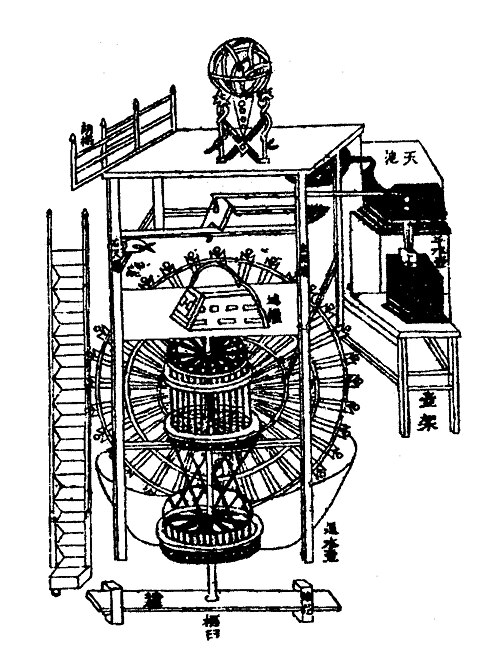
Art Note: Su Song, Xinyi xiangfayao, 1092. A water wheel turns inside the tower, and an armillary sphere on its roof follows the heavens. The machine stood in Kaifeng until 1127. The book remained. Woodcut illustration of the water-driven astronomical clock tower. Public domain. Image: Wikimedia Commons.
Ming–Qing China stood in sharp contrast. Among educated elites, the political and social order of the Three Dynasties was widely regarded as an unsurpassable ideal. Confucius and Mencius occupied the status of ultimate intellectual authorities. Later generations might interpret their teachings, but they were not expected to challenge them, much less transcend them. The examination-bureaucratic system reinforced this intellectual order. Success in the examinations served as the principal route to official office and social advancement. Generation after generation, it supplied the state with officials trained in orthodox doctrine, turning the entire educational system—public and private alike—into a brainwashing machine. The entire content of education consisted of studying and memorizing the Four Books and Five Classics, and its ultimate goal was to pass the examinations and enter the privileged bureaucratic class. Western science and technology entered school classrooms only after the imperial examination system was abolished in the late Qing period. In such an environment, neither a Republic of Letters nor a genuine market for ideas could emerge. The contrast extended beyond intellectual life. Although private property was widespread during the Ming and Qing dynasties, property holders lacked the political influence enjoyed by their British counterparts. They could not enter representative institutions and shape legislation designed to strengthen the protection of property rights. Up to this point, the explanation offered by Two Paths remains broadly consistent with the mainstream interpretation of the Great Divergence in economic history. Yet the central puzzle remains. How, then, are China's extraordinary achievements since Reform and Opening-Up to be explained? There are, in principle, only two possible answers. Either China's institutions and social structure have undergone fundamental transformation since the late imperial era, or traditional structures do not necessarily impede industrialization and may, under certain conditions, even facilitate it. Two Paths largely embraces the latter interpretation. Chapter 10 argues that two longstanding features of Chinese society re-emerged during the Reform era: social organization based on kinship networks and a centralized bureaucratic state. Under cultural and institutional conditions markedly different from those of Britain, China followed an alternative path to prosperity. This is not, however, a claim of Chinese exceptionalism. As Mokyr himself recently remarked in Shanghai, one might equally describe the historical experience of Western Europe as a case of exceptionalism. First, in an environment where property rights and legal institutions remained underdeveloped, clans and other forms of social organization rooted in kinship ties and personal relationships played important economic roles. Kinship networks and local connections provided the foundation for spontaneous market exchange, and markets expanded gradually through these informal social networks. Empirical studies find a significant positive relationship between village-level kinship ties and the number of private enterprises, as well as a negative relationship with civil and commercial disputes. The evidence suggests that informal social networks compensated, at least in part, for deficiencies in the formal legal system. Clans once again assumed responsibility for the provision of local public goods, including the protection of property rights against official encroachment, the maintenance of local welfare, participation in public works projects, and the operation of mutual-aid arrangements. Relatives and friends also constituted the principal source of finance during the formative stages of private-sector development. Capital from overseas Chinese communities likewise flowed disproportionately toward native towns and ancestral home regions. Second, the state regarded social stability as its primary objective, while economic development was regarded as the principal means of achieving it. This priority permeated the administrative hierarchy through the cadre promotion system. The advancement of local officials depended heavily on the economic performance of their jurisdictions relative to competing regions, while officials also shared in the fruits of local economic expansion through taxation and various forms of rent extraction. The bureaucratic apparatus proved highly effective in implementing development-oriented policies. Two Paths regards this as a distinctive and advantageous form of state capacity. Yet it is difficult to avoid a fundamental inconsistency when the same traditional culture and social structure are invoked both to explain the economic stagnation of Ming–Qing China and to explain the achievements of the Reform era. Moreover, the conclusions of Two Paths rest on limited empirical support, while its interpretation of China's economic reforms bears traces of accommodation to prevailing academic fashions. The problem, then, is clear. How can one retain the core insights of the knowledge-economy framework while avoiding conclusions that are difficult to sustain logically? I offer a tentative approach by distinguishing between different forms of knowledge.
Catching Up or Surpassing?
Two Paths emphasizes differences in cultural and institutional traditions. Yet it largely overlooks a distinction that lies at the heart of economic development: the distinction between the creation of knowledge and the acquisition of knowledge. As the world's first industrial nation, Britain had no model to emulate. Nor did it possess the guidance of theorists or ready-made blueprints. It was compelled to invent new technologies, experiment with novel forms of business organization, develop financial instruments, and conceive entirely new products. Through a long process of trial and error, market competition ultimately selected innovations such as the spinning jenny and Watt's steam engine. Innovation of this kind—from zero to one—resembles biological evolution. Just as the extraordinary diversity of the Amazon rainforest creates the conditions under which new species emerge, institutions such as the Republic of Letters, the market for ideas, secure property rights, and freedom of inquiry create the conditions under which innovation can flourish. Once Britain had blazed the trail, however, other countries discovered a shortcut: learning and imitation. The transition from one to N places far less demanding requirements on culture and institutions than the transition from zero to one. So long as a country remains open to the outside world, allows markets to play a meaningful role, and protects basic private property rights—including rights to the returns generated by assets—industrialization becomes relatively straightforward. The importance of openness lies not merely in enlarging markets or attracting foreign capital. More fundamentally, it provides access to knowledge at relatively low cost. Beginning in the mid-nineteenth century, continental European countries such as France and Germany, together with Japan in East Asia, followed Britain's example. They purchased machinery, imported engineers and skilled workers, dispatched study missions abroad, collected technical information, and invested heavily in large-scale industrial enterprises. These countries also adapted British experience to their own circumstances through reforms in institutions, economic organization, and public policy. By removing at least some of the premodern barriers to industrialization, they substantially narrowed the gap with Britain within a few decades. Germany eventually surpassed Britain by building upon the strengths of its scientific, financial, and educational systems. This is the classic advantage of backwardness: the cost of learning and imitation is far lower than the cost of original innovation.[15] As industrialization spread across the globe, it encountered cultural traditions and institutional arrangements very different from those of Britain. Yet neither German statism and “market feudalism,” nor the bureaucratic order organized around imperial authority in Japan, nor the military dictatorships of postwar South Korea and Chile prevented industrialization from taking root and prospering. If successful models already exist from which others can learn, prosperity through industrialization need not be confined to two paths. Many paths may exist. The real challenge lies not in catching up but in surpassing; not in acquiring knowledge but in creating it. This observation is not intended to diminish the importance of imitation. Nor does it imply that late-developing economies are incapable of innovation. On the contrary, imitation has often been an indispensable stage in the development process. Chapter 3 of Two Paths itself notes that in agrarian societies and relatively simple commercial economies, social structures organized around personal relationships need not constitute a major obstacle to economic progress. Once technological change accelerates, however, such structures may become constraints. Existing social relationships and institutions tend to favor stability over experimentation, thereby discouraging the individual imagination and creativity upon which innovation ultimately depends. Although Mokyr and his coauthors recognize these limitations, they nevertheless assign considerable importance to the role of kinship networks and personal relationships in China's post-1978 economic rise. In my view, this interpretation is more persuasive when applied to the formative stage of private-sector development during the Reform era. Today, personal relationships undoubtedly remain important. Compared with formal contracts and legal institutions, however, their role has become distinctly secondary. A similar ambiguity surrounds the concept of state capacity. Because the term lacks a widely accepted and rigorous definition, it is particularly susceptible to misunderstanding. If state capacity is understood simply as the state's ability to command and allocate resources, then China's transition from the planned economy to Reform and Opening-Up involved a deliberate reduction in that capacity, opening more room for markets and private enterprise. The expansion of markets and private enterprise occurred largely because a growing share of economic activity was removed from direct administrative allocation and exposed instead to market coordination. Once the distinction between knowledge acquisition and
knowledge creation is brought into focus, China's economic success remains
entirely compatible with the analytical frameworks of New Institutional
Economics and endogenous growth theory. Seen from this perspective, Mokyr's
analysis of the knowledge economy remains not only valid but highly relevant to
contemporary China. As the era of imitation-led industrialization gradually
approaches its limits, the cost of acquiring advanced technologies has risen
sharply for a variety of reasons. China is therefore approaching—or may already
have entered—a stage in which it must move from acquiring existing knowledge to
creating new knowledge through its own innovation. Under such circumstances,
the cultivation of a Republic of Letters, the expansion of the market for
ideas, and the establishment and enforcement of credible protection of property
rights—especially intellectual property rights—become matters of increasing urgency.
Learning and imitation may enable latecomers to catch up with the pioneers. To
surpass them, however, the cultural and institutional foundations of Mokyr's
Industrial Enlightenment are indispensable.
|

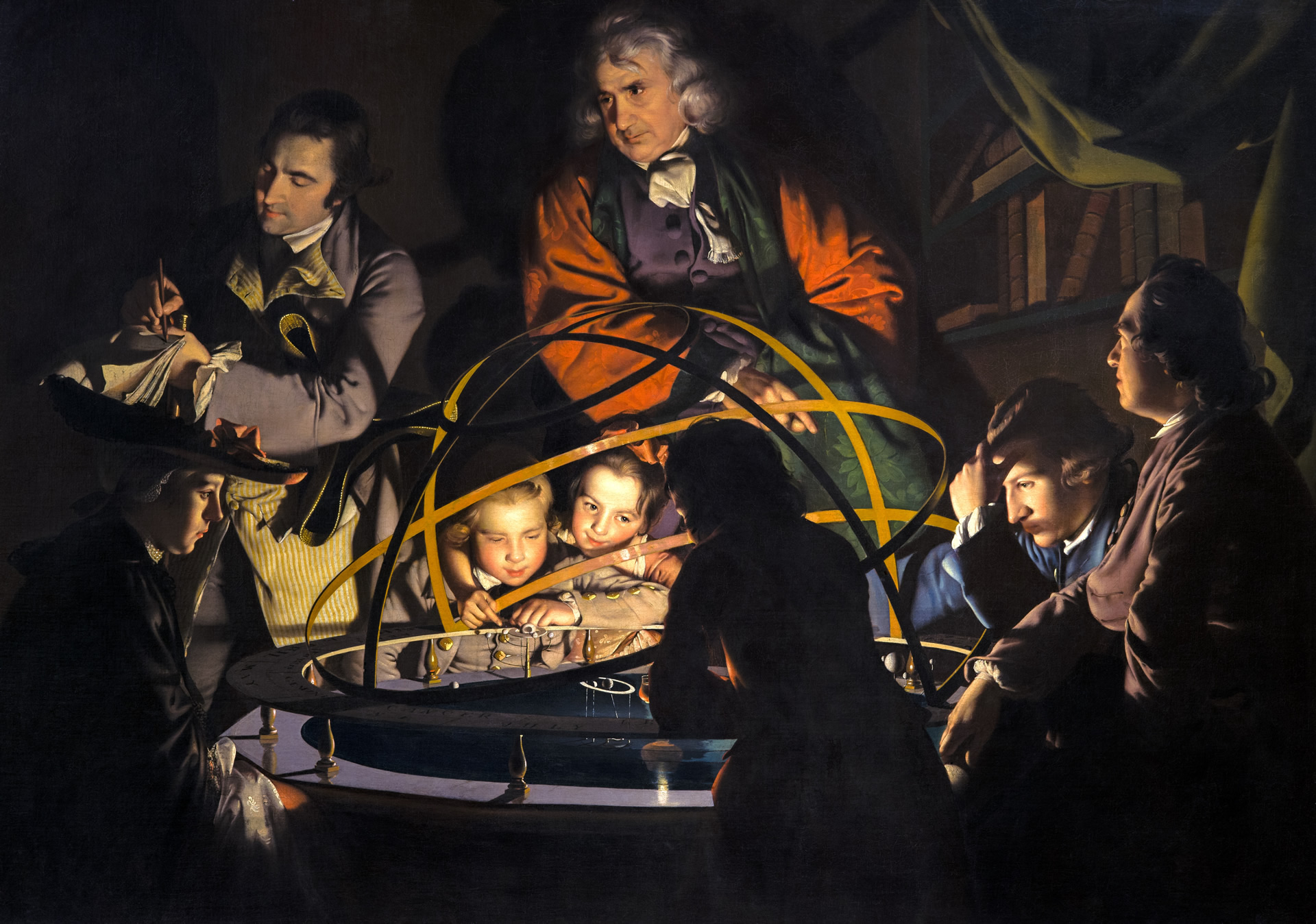
Art Note: A Philosopher Lecturing on the Orrery, Joseph Wright of Derby, c. 1763–65. Orient once meant the rising sun. Here a lamp stands in its place, brass planets turn on their arms, and the faces round the table, lit from the center, follow the lecturer’s hand. Oil on canvas, 147 × 203 cm. Collection Derby Museum and Art Gallery.