CAMELOT—THE MYSTERIOUS LEGEND By Steve Davidson *** The Montréal Review, August 2026 |
|||
Camelot . . . the very name breathes an air of romance, courage, adventure, and beauty. But more than that. Camelot gives dramatic substance to the underlying concepts of Christianity—compassion, generosity, and a philosophy of peace and security. The paradigm knight, Sir Galahad, brave, strong, and gallant, was deeply spiritual. “But soft”, as Shakespeare said. Where was Camelot? Did it ever really exist? And who was King Arthur? Did he ever really exist? Guinevere? Lancelot? The Round Table? No one knows. But everyone wonders, because Camelot symbolizes the world everyone wants to live in, and the kind of people everyone wants to know and be around. Such symbols are powerful. They inspire us, they guide us, and they put a stamp on our societies. They make us better people.
The Camelot Puzzle
The history of the legend is fascinating. But tangled, and, dare one say, mysterious. Eh? Was “Arthur” truly the gracious British paragon of valor and decency beloved the world over? Or was he some kind of minor, transient Welsh chieftain, battling invading Saxons to a draw, who got larded with exotic but dubious fame, a convenient local peg on which to hang a romantic ideal? Was Camelot really the rugged, and devastatingly dreamy-looking, Tintagel Castle, on the coast of Cornwall, or not? Was Camelot the sturdy hillfort at Cadbury, or what? Was the island of Avalon, resting place of King Arthur, a hill in the middle of Glastonbury? Those were wetlands long ago, so the hill looked like an island, even though, now, it’s just a hill, with a tower, among fields. Hmm. If Camelot was in Britain, where was it? They could find Troy. They could find Knossos and Akrotiri. They could find Angkor Wat. Why can’t they find Camelot? This whole shebang, set in the British Isles, after the orderly Romans exited and the British civitas crashed into chaos, was supposedly occurring in about the year 600. But then, how come the Camelot story didn’t show up, in full legendary livery, in any kind of public record or literature until after Crusaders returned from the Eastern Mediterranean? For Anglophiles, the authority on Arthurian matters is Geoffrey of Monmouth; however, his dubious, though electrifying, History of the Kings of Britain, didn’t appear until the 12th century. Often cited as the mother lode of the truly rich Camelot lore, Chrétien de Troyes’s Arthurian romances don’t seem to have materialized in France until the late 12th century. Similarly, some people’s nth degree Arthurian authority is Sir Thomas Malory and his Le Morte d’Arthur, but that didn’t appear until the 15th century. Hmm. Very curious. Many colorful pieces, but still a puzzle. Pray let us consider.
Arthurian Oddities
a) King Arthur. Hey, if Arthur was the king, why doesn’t he do more? He’s almost like a genial cipher, or the facilitator of a growth group for knights, or a king in a game of chess, secondary to the queen. b) Queen Guinevere. An affair with Lancelot? What was she thinking? Is this proper behavior for the lady of the castle? What will the peasants say? (To paraphrase Oscar Wilde, “Really, if the upper orders don’t set us a good example, what on earth is the use of them?”) c) Merlin. Let’s not be churlish here. However, probably not too many people would claim that Celtic culture is overburdened with clever technologists of broad learning and strategic wisdom. So, how is it that a shrewd advisor to the king slips into the Camelot story? Where does that come from? Mm? d) Excalibur. Smirk, if you will, along with everyone else. Who ever heard of a fantastically powerful sword of justice stuck in a stone—trapped in the ground, basically? Then how is it that some bright young lad comes along and is able to pull it out? Then it gets thrown across a lake, and a woman’s hand reaches up and catches it. Ridiculous, no? Charming and colorful, but not quite likely. e) Lady of the Lake. C’mon! This is the North Atlantic. What naked lady is going to be lurking in the water, then holding swords she can’t even see? Where is that from? f) Sir Lancelot. An affair with the king’s wife? What was he thinking? The Spanish Inquisition may have been a while away, but surely he had an imagination. This was, after all, the Dark Ages—halcyon days of slow, brutal murders, for even trivial offenses. g) The Round Table. Does this really make sense? What if a few more knights get added? Where will they sit? What if a few knights get killed? Wouldn’t the spaces at the table be a painful reminder? h) Sir Galahad. He’s young and handsome, highly integritous, brave, and an excellent fighter, but he seems completely uninterested in the fair maidens he encounters. What’s up with that? The only thing he seems interested in is questing after the Holy Grail—that is, bringing fertility back to the land, and then dying and going to Heaven. Is this reason? Is this Britain? What is this? i) The Holy Grail. Legend has it that the Grail is the glorious cup from which Jesus drank at the Last Supper. Discovering the Grail would return fertility to a wounded land. (T.S. Eliot, of course, powerfully, if opaquely, linked The Wasteland to the Grail legend.) The Last Supper was in the Levant, by the eastern Mediterranean Sea. So, how did the Holy Grail get from the sunny eastern Mediterranean to the moody, bucolic wilds of Britain, 3,000 miles away? And why? A little suspicious. And what’s with the Fisher King, the possible final possessor of the Grail? Wouldn’t a king in Britain be a Fox king, or a Stag king, something more akin to the hunting habits of a British leader? j) All those other knights. Who are all these people? Sometimes it seems like Arthurian romances are not about the royal court, the king and queen, who, one would think, would be the key characters, but rather some sort of roll call of knights. Sir Alpha. Sir Bravo. Sir Charlie. Sir Delta. And so on. Right up to Sir Zulu. What gives? k) Chivalry in general. Cheval is French for horse, leading to the word chivalry. Horses are expensive, and the popular presumption is that wealthy people are trained to be courteous (a word coming from court), and courageous, and are in a position to be generous. A splendid collection of traits—courteous, courageous, and generous. Thus, someone riding a cheval would be someone noble and honorable—someone chivalrous. Ironically, knights began as young household pages, thus were directly supervised by women, and so were taught to respect, trust, and acquiesce to women. Pages wouldn’t be promoted up to pre-combat squire status until they demonstrated proper domestic attitudes. However, in the mad warp and woof of history, “chivalrous behavior” has acquired the contrary sense of disrespecting, dominating, and exploiting women. (Out with the bath, out with the baby.) l) The Worthy Opposition: Dragons. Despite what the t-shirt sellers around Loch Ness might have you believe, dragons are rare in Britian. Thus, it’s a little unclear as to why the prototypical combat opponent of an Arthurian knight is a dragon. Arthur usually is considered Welsh, and a symbol of Wales is the dragon, so there may be a vague connection. Perhaps it’s simply more dramatic than fighting the tide, or the inevitable. (Literature, after all, is ever on the hunt for gossip, scandal, conflict, and unlikely plots.) m) Camelot per se. Close your eyes. Put your finger on a map of Britain. There’s Camelot. (Unless it’s somewhere else.)
A Daring Explanation
Now, not to be excessively persnickety, but this Welsh-Celtic-Briton-French Arthurian tale appears to be a shambles, with a raft of questionable constituents. Why is it that so many pieces of this glorious myth just don’t compute? Well, it may be that the original story made nearly perfect sense, but that was a long time ago, in a land far away. The ancient Eastern Mediterranean was a cornucopia of wonderful ideas, fabulous characters, nearly magical locales, great beauty, and transporting legends. Splendid Çatalhöyük may be the root of the Camelot story. Çatalhöyük was a marvelous, massive habitat, about ten thousand years ago, in Southeastern Anatolia. Around five thousand people all lived together in one huge, cobbled-together building (something like a castle). It was probably on a hill, within rivers, among wetlands, fields, and forests (something like an island, that is, like Avalon). The residents probably were on a trade route running from Anatolia to the Middle East, so, likely they were prosperous—able to trade produce and woolens, for example, for materials like silver and lapis lazuli (like royalty). The bizarre thing is that these people seemed to live in a golden harmony with each other, with neighbors, and with passing traders . . . for thousands of years. Their harmony may have been aided by their religion, which, as far as can be discerned, involved a conception of nature as loving and nurturing, humanity as powerful and good, and heaven as awaiting those who did, and said, the right things in life. That is, it seemed to be a thriving community based on a fundamental culture of . . . love. Ironically, or significantly, two of Western culture’s premier standard-bearers of love and generosity are from that Anatolian area. Saint Paul was from Tarsus, and Saint Nicholas was from Myra, both on the Mediterranean coast just south of Çatalhöyük. Again, perhaps coincidentally, or significantly, one of the key founders of Stoicism, Chrysippus, was from Mersin, also on the Mediterranean coast just south of Çatalhöyük. (That’s three, for you who like to count.) Stoicism is a philosophy renowned for its serenity and emotional self-control in the face of difficulties. It has many commonalities with the subsequent neighboring religion, Christianity. A curiosity of Greek language is that it has a broad and appealing array of terms for the concept of love. Eros is the obvious one—romantic desire. Philia is friendship, often a prelude to eros (just as people often note that a strong spousal relationship has a solid friendship basis). Speaking of families, storge is the term for love among family members. As recognized by most people who marry and have children, there is a pragmatic side to marriage and parenthood. It's not just a case of arousal and impulse. Pragma is the type of love characterized by a sense of duty, a recognition of the necessity of systematic, reliable, responsible care. Philautia is self-esteem, a feeling of well-being, a positive view of, and a sense of affection for, the self—doubtless a good foundation for all relationships (as long as it doesn’t decay into narcissism). Likely, philautia ends up being projected onto others, resulting in a radiant sense of well-being and friendliness towards others. Agape (caritas) then, is a general respect and affection for humanity, even strangers, as well as a willingness to sacrifice oneself on behalf of others without any expectation of a return, or advantage. What’s incongruent about this broad, insightful Greek lexicon of love is that the classical Greeks didn’t appear to be particularly loving. Didn’t they keep women confined to the home? Didn’t they kill Socrates? Weren’t Greeks always fighting someone? If it wasn’t the Trojans, the Amazons, or the Persians, it was the Greeks fighting each other, like Athens and Sparta. However, this lexicon of love may fit the residents of Çatalhöyük—a mutually-supportive mentality resulting in millennia of peace. That may be the origin of this catalog of types of love, and that catalog may have functioned, eons ago, as a virtual handbook for living in comfortable harmony with all kinds of others—generous warmth aimed at family, neighbors, and strangers. Plato, long ago, claimed that Solon, a relative and famed Athenian lawgiver, traveled down to Egypt, where he was told by several wisemen that the upstart Greeks had been preceded by the most wonderful people anyone had ever known. That glorious notion segues, eventually, in a rambling, inconclusive dialog, into . . . the Atlanteans. Likely (should that concept have any credibility) the legendary Atlanteans were the well-confirmed Minoans, an Eastern Mediterranean island empire which appears to have lasted thousands of prosperous years in cheerful peace, and in harmony with nature, with its neighbors (such as Canaan and Egypt), as well as with its own citizens (no rebels-without-causes mucking up the community). Atlantis is another one of those words, like Camelot, which breathes such an air of romance, wealth, wisdom, peace, and majesty, as to almost defy credulity—the golden city shining in the mist, beckoning to all, promising glory for everyone. Expert opinions vary, but the impression conveyed by the Atlanteans/Minoans is that they lived brilliantly well for thousands of years in a cheerful atmosphere of vigor and beauty. The classical Greeks, to some extent, inherited the traditions and principles of the Mediterranean island empire which preceded them. Ironically, or significantly, the classical terms of love fall naturally into place with the legend of Camelot. Eros fits racy Sir Lancelot and Queen Guinevere. Pragma fits the fiduciary King Arthur, calmly superintending his court and his Round Table. Philia fits the knights, mates banded together in defense of castle and community. Agape fits all the knights, but fits Sir Galahad particularly well. And philautia seems to apply nicely to Camelot and its residents as a whole. As the Lerner and Loewe musical put it: “Ask ev'ry person if he's heard the story/And tell it strong and clear if he has not/That once there was a fleeting wisp of glory/Called Camelot.” Thus . . . to offer a daring speculation . . . long ago, conceivably, there was a coherent, charismatic Mediterranean Root Culture (MRC) consisting of numerous interacting components: intelligence, ambition, responsibility, industry, cleanliness, beauty, prosperity, bravery, self-esteem, warmth, neighborliness, and generosity, as well as a pervasive, even cosmic sense of the goodness of nature and people, of the Earth and the stars, leading to a profound faith in self, in others, in existence—a pure and beautiful vision of humanity and life. That MRC may have included Çatalhöyük, as well as the benign, ancient philosophy of Egypt’s Ptahhatp, and the Atlantean/Minoan civilizations, eventually spawning Stoicism, Christianity, the legend of the Grail, the charming Corinthian spirit of generous fair play, and the timeless, beloved, charismatic legend of that that shining role model of civilization . . . Camelot.
Arthurian Plausibilities
It may be useful, amongst these wild imaginings, to try to characterize Arthurian tropes in terms which better fit the Eastern Mediterranean of thousands of years ago. Thusly: a) King Arthur. The classic genial father figure, providing a figurehead of social stability. Not necessarily called upon to manage much directly, despite being responsible for high-integrity, rigorously-trained soldiers, sailors, and marines. And, of course, as the formal king of a society aimed at peace, rather than conquest, not absorbed by aggressive military strategizing, nor preoccupied with crushing local rebels. (A smooth-running, secure society is a smooth-running, secure society.) At death, Arthur is taken by maidens in a boat to an island. Very Mediterranean—to Samothrace? Accompanied by Nike and Aphrodite? There he will remain, in some suspended animation, until the moment of his return. That is something like the Mediterranean myth of Orpheus, voyaging to the underworld, and returning, in a cycle of courage and devotion, heartbreaking loss and hopeful gain. b) Queen Guinevere. If the men are typically out in the fields farming, or in the woods obtaining timber, or on boats fishing, or hunting for pirates, the day-to-day management of the community would fall to women. Consequently, they would have a great deal of authority, however understated and affectionate, which everyone must respect, or the civilization, the culture and its community, begins to shred. In addition, in a fertility-based, island culture (as in Greece, or Polynesia), where a failure to procreate can spell extinction, women are sexually liberated. Thus, a queen having an affair with the community’s greatest warrior is a nod towards the community’s survival. A sensible move in a dicey game, a heroine playing the long genetic odds. Not a scandal, a beacon. c) Merlin. Let’s step outside the box, and think for a moment. If the men were usually away doing heavy outdoors work, like hunting or boating, operating on the basis of technological truths, then the women were at home, reminding the children of spiritual truths, and the ultimate consequences of behavior, right or wrong. That generates a certain separation between technology and spirituality . . . though not an antagonism. The two realms are synergistic. That creates a set of technological advisors to the primary leaders of the community—virtual Merlins. The Atlantean/Minoan community was renowned for its technological prowess, encapsulated in the mythical figure of the brilliant engineer Daedalus. (E.g., they made plumbing pipes that still work, 4,000 years later.) Philosophy really found its bearings when it established its famous separation between myth and rationality in about 600 BCE, on the coast of southwest Anatolia (about 300 miles west of Çatalhöyük). Thus, “Merlin” can be seen as an Eastern Mediterranean intellectual powerhouse advising a court of legendary generosity. d) Excalibur. Once upon a time, copper (if you can feature this) was the basis of fearsome, beautiful weapons, such as swords. The earliest ones discovered so far were found in Arslantepe Mound (Aslantepe Höyük), in eastern Anatolia. The island of Cyprus (Alašiya) was a primary source for copper back in the Chalcolithic (Copper) Age, which preceded the Bronze Age, with its clever, more formidable blending of copper and tin. Copper, of course, must be dug out of the stony ground. Not to press an analogy too far, possibly . . . but hardworking lads digging copper would have been, in a sense, pulling swords out of stones. Therein may lie a Mediterranean basis of the Excalibur legend. e) Lady of the Lake. Now, not to cobble together too many coincidences . . . but Cyprus is the reputed “birthplace” of the love goddess Aphrodite, who strode naked out of the sea (like Botticelli’s famous Renaissance painting). And the majestic Greek goddess of justice, Themis, does wield a sword which she can’t see (since she’s blindfolded). Thus, after a fashion . . . a Mediterranean Lady of the Lake, who takes final possession of Excalibur, divine symbol of justice and redemption. f) Sir Lancelot. The number-one knight. As the famed CEO, Jack Welch, pointed out, on a ball team, and in an organization, there’s always a best performer. And everyone knows who it is. In Camelot, it’s Lancelot. The warrior’s warrior. (Thus, a genetic pool of the first rank.) g) The Round Table. The expansive “roof” of the communal building of Çatalhöyük was a probable community gathering place, especially during the hot summer months. The stock of trading goods was an obvious target of thieves, what with foreign merchants roving about. Therefore, it would make sense that a set of armed paladins—knights—selected for their bravery, as well as, for their gentleness and courtesy (they were around children), would be assigned the responsibility of community safety. If so, they likely would meet periodically to give each other security updates, and to strategize defenses. If they met on the rooftop, they likely did so in a circle—voila! A virtual “round table”. The island of Thera (north of Crete), likely the prototype of Atlantis, was circular, an island within an island, housing a brave yet friendly population. Central plazas, for gatherings, are a commonplace of Minoan architecture. And circular meeting areas, such as democratic bouleuterions, and theaters, are a staple of Greek architecture. Democratic discussion in the round thus is something of an Eastern Mediterranean tradition. h) Sir Galahad. Not all dangerous warriors are fire-breathers. Sir Galahad is a highly-respected fighter, but a large portion of his reputation, his power, and his influence flow from his utter dedication to others, and his determination to vanquish evil. Fearless, with excellent self-control, and scrupulous manners. A perfect example of self-sacrifice which expects no reward. And a paragon of respect for women. (As well as, in all likelihood, respectful passion for them). i) The Holy Grail. Climate goes up and down, but, hey—Britain isn’t green for no reason. The wounded land doesn’t quite seem to apply to Britannia’s verdant, rolling fields. So, it’s a little hard to understand why the premier royal court of Britain should have completely dedicated itself to questing for the Grail, which would restore fertility to the wounded land. A bit odd, no? However, in about five thousand BCE . . . Çatalhöyük was wounded—perhaps due to loss of water, woods, and livestock. So, everyone pulled up stakes, and went in quest of less wounded land. (Presumably, they took their wine cups with them.) The True Grail, which boasts museum cases of glamourous candidates across the Mediterranean, from Genoa, to Valencia, to León, to Vienna, (none in Jerusalem, note), can be seen, in ancient lore, as a symbol for health and prosperity—thus, an essential component of a successful community, and well-worth a dedicated quest. It’s hard to know to where the Çatalhöyük residents scattered, about five thousand BCE, but the timing of the populating of the Greek islands, such as Crete, is a match. The Greek islands, initially, were well-watered, and well-wooded, with corresponding abundant game—thus your basic low-hanging fruit (including grapes). The leader of the seafaring, island-hopping exiles then, reasonably, would have been a fisher king . . . just as the legend says. j) All those other knights. Çatalhöyük, as well as Atlantean/Minoan civilization, seemed to be largely egalitarian and remarkably well-run. Thus, the king and queen might be admired, despite having fairly routine duties, in supervising a system full of cooperative members. Yet, there were large stocks of material goods, as well as families, to be protected, and the men were often away. So, a stalwart band of conscientious, armed, well-trained protectors—knights—likely would have been a godsend to the community, guardians widely noted and admired. And glory, as The Iliad and The Aeneid remind us, was, to the brave and the daring, a prize greater than life, thus willingness to self-sacrifice could be understood. As with police in prosperous communities today, the more protection, the better. Therefore, perhaps, is the legend of Camelot replete with the drama and courage of a panoply of protectors of the community—knights—extensive, celebrated local heroes. k) Chivalry in general. “Power corrupts”, they say. And knights are powerful. Thus, it wouldn’t be hard for well-trained, well-armed individuals to cross the yellow lines, then the orange lines, then the red lines, then start expanding their power selfishly, and exponentially, in a runaway crisis of community exploitation (as seems to happen today with too many powerful individuals and groups). To counterbalance that emotional temptation, chivalry immerses initiates from the get-go in an ethos of conscientious consideration of others, and rigorous self-management in the service of higher ideals. That is typically linked to religious beliefs, with their promise of an afterlife, conditional on the judgment that the candidate was of splendid character. l) The Worthy Opposition: Dragons. It’s been a long time since Tyrannosaurus types strolled the Earth. But there is still a place where large, strange, fearsome creatures abound—the sea. The Bible tells a famous story of a fish which ate a man. Then, too, as Psalm 74 shares: “You broke the heads of the dragons in the waters”. Sharks and moray eels inhabit the Eastern Mediterranean Sea. The dragon in the Saint George story comes out of a pond. Thus, knights fighting dragons across the fields of troubadours may be a dramatic terrestrial transposition of ancient sailors dealing with big, dangerous fish. (The Atlanteans/Minoans, of course, were seafarers.) m) Camelot per se. “Camelot” is perhaps not so much an elusive locale as it is a state of mind, a utopian state of grace, not unlike Atlantis. It is, in everyone’s hearts, an esteemed, legendary place—of warmth, courage, courtesy, generosity, prosperity, elegance, and beauty.
The Camelot Ethos
Sure, there’s the glamour of the legendary image of Camelot. And that charming image almost outshines its true soul, its charismatic grace, its deeply touching Corinthian spirit. Ergo, by legend: gray stone castle of great battlements and pointed towers; festive pennants snapping in a bright wind; king and queen smiling, nodding, and laughing within the gracious splendor of the court; handsome knights in shining armor and their bold, colorful, heraldic tunics, bantering with ladies in jewels and long velvet dresses; music of harp and lute and drum for dancing; great tables piled high with apple and quince, fresh bread, boar’s meat, venison, and lamb, matched with fine wine and mead. (The destiny dream life of, perhaps, three-quarters of humanity?) However, the real identity, the real power, the real impact on humanity of “Camelot” may lie in its uncanny cheerfulness, profound decency and warmth, dedicated courage, and unhesitating generosity, its willingness to sacrifice self, and immediate gain, for higher principles, and larger benefits. One might propose that there is something like a Camelot Spirit, deriving from the ancient, brilliant, highly successful civilizations of the Eastern Mediterranean, from Anatolia to the Greek islands, to the wise men of Egypt. Such a spirit might be characterized, generally, by the following components: Beauty. The obvious one, at the forefront of everyone’s concept of the icon. This may seem like an inessential add-on to life, but it’s really elemental. Everyone feels a surge of joy and health when arriving at a beautiful place, such as an evocative seashore, a dreamlike, sunlit grove in the woods, or an idyllic pond surrounded by flowers. Everyone feels a pang of anxiety when they arrive at some place dark and wretched. (“Is there danger here? Will I survive?”) Beauty could be defined as a set of qualities which trigger in observers an elevated sense of sustenance, warmth, and well-being. Everyone who remembers the first time they saw Sleeping Beauty’s Castle at Disneyland knows the feeling—here be paradise. Beauty is a set of qualities which is surprisingly under our control. As with so many things, it’s a matter of systematically applying thought to action to create a beautiful world. Generosity. Being welcoming and helpful is intuitive and automatic. Camelot conveys an air of lighthearted enthusiasm and warmth for other people, an interested openness, and a gracious willingness to share within a frame of cultivated affluence. So appealing. An Attitude of Democracy. Happy families have been studied, and some family management principles have emerged. The parents create a framework of reliable control, and the parents are in charge. Period. (Like a king and queen.) Within that framework, however, governance is very democratic—something like a Round Table. Everyone is free to share an opinion, and all opinions are listened to and taken seriously. The parents, something like King Arthur and Queen Guinevere, then make the final decision. Such a system thrives partly because everyone feels respected, everyone gets to have their say, but nothing ever descends into chaos because the leaders remain firmly in charge, and, having heard all opinions, they make the decisions best for all involved. Danger is Controlled. A major theme of Camelot is beauty, wealth, and cheerfulness protected by a coterie of brave, trained paladins. The leaders of Camelot aren’t naïve simpletons hoping for the best. They are perfectly aware that it’s a dangerous world (remember those dragons), and that savvy, substantial preparation is the best defense, and that the defense must be exercised on behalf of the whole community, rather than becoming an end in itself. Chivalry. But competently dealing with danger, at a more general, societal level, involves two aspects. The first is courage, and the willingness of people to confront danger in an unhesitating manner. The second is blending that with generosity, so that opponents conclude an encounter with grudging respect, while companions cheer. Inculcating a population with a chivalrous attitude is a result of cultural intent, then parental modeling and guidance, then societal reinforcement. Serenity. Princess Grace of Monaco’s title was “Her Serene Highness”. There is something about profound, even-tempered, unruffled confidence which conveys an idea of royalty. As if to say, “I have it all under control”. As Bridget Jones reminded herself, “Develop inner poise”. Everyone wants to be able to deal with the slings and arrows of existence, but blithely. People want to solve problems, not get dragged down by them. Joy. One of the leading qualities of Camelot, as a positive archetype, is happiness. The king and queen, the knights, and the ladies, and, presumably, most of the peasants (the “simple folk”), are cheerful. Vision. As Broadway’s Lerner and Loewe put it, “In short, there's simply not/A more congenial spot/For happily-ever-aftering than here/In Camelot”. Camelot could be considered a philosophy of life which those of a favorable inclination could adopt. Its elements? Courage. Elegance and beauty. Courtly manners. Cheerful camaraderie. Respect for legitimate authority. Rigorous honesty and responsibility. Prosperity. A deep sense of security blended with bold ambition. Complete dedication to higher principles. Unflinching generosity. A democratic social premise, resolutely respecting the rights of others, however different. Thus, a cosmic sense of belonging, of justifiable purpose, of serene satisfaction—pervasive happiness of good people living in a good world. Is that so bad?
A Gospel of Love
A curiosity of Christianity, which might be termed the Western religion of love and compassion (the Eastern religion of love and compassion, of course, hailing from India), is that it ostensibly originated in Jerusalem, which is in the Levant—the Middle East. However, it blossomed, not by the Dead Sea, not in the Negev, Sinai, Damascus, or Persia, but in the Eastern Mediterranean region. Similarly, “Mary’s House”, so-called, where Jesus’s mother (Queen of Heaven, to many) supposedly spent the end of her life, is in Ephesus—western Anatolia. A strange, yet often respected section of the New Testament, the Book of Revelation, was written by John on a Greek island—Patmos. The travels, and letters, of Saint Paul primarily engaged Anatolia, and Greek cities—such as Ephesus and Corinth. Another curiosity is that a stunning proportion of the Bible initially appeared in Greek, in particular, the Gospels. Even today, Greek terms are central, such as Pentateuch, synagogue, Deuteronomy, Decalogue, and kyrie eleison. Christos, of course, is Greek. Thus, Christianity, surprisingly, found a home, not in its area of origin, the ready-to-hand Middle East (where, unfortunately, the fractious residents still seem to breathe the heady air of Assyria), but rather west of the Levant, in the area of the Eastern Mediterranean Sea. Conceivably . . . the reason is that the Eastern Mediterranean area was primed by a prior culture of friendliness to strangers, compassion, forgiveness, and generosity . . . established by Çatalhöyük and the subsequent Atlanteans/Minoans.
|

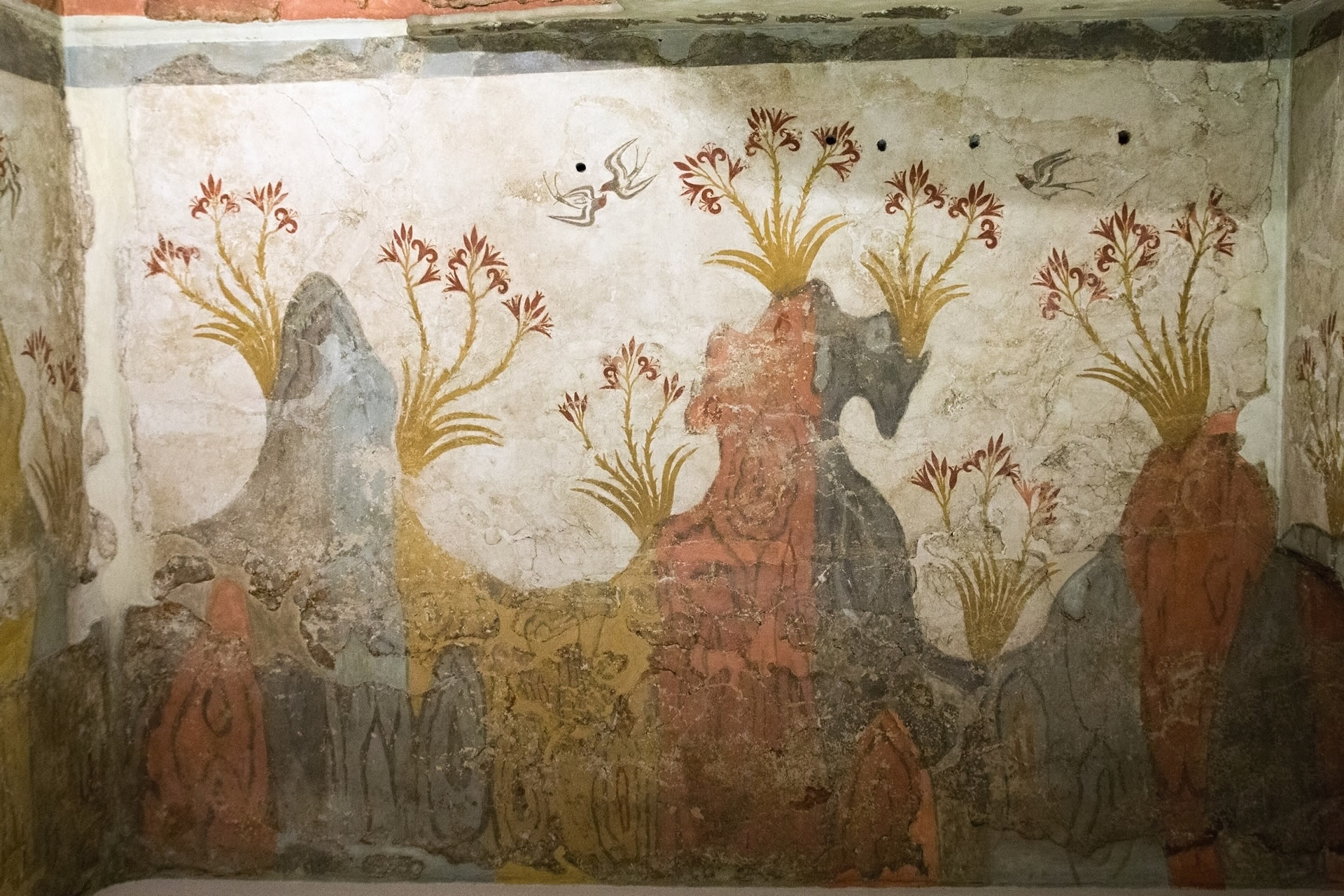
Art Note: Spring Fresco (c. 1600 BCE), Akrotiri, Thera (Santorini). Swallows pair among blooming lilies in an idealized Aegean landscape — a visual testament to the peaceful, prosperous island culture that inspired the Atlantis myth, and the unwounded world Steve Davidson sees echoing beneath the legend of Camelot. National Archaeological Museum, Athens — National Archaeological Museum Collections.

